


고유가는 세계경제 성장을 둔화시킬 수 있고, 계속해서 대체 연료로의 전환을 가속화시킬 것으로 보인다고 앨런 그린스펀(Alan Greenspan) 美 연준 의장이 18일 일본에서 가진 연설을 통해 지적했다.그린스펀 의장은 이날 도쿄에서 일본상공회의소 및 게이단렌(經團聯) 초청 강연에서 "비록 세계경제의 확장 국면이 올해 여름을 거치면서 상당히 강화된 것으로 보이지만, 최근 에너지물가의 급등은 명백히 경제성장을 둔화시킬 것으로 예상된다"고 경고했다.그러나 그는 또한 세계경제가 30년 전에 비해 일인당 석유사용 규모가 2/3로 줄어든 것 때문에, "현재와 같은 고유가 사태의 영향은 비록 무시할 수 없을 정도이긴 하지만 경제성장 및 인플레이션에 미치는 결과는 1970년대에 비해서는 상당히 낮은 수준일 것"이라고 낙관적인 전망을 덧붙였다.연준은 올해 초 배럴당 44달러하던 국제유가가 20달러나 급등한 사실에 대해 계속 우려를 표명하고 있는 중이다. 고유가는 성장을 둔화시키는 동시에 인플레이션 압력을 상승시키는 요인이다.최근 연준은 이러한 요인 중에서 인플레 쪽에 비중을 두면서 금리인상 추세를 지속할 것이란 입장을 선명하게 드러냈다.그린스펀은 지난 1985년 유가 급락사태를 지적하며 미국의 GDP 1달러 중 에너지 소비를 나타내는 에너지 원단위(energy intensity)가 낮아진 점에 대해 지적했다. 이처럼 유가가 상승할 수록 "에너지 원단위의 좀 더 급격한 하락세가 거의 불가피해 보인다"고 그는 말했다.특히 그린스펀은 최근 미국의 휘발유 소비가 현저하게 줄어든 사실을 지적하면서, 이 같은 원단위 하락세가 진행형임을 강조했다.또한 소비의 감소가 경제활동의 위축보다는 소비자들의 보수적인 태도로 인한 것이라면 연준은 소비자들이 고유가를 제대로 극복하고 있다고 보고 좀 더 편안하게 금리를 올릴 수 있을 것으로 예상된다.그린스펀 의장은 장기적인 안목에서는 "역사가 하나의 지침이 된다면 석유는 매장석유가 고갈되기 전에 결국 좀 더 비용이 낮은 대체연료로 대체될 것"이라며, "21세기 중반 이전에 이 같은 주력 에너지원의 대체과정이 개시될 것으로 본다"고 말했다.그는 아직도 석탄 매장량이 풍부한데도 석유가 이를 대체한 것은, 나무가 많아도 석탄이 이를 대체한 것처럼 그 에너지 효율성과 낮은 비용 때문이라고 설명했다.하지만 그린스펀 의장은 이러한 새로운 에너지원으로의 이행 과정은 장기간이 소요될 뿐 아니라 중국과 같은 높은 에너지 원단위를 가진 경제의 출현으로 인해 그 속도가 더 느려질 수 있다고 경고했다.이런 점에서 "세계경제는 당분간 석유시장에 대한 지정학적인 그리고 또다른 불확실성 속에 살아가야 할 것"으로 보인다고 그는 지적했다.Remarks by Chairman Alan Greenspan: EnergyBefore the Japan Business Federation, the Japan Chamber of Commerce and Industry, and the Japan Association of Corporate Executives, Tokyo, JapanOctober 17, 2005 Even before the devastating hurricanes of August and September 2005, world oil markets had been subject to a degree of strain not experienced for a generation. Increased demand and lagging additions to productive capacity had eliminated a significant amount of the slack in world oil markets that had been essential in containing crude oil and product prices between 1985 and 2000. In such tight markets, the shutdown of oil platforms and refineries last month by Hurricanes Katrina and Rita was an accident waiting to happen. In their aftermath, prices of crude oil worldwide moved sharply higher, and with refineries stressed by a shortage of capacity, margins for refined products in the United States roughly doubled. Prices of natural gas soared as well. Oil prices had been persistently edging higher since 2002 as increases in global oil consumption progressively absorbed the buffer of several million barrels a day in excess capacity that stood between production and demand. Any pickup in consumption or shortfall in production for a commodity as price inelastic in the short run as oil was bound to be immediately reflected in a spike in prices. Such a price spike effectively represented a tax that drained purchasing power from oil consumers. Although the global economic expansion appears to have been on a reasonably firm path through the summer months, the recent surge in energy prices will undoubtedly be a drag from now on. In the United States, Japan, and elsewhere, the effect on growth would have been greater had oil not declined in importance as an input to world economic activity since the 1970s. How did we arrive at a state in which the balance of world energy supply and demand could be so fragile that weather, not to mention individual acts of sabotage or local insurrection, could have a significant impact on economic growth? Even so large a weather event as August and September's hurricanes, had they occurred in earlier decades of ample oil capacity, would have had hardly noticeable effects on crude prices if producers placed their excess supplies on the market or on product prices if idle refinery capacity were activated. The history of the world petroleum industry is one of a rapidly growing industry seeking the stable prices that have been seen by producers as essential to the expansion of the market. In the early twentieth century, pricing power was firmly in the hands of Americans, predominately John D. Rockefeller and Standard Oil. Reportedly appalled by the volatility of crude oil prices that stunted the growth of oil markets in the early years of the petroleum industry, Rockefeller had endeavored with some success to stabilize those prices by gaining control by the turn of the century of nine-tenths of U.S. refining capacity. But even after the breakup of the Standard Oil monopoly in 1911, pricing power remained with the United States--first with the U.S. oil companies and later with the Texas Railroad Commission, which raised limits on output to suppress price spikes and cut output to prevent sharp price declines. Indeed, as late as 1952, crude oil production in the United States (44 percent of which was in Texas) still accounted for more than half of the world total. Excess Texas crude oil capacity was notably brought to bear to contain the impact on oil prices of the nationalization of Iranian oil a half-century ago. Again, excess American oil was released to the market to counter the price pressures induced by the Suez crisis of 1956 and the Arab-Israeli War of 1967. Of course, concentrated control in the hands of a few producers over any resource can pose potential problems. In the event, that historical role ended in 1971, when excess crude oil capacity in the United States was finally absorbed by rising world demand. At that point, the marginal pricing of oil, which for so long had been under the control of international oil companies, predominantly American, abruptly shifted to a few large Middle East producers and to greater market forces than those that they and the other members of the Organization of Petroleum Exporting Countries (OPEC) could contain. To capitalize on their newly acquired pricing power, many producing nations, especially in the Middle East, nationalized their oil companies. But the full magnitude of the pricing power of the nationalized oil companies became evident only in the aftermath of the oil embargo of 1973. During that period, posted crude oil prices at Ras Tanura, Saudi Arabia, rose to more than $11 per barrel, a level significantly above the $1.80 per barrel that had been unchanged from 1961 to 1970. The further surge in oil prices that accompanied the Iranian Revolution in 1979 eventually drove up prices to $39 per barrel by February 1981 ($75 per barrel in today's prices). The higher prices of the 1970s abruptly ended the extraordinary growth of U.S. and world consumption of oil and the increased intensity of its use that was so evident in the decades immediately following World War II. Since the more than tenfold increase in crude oil prices between 1972 and 1981, world oil consumption per real dollar equivalent of global gross domestic produce (GDP) has declined by approximately one-third. In the United States, between 1945 and 1973, consumption of petroleum products rose at a startling average annual rate of 4-1/2 percent, well in excess of growth of our real GDP. However, between 1973 and 2004, oil consumption grew in the United States, on average, at only 1/2 percent per year, far short of the rise in real GDP. In consequence, the ratio of U.S. oil consumption to GDP fell by half. Much of the decline in the ratio of oil use to real GDP in the United States has resulted from growth in the proportion of GDP composed of services, high-tech goods, and other presumably less oil-intensive industries. Additionally, part of the decline in this ratio is due to improved energy conservation for a given set of economic activities, including greater home insulation, better gasoline mileage, more efficient machinery, and streamlined production processes. These trends have been ongoing but have likely intensified of late with the sharp, recent increases in oil prices. In Japan, which until recently was the world's second largest oil consumer, the growth of demand was also strong before the developments of the 1970s. Subsequently, shocked by the increase in prices and without indigenous production to cushion the effects on incomes, Japan sharply curtailed the growth of its oil use, reducing the ratio of oil consumption to GDP by about half as well. Although the production quotas of OPEC have been a significant factor in price determination for a third of a century, the story since 1973 has been as much about the power of markets as it has been about power over markets. The incentives to alter oil consumption provided by market prices eventually resolved even the most seemingly insurmountable difficulties posed by inadequate supply outside the OPEC cartel. Many observers feared that the gap projected between supply and demand in the immediate post-1973 period would be so large that rationing would be the only practical solution. But the resolution did not occur that way. In the United States, to be sure, mandated fuel-efficiency standards for cars and light trucks induced the slower growth of gasoline demand. Some observers argue, however, that, even without government-enforced standards, market forces would have led to increased fuel efficiency. Indeed, the number of small, fuel-efficient Japanese cars that were imported into U.S. markets rose throughout the 1970s as the price of oil moved higher. Moreover, at that time, prices were expected to go still higher. For example, the U.S. Department of Energy in 1979 had projections showing real oil prices reaching nearly $60 per barrel by 1995--the equivalent of more than $120 in today's prices. The failure of oil prices to rise as projected in the late 1970s is a testament to the power of markets and the technologies they foster. Today, the average price of crude oil, despite its recent surge, is still in real terms below the price peak of February 1981. Moreover, since oil use, as I noted, is only two-thirds as important an input into world GDP as it was three decades ago, the effect of the current surge in oil prices, though noticeable, is likely to prove significantly less consequential to economic growth and inflation than the surge in the 1970s. The petroleum industry's early years of hit-or-miss exploration and development of oil and gas has given way to a more systematic, high-tech approach. The dramatic changes in technology in recent years have made existing oil and natural gas reserves stretch further while keeping energy costs lower than they otherwise would have been. Seismic imaging and advanced drilling techniques are facilitating the discovery of promising new reservoirs and are enabling the continued development of mature fields. Accordingly, one might expect that the cost of developing new fields and, hence, the long-term price of new oil and gas would have declined. And, indeed, these costs have declined, though less than they might otherwise have done. Much of the innovation in oil development outside OPEC, for example, has been directed at overcoming an increasingly inhospitable and costly exploratory environment, the consequence of more than a century of draining the more immediately accessible sources of crude oil. Still, consistent with declining long-term marginal costs of extraction, distant futures prices for crude oil moved lower, on net, during the 1990s. The most-distant futures prices fell from a bit more than $20 per barrel before the first Gulf War to less than $18 a barrel on average in 1999. Such long-term price stability has eroded noticeably over the past five years. Between 1991 and 2000, although spot prices ranged between $11 and $35 per barrel, distant futures exhibited little variation. Since then, distant futures prices have risen sharply. In early August, prices for delivery in 2011 of light sweet crude breached $60 per barrel, in line with recent increases in spot prices. This surge arguably reflects the growing presumption that increases in crude oil capacity outside OPEC will no longer be adequate to serve rising world demand going forward, especially from emerging Asia. Additionally, the longer-term crude price has presumably been driven up by renewed fears of supply disruptions in the Middle East and elsewhere. But the opportunities for profitable exploration and development in the industrial economies are dwindling, and the international oil companies are currently largely prohibited, restricted, or face considerable political risk in investing in OPEC and other developing countries. In such a highly profitable market environment for oil producers, one would have expected a far greater surge of oil investments. Indeed, some producers have significantly ratcheted up their investment plans. But because of the geographic concentration of proved reserves, much of the investment in crude oil productive capacity required to meet demand, without prices rising unduly, will need to be undertaken by national oil companies in OPEC and other developing economies. Although investment is rising, the significant proportion of oil revenues invested in financial assets suggests that many governments perceive that the benefits of investing in additional capacity to meet rising world oil demand are limited. Moreover, much oil revenue has been diverted to meet the perceived high-priority needs of rapidly growing populations. Unless those policies, political institutions, and attitudes change, it is difficult to envision adequate reinvestment into the oil facilities of these economies. Besides feared shortfalls in crude oil capacity, the status of world refining capacity has become worrisome as well. Crude oil production has been rising faster than refining capacity over the past decade. A continuation of this trend would soon make lack of refining capacity the binding constraint on growth in oil use. This may already be happening in certain grades, given the growing mismatch between the heavier and more sour content of world crude oil production and the rising world demand for lighter, sweeter petroleum products. There is thus an especial need to add adequate coking and desulphurization capacity to convert the average gravity and sulphur content of much of the world's crude oil to the lighter and sweeter needs of product markets, which are increasingly dominated by transportation fuels that must meet ever more stringent environmental requirements. Yet the expansion and the modernization of world refineries are lagging. For example, no new refinery has been built in the United States since 1976. The consequence of lagging modernization is reflected in a significant widening of the price spread between the higher priced light sweet crudes such as Brent and the heavier crudes such as Maya. To be sure, refining capacity continues to expand, albeit gradually, and exploration and development activities are ongoing, even in developed industrial countries. Conversion of the vast Athabasca oil sands reserves in Alberta to productive capacity, while slow, has made this unconventional source of oil highly competitive at current market prices. However, despite improved technology and high prices, proved reserves in the developed countries are being depleted because additions to these reserves have not kept pace with production. * * *The production, demand, and price outlook for oil beyond the current market turbulence will doubtless continue to reflect longer-term concerns. Much will depend on the response of demand to price over the longer run. If history is any guide, should higher prices persist, energy use over time will continue to decline relative to GDP. In the wake of sharply higher prices, the oil intensity of the U.S. economy, as I pointed out earlier, has been reduced by about half since the early 1970s. Much of that displacement was achieved by 1985. Progress in reducing oil intensity has continued since then, but at a lessened pace. For example, after the initial surge in the fuel efficiencies of our light motor vehicles during the 1980s, reflecting the earlier run-up in oil prices, improvements have since slowed to a trickle. The more-modest rate of decline in the energy intensity of the U.S. economy after 1985 should not be surprising, given the generally lower level of real oil prices that have prevailed since then. With real energy prices again on the rise, more-rapid decreases in the intensity of energy use in the years ahead seem virtually inevitable. Long-term demand elasticities over the past three decades have proved noticeably higher than those evident in the short term. Indeed, gasoline consumption has declined markedly in the United States in recent weeks, presumably partly as a consequence of higher prices. * * *Altering the magnitude and manner of energy consumption will significantly affect the path of the global economy over the long term. For years, long-term prospects for oil and natural gas prices appeared benign. When choosing capital projects, businesses in the past could mostly look through short-run fluctuations in oil and natural gas prices, with an anticipation that moderate prices would prevail over the longer haul. The recent shift in expectations, however, has been substantial enough and persistent enough to direct business-investment decisions in favor of energy-cost reduction. Over the past decade, energy consumed, measured in British thermal units, per real dollar of gross nonfinancial, non-energy corporate product in the United States has declined substantially, and this trend may be expected to accelerate in coming years. In Japan, as well, energy use has declined as a fraction of GDP, but these savings were largely achieved in previous decades, and energy intensity has been flat more recently. We can expect similar increases in oil efficiency in the rapidly growing economies of East Asia as they respond to the same set of market incentives. But at present, China consumes roughly twice as much oil per dollar of GDP as the United States, and if, as projected, its share of world GDP continues to increase, the average improvements in world oil-intensity will be less pronounced than the improvements in individual countries, viewed separately, would suggest. * * *We cannot judge with certainty how technological possibilities will play out in the future, but we can say with some assurance that developments in energy markets will remain central in determining the longer-run health of our nations' economies. The experience of the past fifty years--and indeed much longer than that--affirms that market forces play a key role in conserving scarce energy resources, directing those resources to their most highly valued uses. However, the availability of adequate productive capacity will also be driven by nonmarket influences and by other policy considerations. To be sure, energy issues present policymakers with difficult tradeoffs to consider. The concentration of oil reserves in politically volatile areas of the world is an ongoing concern. But that concern and others, one hopes, will be addressed in a manner that, to the greatest extent possible, does not distort or stifle the meaningful functioning of our markets. Barring political impediments to the operation of markets, the same price signals that are so critical for balancing energy supply and demand in the short run also signal profit opportunities for long-term supply expansion. Moreover, they stimulate the research and development that will unlock new approaches to energy production and use that we can now only barely envision. Improving technology and ongoing shifts in the structure of economic activity are reducing the energy intensity of industrial countries, and presumably recent oil price increases will accelerate the pace of displacement of energy-intensive production facilities. If history is any guide, oil will eventually be overtaken by less-costly alternatives well before conventional oil reserves run out. Indeed, oil displaced coal despite still vast untapped reserves of coal, and coal displaced wood without denuding our forest lands. New technologies to more fully exploit existing conventional oil reserves will emerge in the years ahead. Moreover, innovation is already altering the power source of motor vehicles, and much research is directed at reducing gasoline requirements. We will begin the transition to the next major sources of energy, perhaps before midcentury, as production from conventional oil reservoirs, according to central-tendency scenarios of the U.S. Department of Energy, is projected to peak. In fact, the development and application of new sources of energy, especially nonconventional sources of oil, is already in train. Nonetheless, the transition will take time. We, and the rest of the world, doubtless will have to live with the geopolitical and other uncertainties of the oil markets for some time to come. [뉴스핌 Newspim] 김사헌 기자 herra79@newspim.com

[관련키워드]




[뉴스핌 베스트 기사]
 사진
사진
정동영 업무보고 논란
[서울=뉴스핌] 유신모 외교전문기자 = 청와대 영빈관에서 5일 열린 외교·안보 분야 정부 부처의 대통령 업무보고에서 정동영 통일부 장관의 '한반도 평화공존 발전 구상'과 업무보고 발언이 논란을 빚고 있다.
이날 정 장관의 발언 중에는 정부 내 조율을 거치지 않은 사안을 정책으로 추진하겠다고 공언한 것이 있는가 하면 사실 관계에 맞지 않은 설명도 있었다. 이재명 대통령은 공개적으로 신중을 기해 달라고 경고했고, 조현 외교부 장관은 '이상주의적 희망에 근거한 비현실적 구상'이라는 비판을 내놨다.
그동안 정 장관의 대북 정책 관련 발언이 물의를 빚은 적은 여러 번 있지만 대통령과 유관 부처 장관이 공개적으로 부정적 입장을 표명한 것은 이례적이다. 정 장관의 무리한 대북 접근법과 월권을 제어해야 한다는 목소리도 높아지고 있다.
[정동영 통일부 장관이 지난달 23일 오후 서울 종로구 정부서울청사에서 취임 1주년 기자간담회를 하고 있다. [사진=통일부] 2026.07.23
◆통일부 장관 권한 넘어선 주장
정 장관은 이날 업무보고에서 '한반도 평화공존 발전 구상'을 설명하면서 이재명 정부 2년차 핵심 과제로 상호 존중·평화적 갈등 해결·핵 없는 한반도 등 3대 기본 방향을 제시했다.
정 장관은 "대결과 혐오의 언어는 멈춰야 한다"면서 주적 용어 대체를 주장했다. 지난 25년간의 CVID(완전하고 검증가능하며 되돌릴 수 없는 비핵화) 구도는 이미 무너졌다고도 했다. 또 "현 시점에서 흘러간 선(先)비핵화만 되뇌는 것은 현실을 바꾸는 데 힘이 되지 않는다"고 주장했다. 정 장관은 또 "정전 체제를 평화 체제로 바꾸는 논의에 착수하겠다"면서 "북·미 정상회담 견인과 함께 4자 대화의 동력을 확보하기 위해 최선을 다할 것"이라고 말했다.
하지만 이 대통령은 정 장관의 구상에 대부분 제동을 걸었다. 이 대통령은 "평화공존 정책이 정치적으로 악용되는 측면이 있다"며 "많이 조심하셔야 한다"고 지적했다.
북한을 다른 이름으로 불러야 한다는 주장에는 "표현에 꼬투리가 잡혀 정쟁으로 휘몰아 들어가면 원래 하고자 했던 데에서 오히려 나쁜 상황이 초래될 수 있다"고 경고했다.
이 대통령은 남북 신뢰 구축을 위해 9·19 군사합의를 선제적으로 복원해야 한다는 정 장관의 주장에 대해서도 "우리의 선의대로 하는 게 과연 한반도의 평화와 안정에 플러스냐, 결론적으로 약간의 의문이 들 때도 있다"며 부정적으로 반응했다.
조현 외교부 장관은 업무보고 사후 브리핑에서 정 장관이 언급한 '4자 회담'에 대해 "이상주의에 근거한 어떤 희망이라 하더라도 그건 아직 조율되지 않은 방법"이라며 "여러분들께서 디스카운트해 주시면 좋겠다"고 선을 그었다.
정 장관이 9월 러시아 블라디보스토크에서 열리는 '동방경제포럼(EEF)'을 언급하며 "정부 차원에서 (참석을) 검토하고 있다"고 발언한 데 대해서도 조 장관은 "그것은 외교부의 몫"이라며 "아직 거기까지 진도가 나가지 않았다"고 잘랐다.
정 장관이 이날 소개한 대북 구상과 설명은 정부 내 조율을 거치지 않았다는 점에서 문제가 있다. 특히 주적 표현 대체와 국호 사용, 9·19 군사합의 복원, 4자회담 추진 등은 통일부 장관이 결정할 사안이 아니어서 월권이라는 지적이 나오고 있다. 이 대통령은 정 장관의 업무보고를 듣고 난 뒤 "여기 업무보고에 발표했다고 승인난 건 아니다"라고 재차 확인했다.
정부의 한 소식통은 "정 장관의 발언 내용은 대부분 국가안전보장회의(NSC)를 거쳐 결정된 사안이 아닌 정 장관의 개인적 생각에 가깝다"며 "안보 관련 부처 장관이 정부의 공식 정책이 아닌 사안을 추진하겠다고 업무보고를 하고 대통령의 면전에서 '국군통수권자가 나서야 한다'고 주장한 것은 심각한 문제"라고 지적했다.
이재명 대통령이 5일 청와대 영빈관에서 열린 통일 외교 국방 등 외교 안보 부처 업무보고에서 발언하고 있다. [사진=청와대] 2026.08.05
◆시대착오적 접근, 대북 인식 오류
더욱 문제인 것은 정 장관의 이같은 주장이 현 시점에서 이미 참고가 될 수 없는 과거의 경험 또는 사실과 다른 인식에 기반하고 있다는 것이다. 정 장관이 주장하는 구상은 급격히 변화하고 있는 북한의 전략과 한반도 및 국제 정세를 전혀 반영하지 못하고 있다는 비판이 제기되고 있다.
정 장관이 "흘러간 선(先)비핵화만 되뇌는 것은 현실을 바꾸지 못한다"고 언급한 것은 지금까지의 대북 접근법을 호도하고 있다. 북핵 위기 발발 이후 지금까지 모든 핵 협상에서 한국이나 미국은 북한에 선비핵화를 공식적으로 요구한 적이 없기 때문이다.
지금까지의 북핵 협상은 북한의 비핵화 조치에 한·미가 상응하는 대가를 제공하는 방식으로 이뤄졌다. 1994년 북·미 제네바 기본합의는 핵시설 동결과 중유 제공의 교환이었다. 2005년 9.19 공동성명도 북한의 비핵화 조치의 모든 단계에 상응조치를 제공하는 '행동 대 행동' 원칙이 적용됐다.
대북 협상에 관여했던 한 전직 관료는 "모든 북핵 협상은 북한의 비핵화 조치와 한·미가 제공하는 상응조치를 어떻게 정교하게 배열하느냐가 관건이었다"면서 "정 장관의 발언은 지금까지 한·미가 북한에 먼저 핵을 포기해야 대화할 수 있다는 정책을 고수해 현 상황에 이르게 됐다는 잘못된 인식에서 비롯된 것으로 보인다"고 말했다.
정 장관이 "지난 25년간의 CVID 구도가 무너졌다"고 말한 것도 비핵화의 개념에 대한 이해 부족이라는 비판이 제기되고 있다. 북핵 문제에 정통한 외교 소식통은 "어떤 명칭을 붙이든 핵을 제거한 뒤 이를 검증하고 재발 방지 조치를 하는 것은 비핵화에 반드시 포함되어야 하는 기본적 절차"라며 "CVID는 안 된다고 말하는 것은 북한의 비핵화 조치를 검증도 하지 않고 언제든 되돌릴 수 있도록 합의하자는 말과 같다"고 지적했다.
[서울=뉴스핌] 이길동 기자 = 조현 외교부 장관이 5일 오후 서울 종로구 정부서울청사 별관에서 2026년 하반기 업무보고 사후브리핑을 하고 있다. 2026.08.05 gdlee@newspim.com
◆안보 리스크 키우는 통일부 장관
정 장관은 지난해 취임 직후부터 청와대와 외교부를 제치고 통일부가 북한과 관련된 모든 정책을 주도해야 한다는 주장을 펴면서 단독 질주를 거듭해왔다.
북한의 '적대적 두 국가' 주장을 변형한 '평화적 두 국가'를 지향해야 한다고 주장하면서 이에 문제점을 지적하는 목소리를 무시했다. 외교부가 미국과 북한 문제를 논의하는 것에 대해 "한반도 정책과 남북관계는 주권의 영역이며 동맹국과 협의의 주체는 통일부"라고 주장해 물의를 빚었다. 문재인 정부 시절 한·미 워킹그룹이 남북관계 파탄 원인이었다고 사실과 다른 주장을 폈다.
지난해 업무보고에서는 국제정세를 감안하지 않고 남북대화 재개에만 초점을 맞춘 비현실적 내용으로 논란을 빚었다. 정부 내 조율도 거치지 않고 독자 대북제재인 5·24 조치를 해제하고 9·19 군사합의 비행금지구역 복원을 추진하겠다는 방침도 밝혔다.
지난 4월에는 평안북도 구성시에 우라늄 농축 시설이 있다고 말해 파장을 일으켰다. 미국은 이 발언을 계기로 한국과 대북정보 공유를 제한했다. 이 조치는 지금도 계속되고 있는 것으로 알려졌다.
정 장관이 이처럼 정부의 공식 결정을 거치지 않은 사안을 정부 정책인 것처럼 주장하며 좌충우돌하는 배경에 대해 여러가지 해석이 나온다. 북한 문제에서 조기에 성과를 거둬야 한다는 조급증과 자신의 존재감 과시 욕구가 작용하고 있다는 평가가 많다.
일각에서는 정 장관이 2007년 민주당 대선후보였을 때 이재명 대통령이 캠프에서 비서실 부실장으로 활동한 전력이 있다는 것을 들어 "정 장관이 아직도 이 대통령을 아랫사람으로 생각하고 있는 것 아니냐"는 비판을 내놓기도 한다.
한·미 관계와 북한 문제를 오래 다뤘던 전직 관료 출신의 한 전문가는 "정 장관 취임 후 지금까지의 언행은 잘못된 현실 인식에 따른 독단과 앞서 가기, 월권 등으로 점철돼 있다"면서 "통일부 장관이라는 중요한 직책에 있으면서 스스로 안보 리스크를 키우는 역할만 했다"고 비판했다.
opento@newspim.com
2026-08-06 06:10
 사진
사진
6월 경상수지 최대 흑자
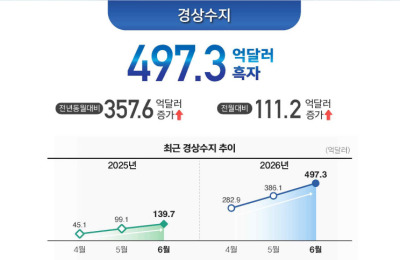
[서울=뉴스핌] 박가연 기자 = 지난 6월 우리나라의 경상수지가 전월에 이어 역대 최대 흑자를 기록했다. 반도체를 중심으로 한 정보기술(IT) 품목 수출 호조로 월간 상품수출이 처음으로 1000억달러를 넘어선 영향이다.
[자료=한국은행]
한국은행이 6일 발표한 '2026년 6월 국제수지(잠정)'에 따르면 지난 6월 경상수지는 497억3000만달러 흑자로 집계됐다. 전월(386억1000만달러)에 이어 두 달 연속 월간 기준 역대 최대 기록을 갈아치웠다. 이에 따라 올해 상반기 누적 경상수지 흑자는 1910억1000만달러를 기록했다.
경상수지 흑자를 견인한 것은 상품수지다. 6월 상품수지는 478억9000만달러 흑자를 기록하며 전월에 이어 역대 최대를 다시 썼다. 국제수지 기준 상품수출은 1123억7000만달러로 전년 동월 대비 84.5% 증가하며 월간 기준 처음으로 1000억달러를 넘어섰다. 상품수입은 644억8000만달러로 38.6% 늘었다.
통관 기준으로는 반도체 수출이 전년 동월 대비 196.9% 급증했고 컴퓨터·주변기기(SSD)는 282.7% 증가했다. IT 품목 수출은 160.4% 늘었으며 비IT 품목도 ▲석유제품(47.5%) ▲화공품(18.6%) ▲철강제품(17.9%) ▲승용차(6.1%) 등을 중심으로 18.6% 증가했다. 통관 기준 수입은 ▲원자재(30.5%) ▲자본재(35.3%) ▲소비재(16.4%)가 모두 늘었다.
서비스수지는 12억9000만달러 적자를 기록해 전월(-10억9000만달러)보다 적자 폭이 확대됐다. 여행수지는 외국인 입국자 증가와 유류할증료 인상 등에 따른 출국자 감소로 4억4000만달러 흑자를 기록했지만 지식재산권사용료수지는 전월 흑자에서 4억4000만달러 적자로 전환됐다.
본원소득수지는 배당소득을 중심으로 32억7000만달러 흑자를 기록해 전월(21억7000만달러)보다 흑자 폭이 확대됐다. 배당소득수지는 배당수입이 늘어난 데다 전월 분기배당에 따른 기저효과로 배당지급이 줄면서 25억6000만달러 흑자를 나타냈다.
금융계정 순자산은 6월 중 467억1000만달러 증가해 월간 기준 역대 최대 증가 폭을 기록했다. 종전 최대였던 올해 3월(369억9000만달러)을 넘어선 것이다. 직접투자에서는 내국인의 해외투자가 80억1000만달러, 외국인의 국내투자가 46억3000만달러 각각 증가했다.
증권투자에서는 외국인의 국내 주식 매도세가 이어졌다. 외국인의 국내 주식 투자는 차익실현 매도 등의 영향으로 316억1000만달러 감소하며 전월(-310억5000만달러)에 이어 역대 최대 순매도 기록을 다시 경신했다.
외국인의 국내 채권투자는 세계국채지수(WGBI) 자금 유입에도 분기 말 만기도래 영향으로 증가 폭이 줄어든 52억9000만달러를 기록했다. 내국인의 해외 증권투자는 주식을 중심으로 35억6000만달러 증가했다.
eoyn2@newspim.com
2026-08-06 08:00