


Testimony of Chairman Ben S. BernankeSemiannual Monetary Policy Report to the CongressBefore the Committee on Banking, Housing, and Urban Affairs, U.S. Senate July 19, 2006 Mr. Chairman and members of the Committee, I am pleased to be here again to present the Federal Reserve's Monetary Policy Report to the Congress.Over the period since our February report, the U.S. economy has continued to expand. Real gross domestic product (GDP) is estimated to have risen at an annual rate of 5.6 percent in the first quarter of 2006. The available indicators suggest that economic growth has more recently moderated from that quite strong pace, reflecting a gradual cooling of the housing market and other factors that I will discuss. With respect to the labor market, more than 850,000 jobs were added, on net, to nonfarm payrolls over the first six months of the year, though these gains came at a slower pace in the second quarter than in the first. Last month the unemployment rate stood at 4.6 percent.Inflation has been higher than we had anticipated in February, partly as a result of further sharp increases in the prices of energy and other commodities. During the first five months of the year, overall inflation as measured by the price index for personal consumption expenditures averaged 4.3 percent at an annual rate. Over the same period, core inflation--that is, inflation excluding food and energy prices--averaged 2.6 percent at an annual rate. To address the risk that inflation pressures might remain elevated, the Federal Open Market Committee (FOMC) continued to firm the stance of monetary policy, raising the federal funds rate another 3/4 percentage point, to 5-1/4 percent, in the period since our last report.Let me now review the current economic situation and the outlook in a bit more detail, beginning with developments in the real economy and then turning to the inflation situation. I will conclude with some comments on monetary policy.The U.S. economy appears to be in a period of transition. For the past three years or so, economic growth in the United States has been robust. This growth has reflected both the ongoing re-employment of underutilized resources, as the economy recovered from the weakness of earlier in the decade, and the expansion of the economy's underlying productive potential, as determined by such factors as productivity trends and growth of the labor force. Although the rates of resource utilization that the economy can sustain cannot be known with any precision, it is clear that, after several years of above-trend growth, slack in resource utilization has been substantially reduced. As a consequence, a sustainable, non-inflationary expansion is likely to involve a modest reduction in the growth of economic activity from the rapid pace of the past three years to a pace more consistent with the rate of increase in the nation's underlying productive capacity. It bears emphasizing that, because productivity growth seems likely to remain strong, the productive capacity of our economy should expand over the next few years at a rate sufficient to support solid growth in real output.As I have noted, the anticipated moderation in economic growth now seems to be under way, although the recent erratic growth pattern complicates this assessment. That moderation appears most evident in the household sector. In particular, consumer spending, which makes up more than two-thirds of aggregate spending, grew rapidly during the first quarter but decelerated during the spring. One likely source of this deceleration was higher energy prices, which have adversely affected the purchasing power of households and weighed on consumer attitudes.Outlays for residential construction, which have been at very high levels in recent years, rose further in the first quarter. More recently, however, the market for residential real estate has been cooling, as can be seen in the slowing of new and existing home sales and housing starts. Some of the recent softening in housing starts may have resulted from the unusually favorable weather during the first quarter of the year, which pulled forward construction activity, but the slowing of the housing market appears to be more broad-based than can be explained by that factor alone. Home prices, which have climbed at double-digit rates in recent years, still appear to be rising for the nation as a whole, though significantly less rapidly than before. These developments in the housing market are not particularly surprising, as the sustained run-up in housing prices, together with some increase in mortgage rates, has reduced affordability and thus the demand for new homes.The slowing of the housing market may restrain other forms of household spending as well. With homeowners no longer experiencing increases in the equity value of their homes at the rapid pace seen in the past few years, and with the recent declines in stock prices, increases in household net worth are likely to provide less of a boost to consumer expenditures than they have in the recent past. That said, favorable fundamentals, including relatively low unemployment and rising disposable incomes, should provide support for consumer spending. Overall, household expenditures appear likely to expand at a moderate pace, providing continued impetus to the overall economic expansion. Although growth in household spending has slowed, other sectors of the economy retain considerable momentum. Business investment in new capital goods appears to have risen briskly, on net, so far this year. In particular, investment in nonresidential structures, which had been weak since 2001, seems to have picked up appreciably, providing some offset to the slower growth in residential construction. Spending on equipment and software has also been strong. With a few exceptions, business inventories appear to be well aligned with sales, which reduces the risk that a buildup of unwanted inventories might act to reduce production in the future. Business investment seems likely to continue to grow at a solid pace, supported by growth in final sales, rising backlogs of orders for capital goods, and high rates of profitability. To be sure, businesses in certain sectors have experienced financial difficulties. In the aggregate, however, firms remain in excellent financial condition, and credit conditions for businesses are favorable.Globally, output growth appears strong. Growth of the global economy will help support U.S. economic activity by continuing to stimulate demand for our exports of goods and services. One downside of the strength of the global economy, however, is that it has led to significant increases in the demand for crude oil and other primary commodities over the past few years. Together with heightened geopolitical uncertainties and the limited ability of suppliers to expand capacity in the short run, these rising demands have resulted in sharp rises in the prices at which those goods are traded internationally, which in turn has put upward pressure on costs and prices in the United States.Overall, the U.S. economy seems poised to grow in coming quarters at a pace roughly in line with the expansion of its underlying productive capacity. Such an outlook is embodied in the projections of members of the Board of Governors and the presidents of Federal Reserve Banks that were made around the time of the FOMC meeting late last month, based on the assumption of appropriate monetary policy. In particular, the central tendency of those forecasts is for real GDP to increase about 3-1/4 percent to 3-1/2 percent in 2006 and 3 percent to 3-1/4 percent in 2007. With output expanding at a pace near that of the economy's potential, the civilian unemployment rate is expected to finish both 2006 and 2007 between 4-3/4 percent and 5 percent, close to its recent level.I turn now to the inflation situation. As I noted, inflation has been higher than we expected at the time of our last report. Much of the upward pressure on overall inflation this year has been due to increases in the prices of energy and other commodities and, in particular, to the higher prices of products derived from crude oil. Gasoline prices have increased notably as a result of the rise in petroleum prices as well as factors specific to the market for ethanol. The pickup in inflation so far this year has also been reflected in the prices of a range of non-energy goods and services, as strengthening demand may have given firms more ability to pass energy and other costs through to consumers. In addition, increases in residential rents, as well as in the imputed rent on owner-occupied homes, have recently contributed to higher core inflation.The recent rise in inflation is of concern to the FOMC. The achievement of price stability is one of the objectives that make up the Congress's mandate to the Federal Reserve. Moreover, in the long run, price stability is critical to achieving maximum employment and moderate long-term interest rates, the other parts of the congressional mandate.The outlook for inflation is shaped by a number of factors, not the least of which is the course of energy prices. The spot price of oil has moved up significantly further in recent weeks. Futures quotes imply that market participants expect petroleum prices to roughly stabilize in coming quarters; such an outcome would, over time, reduce one source of upward pressure on inflation. However, expectations of a leveling out of oil prices have been consistently disappointed in recent years, and as the experience of the past week suggests, possible increases in these and other commodity prices remain a risk to the inflation outlook.Although the costs of energy and other raw materials are important, labor costs are by far the largest component of business costs. Anecdotal reports suggest that the labor market is tight in some industries and occupations and that employers are having difficulty attracting certain types of skilled workers. To date, however, moderate growth in most broad measures of nominal labor compensation and the ongoing increases in labor productivity have held down the rise in unit labor costs, reducing pressure on inflation from the cost side. Employee compensation per hour is likely to rise more quickly over the next couple of years in response to the strength of the labor market. Whether faster increases in nominal compensation create additional cost pressures for firms depends in part on the extent to which they are offset by continuing productivity gains. Profit margins are currently relatively wide, and the effect of a possible acceleration in compensation on price inflation would thus also depend on the extent to which competitive pressures force firms to reduce margins rather than pass on higher costs.The public's inflation expectations are another important determinant of inflation. The Federal Reserve must guard against the emergence of an inflationary psychology that could impart greater persistence to what would otherwise be a transitory increase in inflation. After rising earlier this year, measures of longer-term inflation expectations, based on surveys and on a comparison of yields on nominal and inflation-indexed government debt, have edged down and remain contained. These developments bear watching, however.Finally, the extent to which aggregate demand is aligned with the economy's underlying productive potential also influences inflation. As I noted earlier, FOMC participants project that the growth in economic activity should moderate to a pace close to that of the growth of potential both this year and next. Should that moderation occur as anticipated, it should help to limit inflation pressures over time.The projections of the members of the Board of Governors and the presidents of the Federal Reserve Banks, which are based on information available at the time of the last FOMC meeting, are for a gradual decline in inflation in coming quarters. As measured by the price index for personal consumption expenditures excluding food and energy, inflation is projected to be 2-1/4 percent to 2-1/2 percent this year and then to edge lower, to 2 percent to 2-1/4 percent next year.The FOMC projections, which now anticipate slightly lower growth in real output and higher core inflation than expected in our February report, mirror the somewhat more adverse circumstances facing our economy, which have resulted from the recent steep run-up in energy costs and higher-than-expected inflation more generally. But they also reflect our assessment that, with appropriate monetary policy and in the absence of significant unforeseen developments, the economy should continue to expand at a solid and sustainable pace and core inflation should decline from its recent level over the medium term.Although our baseline forecast is for moderating inflation, the Committee judges that some inflation risks remain. In particular, the high prices of energy and other commodities, in conjunction with high levels of resource utilization that may increase the pricing power of suppliers of goods and services, have the potential to sustain inflation pressures. More generally, if the pattern of elevated readings on inflation is more protracted or more intense than is currently expected, this higher level of inflation could become embedded in the public's inflation expectations and in price-setting behavior. Persistently higher inflation would erode the performance of the real economy and would be costly to reverse. The Federal Reserve must take account of these risks in making its policy decisions.In our pursuit of maximum employment and price stability, monetary policy makers operate in an environment of uncertainty. In particular, we have imperfect knowledge about the effects of our own policy actions as well as of the many other factors that will shape economic developments during the forecast period. These uncertainties bear importantly on our policy decisions because the full influence of policy actions on the economy is felt only after a considerable period of time. The lags between policy actions and their effects imply that we must be forward-looking, basing our policy choices on the longer-term outlook for both inflation and economic growth. In formulating that outlook, we must take account of the possible future effects of previous policy actions--that is, of policy effects still "in the pipeline." Finally, as I have noted, we must consider not only what appears to be the most likely outcome but also the risks to that outlook and the costs that would be incurred should any of those risks be realized. At the same time, because economic forecasting is far from a precise science, we have no choice but to regard all our forecasts as provisional and subject to revision as the facts demand. Thus, policy must be flexible and ready to adjust to changes in economic projections. In particular, as the Committee noted in the statement issued after its June meeting, the extent and timing of any additional firming that may be needed to address inflation risks will depend on the evolution of the outlook for both inflation and economic growth, as implied by our analysis of the incoming information.Thank you. I would be happy to take questions.

[관련키워드]




[뉴스핌 베스트 기사]
 사진
사진
정동영 업무보고 논란
[서울=뉴스핌] 유신모 외교전문기자 = 청와대 영빈관에서 5일 열린 외교·안보 분야 정부 부처의 대통령 업무보고에서 정동영 통일부 장관의 '한반도 평화공존 발전 구상'과 업무보고 발언이 논란을 빚고 있다.
이날 정 장관의 발언 중에는 정부 내 조율을 거치지 않은 사안을 정책으로 추진하겠다고 공언한 것이 있는가 하면 사실 관계에 맞지 않은 설명도 있었다. 이재명 대통령은 공개적으로 신중을 기해 달라고 경고했고, 조현 외교부 장관은 '이상주의적 희망에 근거한 비현실적 구상'이라는 비판을 내놨다.
그동안 정 장관의 대북 정책 관련 발언이 물의를 빚은 적은 여러 번 있지만 대통령과 유관 부처 장관이 공개적으로 부정적 입장을 표명한 것은 이례적이다. 정 장관의 무리한 대북 접근법과 월권을 제어해야 한다는 목소리도 높아지고 있다.
[정동영 통일부 장관이 지난달 23일 오후 서울 종로구 정부서울청사에서 취임 1주년 기자간담회를 하고 있다. [사진=통일부] 2026.07.23
◆통일부 장관 권한 넘어선 주장
정 장관은 이날 업무보고에서 '한반도 평화공존 발전 구상'을 설명하면서 이재명 정부 2년차 핵심 과제로 상호 존중·평화적 갈등 해결·핵 없는 한반도 등 3대 기본 방향을 제시했다.
정 장관은 "대결과 혐오의 언어는 멈춰야 한다"면서 주적 용어 대체를 주장했다. 지난 25년간의 CVID(완전하고 검증가능하며 되돌릴 수 없는 비핵화) 구도는 이미 무너졌다고도 했다. 또 "현 시점에서 흘러간 선(先)비핵화만 되뇌는 것은 현실을 바꾸는 데 힘이 되지 않는다"고 주장했다. 정 장관은 또 "정전 체제를 평화 체제로 바꾸는 논의에 착수하겠다"면서 "북·미 정상회담 견인과 함께 4자 대화의 동력을 확보하기 위해 최선을 다할 것"이라고 말했다.
하지만 이 대통령은 정 장관의 구상에 대부분 제동을 걸었다. 이 대통령은 "평화공존 정책이 정치적으로 악용되는 측면이 있다"며 "많이 조심하셔야 한다"고 지적했다.
북한을 다른 이름으로 불러야 한다는 주장에는 "표현에 꼬투리가 잡혀 정쟁으로 휘몰아 들어가면 원래 하고자 했던 데에서 오히려 나쁜 상황이 초래될 수 있다"고 경고했다.
이 대통령은 남북 신뢰 구축을 위해 9·19 군사합의를 선제적으로 복원해야 한다는 정 장관의 주장에 대해서도 "우리의 선의대로 하는 게 과연 한반도의 평화와 안정에 플러스냐, 결론적으로 약간의 의문이 들 때도 있다"며 부정적으로 반응했다.
조현 외교부 장관은 업무보고 사후 브리핑에서 정 장관이 언급한 '4자 회담'에 대해 "이상주의에 근거한 어떤 희망이라 하더라도 그건 아직 조율되지 않은 방법"이라며 "여러분들께서 디스카운트해 주시면 좋겠다"고 선을 그었다.
정 장관이 9월 러시아 블라디보스토크에서 열리는 '동방경제포럼(EEF)'을 언급하며 "정부 차원에서 (참석을) 검토하고 있다"고 발언한 데 대해서도 조 장관은 "그것은 외교부의 몫"이라며 "아직 거기까지 진도가 나가지 않았다"고 잘랐다.
정 장관이 이날 소개한 대북 구상과 설명은 정부 내 조율을 거치지 않았다는 점에서 문제가 있다. 특히 주적 표현 대체와 국호 사용, 9·19 군사합의 복원, 4자회담 추진 등은 통일부 장관이 결정할 사안이 아니어서 월권이라는 지적이 나오고 있다. 이 대통령은 정 장관의 업무보고를 듣고 난 뒤 "여기 업무보고에 발표했다고 승인난 건 아니다"라고 재차 확인했다.
정부의 한 소식통은 "정 장관의 발언 내용은 대부분 국가안전보장회의(NSC)를 거쳐 결정된 사안이 아닌 정 장관의 개인적 생각에 가깝다"며 "안보 관련 부처 장관이 정부의 공식 정책이 아닌 사안을 추진하겠다고 업무보고를 하고 대통령의 면전에서 '국군통수권자가 나서야 한다'고 주장한 것은 심각한 문제"라고 지적했다.
이재명 대통령이 5일 청와대 영빈관에서 열린 통일 외교 국방 등 외교 안보 부처 업무보고에서 발언하고 있다. [사진=청와대] 2026.08.05
◆시대착오적 접근, 대북 인식 오류
더욱 문제인 것은 정 장관의 이같은 주장이 현 시점에서 이미 참고가 될 수 없는 과거의 경험 또는 사실과 다른 인식에 기반하고 있다는 것이다. 정 장관이 주장하는 구상은 급격히 변화하고 있는 북한의 전략과 한반도 및 국제 정세를 전혀 반영하지 못하고 있다는 비판이 제기되고 있다.
정 장관이 "흘러간 선(先)비핵화만 되뇌는 것은 현실을 바꾸지 못한다"고 언급한 것은 지금까지의 대북 접근법을 호도하고 있다. 북핵 위기 발발 이후 지금까지 모든 핵 협상에서 한국이나 미국은 북한에 선비핵화를 공식적으로 요구한 적이 없기 때문이다.
지금까지의 북핵 협상은 북한의 비핵화 조치에 한·미가 상응하는 대가를 제공하는 방식으로 이뤄졌다. 1994년 북·미 제네바 기본합의는 핵시설 동결과 중유 제공의 교환이었다. 2005년 9.19 공동성명도 북한의 비핵화 조치의 모든 단계에 상응조치를 제공하는 '행동 대 행동' 원칙이 적용됐다.
대북 협상에 관여했던 한 전직 관료는 "모든 북핵 협상은 북한의 비핵화 조치와 한·미가 제공하는 상응조치를 어떻게 정교하게 배열하느냐가 관건이었다"면서 "정 장관의 발언은 지금까지 한·미가 북한에 먼저 핵을 포기해야 대화할 수 있다는 정책을 고수해 현 상황에 이르게 됐다는 잘못된 인식에서 비롯된 것으로 보인다"고 말했다.
정 장관이 "지난 25년간의 CVID 구도가 무너졌다"고 말한 것도 비핵화의 개념에 대한 이해 부족이라는 비판이 제기되고 있다. 북핵 문제에 정통한 외교 소식통은 "어떤 명칭을 붙이든 핵을 제거한 뒤 이를 검증하고 재발 방지 조치를 하는 것은 비핵화에 반드시 포함되어야 하는 기본적 절차"라며 "CVID는 안 된다고 말하는 것은 북한의 비핵화 조치를 검증도 하지 않고 언제든 되돌릴 수 있도록 합의하자는 말과 같다"고 지적했다.
[서울=뉴스핌] 이길동 기자 = 조현 외교부 장관이 5일 오후 서울 종로구 정부서울청사 별관에서 2026년 하반기 업무보고 사후브리핑을 하고 있다. 2026.08.05 gdlee@newspim.com
◆안보 리스크 키우는 통일부 장관
정 장관은 지난해 취임 직후부터 청와대와 외교부를 제치고 통일부가 북한과 관련된 모든 정책을 주도해야 한다는 주장을 펴면서 단독 질주를 거듭해왔다.
북한의 '적대적 두 국가' 주장을 변형한 '평화적 두 국가'를 지향해야 한다고 주장하면서 이에 문제점을 지적하는 목소리를 무시했다. 외교부가 미국과 북한 문제를 논의하는 것에 대해 "한반도 정책과 남북관계는 주권의 영역이며 동맹국과 협의의 주체는 통일부"라고 주장해 물의를 빚었다. 문재인 정부 시절 한·미 워킹그룹이 남북관계 파탄 원인이었다고 사실과 다른 주장을 폈다.
지난해 업무보고에서는 국제정세를 감안하지 않고 남북대화 재개에만 초점을 맞춘 비현실적 내용으로 논란을 빚었다. 정부 내 조율도 거치지 않고 독자 대북제재인 5·24 조치를 해제하고 9·19 군사합의 비행금지구역 복원을 추진하겠다는 방침도 밝혔다.
지난 4월에는 평안북도 구성시에 우라늄 농축 시설이 있다고 말해 파장을 일으켰다. 미국은 이 발언을 계기로 한국과 대북정보 공유를 제한했다. 이 조치는 지금도 계속되고 있는 것으로 알려졌다.
정 장관이 이처럼 정부의 공식 결정을 거치지 않은 사안을 정부 정책인 것처럼 주장하며 좌충우돌하는 배경에 대해 여러가지 해석이 나온다. 북한 문제에서 조기에 성과를 거둬야 한다는 조급증과 자신의 존재감 과시 욕구가 작용하고 있다는 평가가 많다.
일각에서는 정 장관이 2007년 민주당 대선후보였을 때 이재명 대통령이 캠프에서 비서실 부실장으로 활동한 전력이 있다는 것을 들어 "정 장관이 아직도 이 대통령을 아랫사람으로 생각하고 있는 것 아니냐"는 비판을 내놓기도 한다.
한·미 관계와 북한 문제를 오래 다뤘던 전직 관료 출신의 한 전문가는 "정 장관 취임 후 지금까지의 언행은 잘못된 현실 인식에 따른 독단과 앞서 가기, 월권 등으로 점철돼 있다"면서 "통일부 장관이라는 중요한 직책에 있으면서 스스로 안보 리스크를 키우는 역할만 했다"고 비판했다.
opento@newspim.com
2026-08-06 06:10
 사진
사진
6월 경상수지 최대 흑자
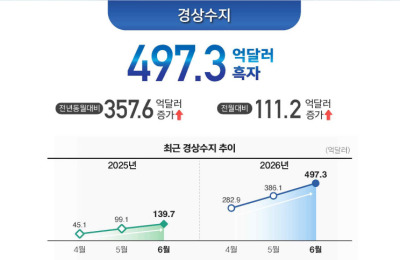
[서울=뉴스핌] 박가연 기자 = 지난 6월 우리나라의 경상수지가 전월에 이어 역대 최대 흑자를 기록했다. 반도체를 중심으로 한 정보기술(IT) 품목 수출 호조로 월간 상품수출이 처음으로 1000억달러를 넘어선 영향이다.
[자료=한국은행]
한국은행이 6일 발표한 '2026년 6월 국제수지(잠정)'에 따르면 지난 6월 경상수지는 497억3000만달러 흑자로 집계됐다. 전월(386억1000만달러)에 이어 두 달 연속 월간 기준 역대 최대 기록을 갈아치웠다. 이에 따라 올해 상반기 누적 경상수지 흑자는 1910억1000만달러를 기록했다.
경상수지 흑자를 견인한 것은 상품수지다. 6월 상품수지는 478억9000만달러 흑자를 기록하며 전월에 이어 역대 최대를 다시 썼다. 국제수지 기준 상품수출은 1123억7000만달러로 전년 동월 대비 84.5% 증가하며 월간 기준 처음으로 1000억달러를 넘어섰다. 상품수입은 644억8000만달러로 38.6% 늘었다.
통관 기준으로는 반도체 수출이 전년 동월 대비 196.9% 급증했고 컴퓨터·주변기기(SSD)는 282.7% 증가했다. IT 품목 수출은 160.4% 늘었으며 비IT 품목도 ▲석유제품(47.5%) ▲화공품(18.6%) ▲철강제품(17.9%) ▲승용차(6.1%) 등을 중심으로 18.6% 증가했다. 통관 기준 수입은 ▲원자재(30.5%) ▲자본재(35.3%) ▲소비재(16.4%)가 모두 늘었다.
서비스수지는 12억9000만달러 적자를 기록해 전월(-10억9000만달러)보다 적자 폭이 확대됐다. 여행수지는 외국인 입국자 증가와 유류할증료 인상 등에 따른 출국자 감소로 4억4000만달러 흑자를 기록했지만 지식재산권사용료수지는 전월 흑자에서 4억4000만달러 적자로 전환됐다.
본원소득수지는 배당소득을 중심으로 32억7000만달러 흑자를 기록해 전월(21억7000만달러)보다 흑자 폭이 확대됐다. 배당소득수지는 배당수입이 늘어난 데다 전월 분기배당에 따른 기저효과로 배당지급이 줄면서 25억6000만달러 흑자를 나타냈다.
금융계정 순자산은 6월 중 467억1000만달러 증가해 월간 기준 역대 최대 증가 폭을 기록했다. 종전 최대였던 올해 3월(369억9000만달러)을 넘어선 것이다. 직접투자에서는 내국인의 해외투자가 80억1000만달러, 외국인의 국내투자가 46억3000만달러 각각 증가했다.
증권투자에서는 외국인의 국내 주식 매도세가 이어졌다. 외국인의 국내 주식 투자는 차익실현 매도 등의 영향으로 316억1000만달러 감소하며 전월(-310억5000만달러)에 이어 역대 최대 순매도 기록을 다시 경신했다.
외국인의 국내 채권투자는 세계국채지수(WGBI) 자금 유입에도 분기 말 만기도래 영향으로 증가 폭이 줄어든 52억9000만달러를 기록했다. 내국인의 해외 증권투자는 주식을 중심으로 35억6000만달러 증가했다.
eoyn2@newspim.com
2026-08-06 08:00