


Remarks to the National Association of Business Economists by Cathy E. Minehan, President and Chief Executive Officer, Federal Reserve Bank of BostonSeptember 11, 2006Good morning. Let me welcome you again to Boston. It’s a pleasure to have the National Association of Business Economists here in our city. And it was certainly a pleasure to entertain you last night at the Bank. As we recognize the fifth anniversary of 9/11 it seems to me to be important to assess both the state of the U.S. economy and the economic health of the world. In that regard, I know this will be a fruitful and productive conference, as there is no dearth of economic challenges on which to focus.I want to start my comments this morning with a thumbnail sketch of my thoughts on the current state of the U.S. economy. Following that, I want to spend most of my time on an important challenge facing us in the medium term -- the declining trend in U.S. savings, in particular the savings people need to provide for a financially secure retirement. In discussing this issue, I will draw on work done by the Center for Retirement Research at Boston College headed by Alicia Munnell, who among her many past accomplishments has served as our Bank’s research director. I will also talk about what the field of behavioral economics has to say about policies to increase personal savings. Behavioral economics is a new focus of the Boston Fed -- we recently formed a new center to enhance our expertise in this evolving area, and particularly to hone in on what this field has to say about macro policy formation. Finally, I want to share with you some perspectives on financial literacy as that is key to the savings question. And, of course, any thoughts I share with you are mine and not those of the members of the Federal Open Market Committee.One of the more striking features of the current economic outlook, reflected in the forecast at the Federal Reserve Bank of Boston as well as in other mainstream forecasts, is how relatively benign it is. Against the backdrop of the war in Iraq, the uneasy ceasefire in the Middle East, the looming fiscal deficits driven by demographic change everywhere in the developed world, and sizable international imbalances, the forecast for the next couple of years seems quite optimistic.Yet, as near as we in Boston can tell, the best baseline forecast is that U.S. growth will moderate from its average of around 4 percent in the first half of 2006 to something slightly below its potential of a bit less than 3 percent over the next year or so. At this pace, the growth of demand will roughly match that of aggregate supply, and lead to little change in unemployment. Moderate growth in jobs and real income is expected to sustain consumer spending, even as cooling housing markets and high energy prices take their toll. Residential construction has already fallen, and may well slow further. But this seems likely to be offset, at least in part, by increases in non-residential construction as businesses add needed capacity after years of sub-par spending. Solid business profits and reserves of cash also augur well for a pick-up in business fixed investment, and recent data for orders and shipments of capital equipment suggest such a pick-up is occurring. Productivity growth remains solid providing some cushion for resource utilization. Financial conditions in both debt and equity markets remain fairly accommodative, making borrowing relatively affordable and softening the impact of flattening house prices on household wealth. Globally, growth is solid as well. U.S. exports have increased and trade is at least for now marginally supportive of growth. Finally, the baseline forecast also sees inflation subsiding slowly, assuming no further geopolitical or other shocks to oil prices. But more on that later. To summarize — I see growth for the next year or so in the high 2’s, approximately full employment, and core inflation subsiding. Not a bad picture, particularly given the challenges I mentioned a moment ago.The next obvious question concerns risks — where are they and how likely are they to materialize? In my view, risks have grown over the summer on both sides of this forecast. Growth could be slower or inflation could be higher and more persistent -- or both. I take both of these risks seriously.On the risks to growth, one obvious concern is the housing market. Trends in housing affordability and sales affect the pace of residential construction, now over 6 percent of GDP and up from its historical average of closer to 4 percent. The Bank’s baseline forecast assumes a continued moderate downturn in residential construction. I’m comfortable with that baseline, but recent data on declines in starts and permits, gloomy assessments by builders, the potential for higher mortgage rates, and increased inventories of unsold homes, remind me that this assessment could well be optimistic. An even larger downside could result if nominal home prices actually decline, rather than flatten out as projected, affecting household wealth and overall spending more than anticipated. Moreover, some have suggested that changes in the ease and terms of mortgage financing spurred more than normal spending during the years of rapidly rising home equity. By that logic, as financing costs rise and equity withdrawals decline, the resulting spending hit could be even greater than that suggested by wealth trends. These are serious concerns. However, I take a measure of reassurance from a number of factors. First, a fall in nominal home prices nationwide would be quite an unusual event. We have never seen a sustained decline in nationwide home prices in any of the more reliable price measures. Even now, as residential construction wanes, home prices, adjusted for quality, continue to grow, albeit at a much slower pace. Second, the so-called “wealth effect” that links increases and decreases in house prices with rises and falls in consumer spending may not be as strong as some analysts suggest. In our estimation, the run-up in housing values over the past several years did not spur much of a bigger-than-expected increase in consumer spending — if anything, the response was a bit on the low side compared to the historical average. So we wonder about how large a spending effect one should expect to accompany a fall in housing prices, if that were to occur. Clearly mortgage equity withdrawals have been sizable during the housing “boom,” but many of these withdrawals were used to reduce other forms of consumer debt and to make one-time improvements in the housing stock. Indeed, as a result, overall household balance sheets today continue to look fairly strong.That is not to say, however, that rising mortgage interest rates are not negatively affecting borrowers. It also does not mean that new types of mortgages won’t contain more than a few nasty surprises. Of particular concern are sub-prime borrowers and perhaps some depository institutions specializing in subprime lending. Thus, there are clear risks to the baseline housing outlook. Overall, however, I continue to think the best guess is that consumption will moderate, not collapse, as the result of cooling housing markets, and that moderate employment growth, and moderately rising income and non-housing financial wealth will buoy household spending.Another concern is the recent and not very favorable trend in inflation at the headline and the core. Headline CPI and PCE numbers (currently at 4.2 percent and 3.4 percent year over year, and 5.0 percent and 4.1 percent for the most recent quarter) are high and rising over the near term, mostly as the result of energy prices. These energy price increases reflect not only geopolitical shocks but also growing world demand for oil, particularly by the emerging giants, India and China. The feed-through of higher oil prices is likely one reason why core inflation also has increased markedly over the past months, though the breadth and persistence of that increase also suggest a role for pressures related to overall resource utilization. The Bank’s baseline forecast assumes that if energy prices stabilize as indicated in the futures market, core inflation will gradually subside. That is my best guess at this point and, based on inflation expectations measured in a variety of ways, private-sector individuals, businesses, and financial markets appear to agree. But, as others have said repeatedly, monetary policy is about risk management. A key risk is that inflation will continue to rise or persist at high levels and embed itself in consumer and business plans. Managing that risk is clearly important, and a matter about which central banks need to be quite vigilant – as I believe the FOMC has been and will continue to be.While the near term forecast seems benign, though certainly not without risks, the medium-term presents real challenges. One of these involves the dearth of U.S. national savings, more particularly savings by households and the federal government. Let me say a couple of words about the overall numbers, and then turn to the question of personal savings and the retirement of today's workers. Given the demographics, the health and welfare of the consumers in this cohort is a vital aspect of our nation's future.As many of you no doubt know, U.S. national savings, now about 13 percent of national income, is down about five percentage points since the late 1990s, and is lower in the U.S. than in any other major developed country. National savings includes both private savings by households and firms, plus public savings or the net of government spending and tax receipts. Let’s start with public saving, and the federal budget deficit — which reached $318 billion in 2005. Relative to the overall size of GDP, the current budget situation doesn’t look all that dire; the deficit was about 2.6 percent of GDP in 2005, a decline from 2004 and relatively low when compared to the 1980s. Indeed, the fiscal deficit as a share of GDP has declined through this year as well. But it would be a mistake, I think, to take a great measure of confidence from this short-term trend.One must recognize that the deficit would be much larger, 4.1 percent for fiscal 2005, if it were not for a sizable surplus in Social Security — a surplus that is the direct result of payroll tax rates designed to prepare the Social Security system for the surge in benefit payments that will result as baby boomers retire. By 2030, almost one in five U.S. residents will be 65 years or older. Well before then, beginning in about 2018, Social Security will start to pay out more in benefits than it receives from payroll taxes. Even before that, -- in the neighborhood of 2010 -- Social Security will start exerting upward pressure on the unified federal budget deficit as its surplus diminishes, with a consequent reduction in net public saving, absent changes in the program itself, increased taxes, or reduced spending on other government programs. The situation for Medicare is similar and, potentially even more serious. Payroll taxes to cover Medicare expenditures are currently in surplus. Over time, however, Medicare spending is expected to increase more rapidly than related tax revenues, creating a deficit problem that analysts see as potentially greater in size and more difficult to deal with than that associated with Social Security. Thus, despite the relatively benign federal deficit we currently see, it is clear the situation will worsen dramatically over the next decade. And, unlike the late '80s when deficits became a national concern, there seems to be no political consensus on the nature of this problem or its resolution -- a fact that should be a concern to all of us.Along with the decline in public saving, the personal savings rate is now in negative territory. In the late 1980s and early 1990s, personal saving in the U.S. was running at about 7 percent of personal income; in 1994, it dropped to 4.8 percent; by 2005 it was actually negative and remains so. A key question here is whether the U.S. consumer is saving enough for retirement, particularly given the nature of the challenges facing Social Security and Medicare. Given the country’s demographics, the retiring baby boomers, faced with inadequate retirement income, could impact overall spending and place additional burdens on the government programs and tax rates. The issue is also of concern when one considers the high stakes for low- and moderate-income consumers who face the most difficulty saving and have the smallest margin for error. So for overall macro concerns, and distributional reasons, the question of the adequacy of saving for retirement is key.Now some have rightly pointed out that the National Income and Product Account’s measurement of savings on which the personal savings rate calculation is based may not be well-suited to questions about the sufficiency of household savings for retirement. Measured NIPA savings does not include capital gains, and thus may omit what households consider an important component of their retirement resources. On the other hand, there are also NIPA accounting rules that tend to overstate saving, such as the fact that interest receipts and payments are included in nominal terms and that pension contributions to saving don’t net out the associated future tax liability. In addition, NIPA investment excludes spending on education, which most households surely undertake because they expect it to raise future income and add to retirement resources. So NIPA measures may not tell the whole story about the adequacy of retirement resources, and they certainly do not address distributional issues. But, one should not ignore the headline message -- personal savings need to grow. Others take a different approach to measurement — one that focuses not on aggregate measures of saving but on the retirement readiness of individual households. The Center for Retirement Research (CRR) has developed a National Retirement Risk Index to measure the share of working-age households that are in danger of being financially unprepared for retirement. Their findings are sobering. They report that almost 45 percent of all such households are “at risk” of falling well short of the amount estimated to be necessary to maintain the household’s pre-retirement standard of living. Younger households are particularly vulnerable, as are low-income households and those with neither a defined benefit pension nor a 401(k) plan. Other studies perform similar exercises and come to similar conclusions. A number of you may have been involved in such efforts in the course of your work. What accounts for the gloomy retirement picture? Part of the explanation is simply that Social Security will replace a smaller fraction of pre-retirement earnings as the normal retirement age rises from 65 to 67, assuming that people do not delay retirement. Another important part is the shift away from defined benefit pensions to voluntary defined contribution plans, such as 401(k) plans. Since most workers save little outside of employer-sponsored plans, they are an increasingly important part of our nation’s retirement readiness. While 401(k)s and IRAs have the potential to work well, they require some expertise and discipline from workers who typically must choose to enroll, decide how much to save, and how their savings will be invested.Although the projections are worrisome, there are a number of avenues for action. For younger households especially, relatively small changes in savings behavior could substantially reduce the number of households at risk if they occur early enough. Stress tests of the CRR model show that increases in the saving rate of only 3 percent among Generation Xers could reduce the number of households “at risk” substantially. Good news, but this is a fix that is easy to prescribe and much harder to accomplish. How do we encourage people to save more? Good public policy can help. In that vein there may be some assistance from the Pension Reform Act of 2006 which Congress passed in early August with broad bipartisan support. The bill is more than 900 pages long and contains some very complex provisions, so it may be awhile before its implications are fully understood. Nonetheless, it has a number of provisions that appear likely to increase the flow of savings into both defined benefit and defined contribution plans, and to produce a modest increase in national saving. They include increasing the funding target for most defined benefit pension plans from 90 to 100 percent. And they would allow 401(k) plans to automatically enroll workers; that is, workers would have to “opt out” if they don’t want to participate.This brings me to some encouraging developments from the emerging field of behavioral economics. Behavioral economics attempts to incorporate insights from psychology and other social sciences into the study of economics, and some of its insights have been particularly helpful in studying savings behavior. For example, behavioral economists have focused on the insight that people don’t always behave in a consistent fashion over time. In other words, they often have a hard time getting themselves to do in the short-run what they know is best for them in the long-run. This is true when it comes to exercise and to diet — and it is also true for retirement saving. Not surprisingly, people tend to give in to the immediate gratification of spending even though they know they would be better off in the long run if they saved. Households end up saving less than they really intend or want. Another psychological phenomena addressed by behavioral economists is that people sometimes become overwhelmed when faced with a complicated decision that has many choices and options and they may respond in a counterproductive way by procrastinating or making no decision at all. Retirement planning can be complicated and anxiety-provoking for the person trying to figure out what to do. Some end up putting the decision off, maybe even indefinitely. Of course many people are well aware of these difficulties and adopt strategies to help them save, such as saving by automatic payroll deduction or using tax withholding to save over the course of a year. In essence, these are pre-commitment devices that make it more likely that a person’s short-run impulses do not undermine their long-run goals.Such insights from behavioral research are already helping design saving programs that deal with complexity and self control issues. One example is adjusting the default option in a savings program — whether people have to “opt out” versus “opt in.” People are more likely to join a 401(k) program if they are automatically enrolled and have to actively drop out than if the default is non-enrollment and they have to decide to sign up. The new pension reform bill, by explicitly allowing “automatic opt in” could really help companies in shaping their 401(k) programs. Taking this a step further are programs that automatically increase 401(k) contributions with salary increases by having staff commit to this in advance. Results from one such program showed a high proportion of those offered the plan enroll, and the majority of those who enroll stay in at least through the fourth pay raise. Average savings rates among participants almost quadrupled, from 3.5 percent to over 13 percent in the first 40 months of the program.A number of researchers have suggested that simplified portfolio choices might help overcome procrastination and encourage more people to enroll in 401(k) plans. In one study, allowing people to enroll using a preset contribution rate and asset allocation tripled the number of new employees enrolling in the program and increased enrollment by current employees by more than 10 percentage points. Now, these programs might also have downsides; some may feel that they are too paternalistic or worry that they encourage people to be too conservative in their investment decisions. But these studies are also promising, as they point the way to more research that will resolve some of the uncertainties and help us devise even better programs in the future. Perhaps some of them will come out of the Boston Fed’s new Center for Behavioral Economics and Decision-Making. The Center is an exciting innovation for us, as behavioral research has potential applications to many aspects of monetary policy and bank supervision as well as savings behavior. One new initiative from this Center is an effort by Boston Fed economist Stephan Meier to better understand the credit problems of low-income individuals and specifically study how credit counseling can improve individual credit outcomes. The Center also is co-sponsoring a conference with Boston University and the Research Foundation of the Chartered Financial Analysts Society this fall on the development of new financial products and policy to address consumer savings and investment issues. This raises an area that is probably already apparent to all of you. That is the importance of financial literacy if workers and households are going to be able to save effectively for retirement. Planning for retirement has always been a complicated undertaking, requiring a fair amount of sophistication and financial skill. But a number of changes in the economic landscape — particularly the introduction of new technology and advances in financial instruments and institutions, along with the increased reliance on 401(k) saving — have really raised the bar on the level of sophistication and financial literacy necessary for effective planning. More than ever, people need to be well informed about the options they face and the potential outcomes that might arise from their decisions. Unfortunately most assessments of financial literacy only serve to underscore how far we have to go. One 2004 survey found that only a third of adults over 50 years of age surveyed could answer basic questions about interest compounding, inflation, and risk diversification. Fewer than one third had ever tried to devise a retirement plan — and of those who tried, many didn’t succeed. In another survey, more than a third of respondents could not even guess at the amount they would need for retirement. Other studies have shown that financial literacy is a particular problem among low-income individuals, people who are especially at risk because of limited resources.Now again, there is some good news. We have reason to think that financial education works — that it improves knowledge and is associated with better behavior and outcomes. For example, one study suggests that high school curriculum mandates were effective at increasing students’ exposure to financial education and were also associated with higher saving rates and net worth in adulthood. Others find that workplace education can increase participation in 401(k) plans and increase wealth, especially in families in the bottom of the distribution and with less education. One study even suggests the possibility that workplace training may have social spillovers to other employees, raising participation in savings programs even among coworkers who did not attend training.Increasing the general level of financial literacy is also an area of special concern and involvement for the Boston Fed and the Federal Reserve System in general. To this end, the Federal Reserve undertakes a variety of financial education activities focused on increasing access to information about financial products and services, supporting and identifying best practices, and collaborating with educational and community organizations to improve financial literacy. Some of the initiatives focus on students, others on adults, and they cover a wide range of issues. Many either directly or indirectly try to improve savings and retirement decisions. For example, at a System level, we are active in America Saves, a campaign sponsored by nonprofit, corporate, and government groups targeted at helping low- and moderate-income individuals and families save and build wealth. In Boston, as I mentioned, among our many activities we are trying to better understand the credit problems of low-income people. We have also put a lot of effort into on-line games that make learning the basic concepts of economics fun, and have developed our own "Economic Adventure" at the Bank to teach the concepts behind rising standards of living in a hands-on way. We hope the over 12,000 students and others who visit the Adventure each year come away with an enhanced appreciation of the role their own financial habits can play both in their personal future, and in the health of the overall economy.U.S. national savings are a major concern. More attention needs to be directed at the potential medium term fiscal deficit. As the economy slows over the near term, consumers could become more uncertain about the future and save more. Indeed, most forecasts assume this will happen. But more is needed here as well. Individuals must focus more on retirement savings, given the evolving picture of corporate benefits and the challenges facing both Social Security and Medicare. We at the Boston Fed believe there is much that can be done to encourage more savings. Through innovative ideas and research, we continue to learn more about how to devise savings programs in ways that encourage people to participate and help them save more. New and better programs to more effectively reach out to improve economic education and financial literacy can also help. We also encourage you, the country’s business economists, to join us and look for ways to participate in this most important endeavor. In that way, we can all look forward to a better economic future for ourselves and our country.

[관련키워드]



[뉴스핌 베스트 기사]
 사진
사진
정동영 업무보고 논란
[서울=뉴스핌] 유신모 외교전문기자 = 청와대 영빈관에서 5일 열린 외교·안보 분야 정부 부처의 대통령 업무보고에서 정동영 통일부 장관의 '한반도 평화공존 발전 구상'과 업무보고 발언이 논란을 빚고 있다.
이날 정 장관의 발언 중에는 정부 내 조율을 거치지 않은 사안을 정책으로 추진하겠다고 공언한 것이 있는가 하면 사실 관계에 맞지 않은 설명도 있었다. 이재명 대통령은 공개적으로 신중을 기해 달라고 경고했고, 조현 외교부 장관은 '이상주의적 희망에 근거한 비현실적 구상'이라는 비판을 내놨다.
그동안 정 장관의 대북 정책 관련 발언이 물의를 빚은 적은 여러 번 있지만 대통령과 유관 부처 장관이 공개적으로 부정적 입장을 표명한 것은 이례적이다. 정 장관의 무리한 대북 접근법과 월권을 제어해야 한다는 목소리도 높아지고 있다.
[정동영 통일부 장관이 지난달 23일 오후 서울 종로구 정부서울청사에서 취임 1주년 기자간담회를 하고 있다. [사진=통일부] 2026.07.23
◆통일부 장관 권한 넘어선 주장
정 장관은 이날 업무보고에서 '한반도 평화공존 발전 구상'을 설명하면서 이재명 정부 2년차 핵심 과제로 상호 존중·평화적 갈등 해결·핵 없는 한반도 등 3대 기본 방향을 제시했다.
정 장관은 "대결과 혐오의 언어는 멈춰야 한다"면서 주적 용어 대체를 주장했다. 지난 25년간의 CVID(완전하고 검증가능하며 되돌릴 수 없는 비핵화) 구도는 이미 무너졌다고도 했다. 또 "현 시점에서 흘러간 선(先)비핵화만 되뇌는 것은 현실을 바꾸는 데 힘이 되지 않는다"고 주장했다. 정 장관은 또 "정전 체제를 평화 체제로 바꾸는 논의에 착수하겠다"면서 "북·미 정상회담 견인과 함께 4자 대화의 동력을 확보하기 위해 최선을 다할 것"이라고 말했다.
하지만 이 대통령은 정 장관의 구상에 대부분 제동을 걸었다. 이 대통령은 "평화공존 정책이 정치적으로 악용되는 측면이 있다"며 "많이 조심하셔야 한다"고 지적했다.
북한을 다른 이름으로 불러야 한다는 주장에는 "표현에 꼬투리가 잡혀 정쟁으로 휘몰아 들어가면 원래 하고자 했던 데에서 오히려 나쁜 상황이 초래될 수 있다"고 경고했다.
이 대통령은 남북 신뢰 구축을 위해 9·19 군사합의를 선제적으로 복원해야 한다는 정 장관의 주장에 대해서도 "우리의 선의대로 하는 게 과연 한반도의 평화와 안정에 플러스냐, 결론적으로 약간의 의문이 들 때도 있다"며 부정적으로 반응했다.
조현 외교부 장관은 업무보고 사후 브리핑에서 정 장관이 언급한 '4자 회담'에 대해 "이상주의에 근거한 어떤 희망이라 하더라도 그건 아직 조율되지 않은 방법"이라며 "여러분들께서 디스카운트해 주시면 좋겠다"고 선을 그었다.
정 장관이 9월 러시아 블라디보스토크에서 열리는 '동방경제포럼(EEF)'을 언급하며 "정부 차원에서 (참석을) 검토하고 있다"고 발언한 데 대해서도 조 장관은 "그것은 외교부의 몫"이라며 "아직 거기까지 진도가 나가지 않았다"고 잘랐다.
정 장관이 이날 소개한 대북 구상과 설명은 정부 내 조율을 거치지 않았다는 점에서 문제가 있다. 특히 주적 표현 대체와 국호 사용, 9·19 군사합의 복원, 4자회담 추진 등은 통일부 장관이 결정할 사안이 아니어서 월권이라는 지적이 나오고 있다. 이 대통령은 정 장관의 업무보고를 듣고 난 뒤 "여기 업무보고에 발표했다고 승인난 건 아니다"라고 재차 확인했다.
정부의 한 소식통은 "정 장관의 발언 내용은 대부분 국가안전보장회의(NSC)를 거쳐 결정된 사안이 아닌 정 장관의 개인적 생각에 가깝다"며 "안보 관련 부처 장관이 정부의 공식 정책이 아닌 사안을 추진하겠다고 업무보고를 하고 대통령의 면전에서 '국군통수권자가 나서야 한다'고 주장한 것은 심각한 문제"라고 지적했다.
이재명 대통령이 5일 청와대 영빈관에서 열린 통일 외교 국방 등 외교 안보 부처 업무보고에서 발언하고 있다. [사진=청와대] 2026.08.05
◆시대착오적 접근, 대북 인식 오류
더욱 문제인 것은 정 장관의 이같은 주장이 현 시점에서 이미 참고가 될 수 없는 과거의 경험 또는 사실과 다른 인식에 기반하고 있다는 것이다. 정 장관이 주장하는 구상은 급격히 변화하고 있는 북한의 전략과 한반도 및 국제 정세를 전혀 반영하지 못하고 있다는 비판이 제기되고 있다.
정 장관이 "흘러간 선(先)비핵화만 되뇌는 것은 현실을 바꾸지 못한다"고 언급한 것은 지금까지의 대북 접근법을 호도하고 있다. 북핵 위기 발발 이후 지금까지 모든 핵 협상에서 한국이나 미국은 북한에 선비핵화를 공식적으로 요구한 적이 없기 때문이다.
지금까지의 북핵 협상은 북한의 비핵화 조치에 한·미가 상응하는 대가를 제공하는 방식으로 이뤄졌다. 1994년 북·미 제네바 기본합의는 핵시설 동결과 중유 제공의 교환이었다. 2005년 9.19 공동성명도 북한의 비핵화 조치의 모든 단계에 상응조치를 제공하는 '행동 대 행동' 원칙이 적용됐다.
대북 협상에 관여했던 한 전직 관료는 "모든 북핵 협상은 북한의 비핵화 조치와 한·미가 제공하는 상응조치를 어떻게 정교하게 배열하느냐가 관건이었다"면서 "정 장관의 발언은 지금까지 한·미가 북한에 먼저 핵을 포기해야 대화할 수 있다는 정책을 고수해 현 상황에 이르게 됐다는 잘못된 인식에서 비롯된 것으로 보인다"고 말했다.
정 장관이 "지난 25년간의 CVID 구도가 무너졌다"고 말한 것도 비핵화의 개념에 대한 이해 부족이라는 비판이 제기되고 있다. 북핵 문제에 정통한 외교 소식통은 "어떤 명칭을 붙이든 핵을 제거한 뒤 이를 검증하고 재발 방지 조치를 하는 것은 비핵화에 반드시 포함되어야 하는 기본적 절차"라며 "CVID는 안 된다고 말하는 것은 북한의 비핵화 조치를 검증도 하지 않고 언제든 되돌릴 수 있도록 합의하자는 말과 같다"고 지적했다.
[서울=뉴스핌] 이길동 기자 = 조현 외교부 장관이 5일 오후 서울 종로구 정부서울청사 별관에서 2026년 하반기 업무보고 사후브리핑을 하고 있다. 2026.08.05 gdlee@newspim.com
◆안보 리스크 키우는 통일부 장관
정 장관은 지난해 취임 직후부터 청와대와 외교부를 제치고 통일부가 북한과 관련된 모든 정책을 주도해야 한다는 주장을 펴면서 단독 질주를 거듭해왔다.
북한의 '적대적 두 국가' 주장을 변형한 '평화적 두 국가'를 지향해야 한다고 주장하면서 이에 문제점을 지적하는 목소리를 무시했다. 외교부가 미국과 북한 문제를 논의하는 것에 대해 "한반도 정책과 남북관계는 주권의 영역이며 동맹국과 협의의 주체는 통일부"라고 주장해 물의를 빚었다. 문재인 정부 시절 한·미 워킹그룹이 남북관계 파탄 원인이었다고 사실과 다른 주장을 폈다.
지난해 업무보고에서는 국제정세를 감안하지 않고 남북대화 재개에만 초점을 맞춘 비현실적 내용으로 논란을 빚었다. 정부 내 조율도 거치지 않고 독자 대북제재인 5·24 조치를 해제하고 9·19 군사합의 비행금지구역 복원을 추진하겠다는 방침도 밝혔다.
지난 4월에는 평안북도 구성시에 우라늄 농축 시설이 있다고 말해 파장을 일으켰다. 미국은 이 발언을 계기로 한국과 대북정보 공유를 제한했다. 이 조치는 지금도 계속되고 있는 것으로 알려졌다.
정 장관이 이처럼 정부의 공식 결정을 거치지 않은 사안을 정부 정책인 것처럼 주장하며 좌충우돌하는 배경에 대해 여러가지 해석이 나온다. 북한 문제에서 조기에 성과를 거둬야 한다는 조급증과 자신의 존재감 과시 욕구가 작용하고 있다는 평가가 많다.
일각에서는 정 장관이 2007년 민주당 대선후보였을 때 이재명 대통령이 캠프에서 비서실 부실장으로 활동한 전력이 있다는 것을 들어 "정 장관이 아직도 이 대통령을 아랫사람으로 생각하고 있는 것 아니냐"는 비판을 내놓기도 한다.
한·미 관계와 북한 문제를 오래 다뤘던 전직 관료 출신의 한 전문가는 "정 장관 취임 후 지금까지의 언행은 잘못된 현실 인식에 따른 독단과 앞서 가기, 월권 등으로 점철돼 있다"면서 "통일부 장관이라는 중요한 직책에 있으면서 스스로 안보 리스크를 키우는 역할만 했다"고 비판했다.
opento@newspim.com
2026-08-06 06:10
 사진
사진
6월 경상수지 최대 흑자
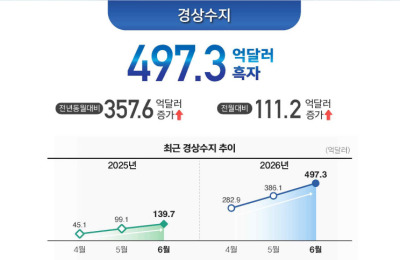
[서울=뉴스핌] 박가연 기자 = 지난 6월 우리나라의 경상수지가 전월에 이어 역대 최대 흑자를 기록했다. 반도체를 중심으로 한 정보기술(IT) 품목 수출 호조로 월간 상품수출이 처음으로 1000억달러를 넘어선 영향이다.
[자료=한국은행]
한국은행이 6일 발표한 '2026년 6월 국제수지(잠정)'에 따르면 지난 6월 경상수지는 497억3000만달러 흑자로 집계됐다. 전월(386억1000만달러)에 이어 두 달 연속 월간 기준 역대 최대 기록을 갈아치웠다. 이에 따라 올해 상반기 누적 경상수지 흑자는 1910억1000만달러를 기록했다.
경상수지 흑자를 견인한 것은 상품수지다. 6월 상품수지는 478억9000만달러 흑자를 기록하며 전월에 이어 역대 최대를 다시 썼다. 국제수지 기준 상품수출은 1123억7000만달러로 전년 동월 대비 84.5% 증가하며 월간 기준 처음으로 1000억달러를 넘어섰다. 상품수입은 644억8000만달러로 38.6% 늘었다.
통관 기준으로는 반도체 수출이 전년 동월 대비 196.9% 급증했고 컴퓨터·주변기기(SSD)는 282.7% 증가했다. IT 품목 수출은 160.4% 늘었으며 비IT 품목도 ▲석유제품(47.5%) ▲화공품(18.6%) ▲철강제품(17.9%) ▲승용차(6.1%) 등을 중심으로 18.6% 증가했다. 통관 기준 수입은 ▲원자재(30.5%) ▲자본재(35.3%) ▲소비재(16.4%)가 모두 늘었다.
서비스수지는 12억9000만달러 적자를 기록해 전월(-10억9000만달러)보다 적자 폭이 확대됐다. 여행수지는 외국인 입국자 증가와 유류할증료 인상 등에 따른 출국자 감소로 4억4000만달러 흑자를 기록했지만 지식재산권사용료수지는 전월 흑자에서 4억4000만달러 적자로 전환됐다.
본원소득수지는 배당소득을 중심으로 32억7000만달러 흑자를 기록해 전월(21억7000만달러)보다 흑자 폭이 확대됐다. 배당소득수지는 배당수입이 늘어난 데다 전월 분기배당에 따른 기저효과로 배당지급이 줄면서 25억6000만달러 흑자를 나타냈다.
금융계정 순자산은 6월 중 467억1000만달러 증가해 월간 기준 역대 최대 증가 폭을 기록했다. 종전 최대였던 올해 3월(369억9000만달러)을 넘어선 것이다. 직접투자에서는 내국인의 해외투자가 80억1000만달러, 외국인의 국내투자가 46억3000만달러 각각 증가했다.
증권투자에서는 외국인의 국내 주식 매도세가 이어졌다. 외국인의 국내 주식 투자는 차익실현 매도 등의 영향으로 316억1000만달러 감소하며 전월(-310억5000만달러)에 이어 역대 최대 순매도 기록을 다시 경신했다.
외국인의 국내 채권투자는 세계국채지수(WGBI) 자금 유입에도 분기 말 만기도래 영향으로 증가 폭이 줄어든 52억9000만달러를 기록했다. 내국인의 해외 증권투자는 주식을 중심으로 35억6000만달러 증가했다.
eoyn2@newspim.com
2026-08-06 08:00