


A Primer on Inflation (with Comments on Real Estate in the Metroplex)Remarks at the 6th Annual Real Estate Symposium, North Dallas Chamber of CommerceDallas, TexasAugust 30, 2006Real estate runs on borrowed money—so I suspect most of you keep a sharp eye on Federal Reserve policymaking and its effect on interest rates. At times, I am sure, we have made your business more difficult for you, but I urge you to keep in mind the Fed’s raison d’être. We are charged with maintaining the monetary conditions for sustainable, non-inflationary economic growth. Will Rogers once quipped that “the three greatest inventions of man were fire, the wheel and central banking.” Given the times, shortly after the failure of the Bank of the United States and the onset of the Great Depression, he just may have been striking a sarcastic note! Even so, the idea of an independent central bank like the Federal Reserve is, I think, an ingenious one.President Woodrow Wilson signed the Federal Reserve Act in 1913. One of the more successful and brilliant aspects of this legislation was the creation of 12 regional banks that would influence monetary policymaking. Having representatives from all parts of the country brings a deeper, more diverse perspective to the policy debate, giving a clearer view of what is really happening in the U.S. economy.Texas lobbied Washington heavily to host one of the 12 regional banks. Dallas won out over Fort Worth and Houston, largely because of the efforts of Dallas Morning News publisher George B. Dealey. He rallied support for Dallas by recruiting influential Texans in Washington to back the city’s cause. Dealey’s emissaries succeeded by pleading their case before the Treasury secretary and President Wilson himself. Dallas won its bid to become a Reserve Bank city on April 3, 1914, the same day, incidentally, that Pancho Villa’s forces captured the Mexican town of Torreón. Other notable events that year included the completion of the Panama Canal, the start of World War I and the invention of the air conditioner. I will leave it to you to decide whether that last one tops the Dallas Fed in importance to this great city’s development. Few Dallas institutions have survived as long as the Dallas Fed. We have been part of the downtown community since we opened, moving from temporary quarters to that stately building on Akard Street in 1921 and then to our current building on Pearl Street, just opposite the Arts District, in 1992. We have the third longest continuous business presence in downtown Dallas and are proud of it. Of the remaining downtown institutions, only the Morning News and Neiman Marcus predate our arrival in Dallas. The Dallas Fed has been at its best in hard times. During the Great Depression, our employees voluntarily took 5 percent pay cuts so the Bank could share the work and hire unemployed Dallasites. In an earlier recession, panicked customers stampeded a Dallas bank, demanding to withdraw their money. It was the kind of run that could ruin a bank. The head of the Dallas Fed, a man named W. F. Ramsey, showed up in an armored car with guards. They hauled a quarter million dollars into the lobby—where everyone could see it. In a scene right out of It’s a Wonderful Life, Ramsey jumped on a desk and shouted across the crowded lobby that he had $30 million more sitting in the Fed’s vault down the street. Just like that, the bank run ended. The Fed has come a long way from its early years. Today, we employ more than 1,300 people in Texas, almost a thousand of them in Dallas. Each year, the Dallas Fed processes 1 billion paper checks worth about $900 billion and between 240 million and 300 million electronic checks and handles 5.4 billion in circulating banknotes worth nearly $92 billion. We continue to supply the liquidity banking customers need in times of potential and real crises, such as Y2K, the aftermath of 9/11 and last year’s devastating hurricanes. Our operations require an underground vault the size of a five-story building—quite something, when you realize our vault was little more than an office safe in 1914. Our other responsibilities include supervising the banking industry within the Eleventh Federal Reserve District. We conduct on-site audits of our member banks and monitor bank performance and stability. We have public education programs designed to raise financial and economic literacy in our community and host many public events and conferences on significant activities within our economy. We maintain a first-rate research department that provides me with the authoritative economic analysis I need for my role on the Federal Open Market Committee—the FOMC—as well as speeches like this one. I mean it when I say first-rate. Some of you may not know that Finn Kydland, an associate of our research team for the past 13 years, won the Nobel Prize for economics in 2004. Finn is with me this morning. Now, he is a Norwegian and is therefore genetically incapable of promoting or drawing attention to himself. Nevertheless, I am going to embarrass Finn and ask him to stand up and take a bow. Our current analysis points to an economy at a crossroads. High energy prices, rising interest rates and the slowdown in a red-hot housing market have taken some of the steam out of what had been a fairly robust expansion. At the same time, our current inflation indicators are not presently as well behaved as I would like them to be. Central bankers are always concerned when inflation starts to rear its ugly head. We know from experience that once inflation gains momentum, it becomes harder and harder to stop.As you know from reading this morning’s papers, at our last meeting of the FOMC, we collectively decided to pause in raising the fed funds rate after 17 consecutive rounds of quarter-point tightenings. It was the collective judgment of the committee that we were at a juncture where it made sense to evaluate the lagged effect of these tightenings, especially on the inflationary impetus of the economy.How do we define inflation, and how do we measure it? This is a question I want to discuss in depth with you today. Before I do, however, let me issue the usual disclaimer that today, as always, I speak only for myself, not for the Federal Open Market Committee, nor for any of the other committee members.Inflation is an increase in the general price level. If prices for all goods and services went up in the same proportion, over some period of time—if all prices increased by, say, 2 percent over the past 12 months—there would be no difficulty in identifying the rate of inflation: It would be 2 percent a year. In reality, over any stretch of time, some prices will rise faster than others and some may actually decline. When we speak of inflation as a sustained increase in the “general level of prices,” we have in mind an increase in an average of all prices.This average is more sophisticated than a simple arithmetic mean. We don’t want to treat a 10 percent increase in the price of pepper, for example, as having the same importance as a 10 percent increase in the price of shelter, clothing or transportation. So the formulas we use weight items by how important they are in people’s budgets.Differences in weighting, and the scope of goods and services included, give rise to the various inflation measures we hear reported on radio and television broadcasts or read about in the papers. The Consumer Price Index (CPI) focuses on the prices of the goods and services consumed by a typical urban household. The price index for personal consumption expenditures (PCE) looks more broadly at all goods and services purchased for final consumption and, additionally, uses a more sophisticated weighting scheme than the CPI. Most broadly, the price index for gross domestic product, also known as the GDP deflator, looks at the prices of all goods and services produced in the economy; thus, it includes not just consumer goods, but also capital goods and government-provided services.Now, bear with me here.Each of these measures comes in two flavors: “headline” and “core.” The latter—the “core”—excludes prices for food and energy. The man on the street—someone known to occasionally purchase food and gas and air-condition or heat his home—often puzzles at policymakers’ focus on core inflation. To add to that man’s confusion, it is not uncommon for the press to report the same inflation numbers in different ways. When July’s CPI numbers were reported earlier this month, a Washington Post article stated, “The Labor Department reported yesterday that inflation rose last month, eating into people’s paychecks and savings at a quickening clip.” The same day, New York Times readers learned that “the government’s latest report on consumer prices, issued yesterday, suggests that inflation is slowing.” Both were right. The Post had focused on the headline rate, which had picked up relative to the month before, while the Times focused on the core rate, which had fallen a bit from prior months.Policymakers and economists tend to focus on the core measures because they strip out volatile items and show more stability than headline inflation. The core measures give a better indication of the underlying inflationary trends that matter most in formulating policy. I have been using the word “core” as shorthand for “excluding food and energy,” and that is the common connotation. To be precise, however, “ex food and energy” measures are but one form of the core rate, and—according to research at the Dallas Fed, the Cleveland Fed and elsewhere—not even necessarily the best. The Dallas Fed has created a measure of core inflation called the Trimmed-Mean PCE inflation rate. It is calculated by stripping out the most volatile price movements each month, regardless of whether the items in question are food, energy or something else, in order to not be distracted by temporary price rises or declines and to enable us to focus instead on the underlying trend of inflation. The Trimmed-Mean PCE in one month this past spring, for example, excluded guns, which were set aside because of a big price decline, and funeral expenses, deleted because of a big price increase. I won’t speculate on whether these price movements were related.Central bankers abhor inflation and deflation. Our mantra is “price stability.” Taken literally, this means zero inflation. But our inflation measures are imperfect and likely biased upward, so many central bankers see price stability as a very low, though positive, rate of measured inflation. The point is to have an inflation rate that is, in its economic effects, essentially zero. Stated differently, we seek to create the monetary conditions for an economy where inflation is not distorting anyone’s decisions.Why do we value price stability? Somewhere in France, there is—or at least there used to be—a rod that precisely defines a meter. It is quite useful to know that the length of that rod is constant from one month to the next, one year to the next. This is the only way to ensure that those 10-meter doohickeys that are on order, when they arrive, will fit with the 10-meter doodads you already have on hand. The best situation is a rod that doesn’t change—“meter stability,” if you will. Next best would be a rod that changed in predictable ways—say, a rod known to grow by 2 percent a year. Setting aside the question of where—after many years—one would keep such a rod, people could at least confidently plan for the future. The worst case, of course, would be a rod that changed unpredictably—some months growing by “X” percent, some months actually shrinking. Manufacturers and others, like the people who organize marathons, would expend resources attempting to predict changes in the rod’s length—resources that could have been put to more productive use. And still, at the end of the day, some of their plans would come to naught because of unforeseen variations. You couldn’t build a new house under those circumstances, or a factory, or a school, or practically anything else.Inflation is a bit like having a measuring stick that grows or shrinks from one month to the next; the “doohickeys” and “doodads” that need to fit together, in this case, are prices for money or goods today and in the future. You get the picture. The consequences of a randomly varying dollar value would be severe. It doesn’t take a Finn Kydland to conclude that low and predictable inflation is preferable to high and variable inflation and that low and predictable inflation should be the goal of your central bank. The evidence suggests central bankers have had some success in that pursuit. In the U.S. and elsewhere, inflation has been brought down to near-negligible levels and has become more predictable in the past 20 years. In 1993, a great economist named John Taylor proposed a simple rule for conducting monetary policy. He recommended setting interest rates based on two inputs: first, the deviation of actual inflation from the central bank’s desired rate and, second, a measure of the economy’s excess capacity, usually called the “output gap.” The Taylor rule recommends raising nominal interest rates—that is, tightening monetary policy—whenever inflation is above its target or output is temporarily above its long-term potential.The Taylor rule begat the Taylor principle, which recommends how much to tighten in response to a given deviation of inflation from its target. It suggests that increases in nominal interest rates need to be greater than the rise in inflation. In response to a 1 percentage point increase in inflation, for example, the principle might prescribe a 1.5 percentage point increase in nominal interest rates. If you do the math, you will see that a rise in inflation has been met with an increase in the real, or inflation-adjusted, interest rate. Higher real interest rates act as a tap on the economy’s brakes, slowing the pace of real activity and reducing upward pressure on prices.John Taylor originally formulated his rule as a prescription for policymakers. But it turns out that, at least since the mid-1980s, the Taylor rule is a good description of how the Fed has conducted monetary policy. While the Fed has never bound itself to any explicit policy rule, its de facto adherence to the Taylor principle since the mid-1980s has paid off handsomely in terms of achieving price stability. Inflation measured by the PCE price index averaged about 7 percent in the 1970s, 4.5 percent in the 1980s and 2.2 percent in the 1990s and through the first half of this decade.In the simplest version of the Taylor rule, current inflation is the primary determinant of a central bank’s policy actions. In the real world, policymakers look at many other indicators to gauge inflationary pressures before they show up in actual inflation rates. This makes sense, given the lags between policy actions and their ultimate effects on the economy—lags that economist Milton Friedman famously described as “long and variable.”Among the additional variables we look at are measures of capacity utilization of business operators and tightness in the labor market—for example, the unemployment rate. Strong job growth will lead to demands for higher pay. Many of you might wonder why that could ever be bad. Well, when it comes to workers’ pay and benefits, it is not the increases themselves that cause concern. Problems occur when labor costs rise faster than gains in labor productivity. When that happens, firms often see shrinking profit margins, which add to pressure to raise product prices. What policymakers look at is unit labor costs, a measure of workers’ pay adjusted for productivity. Even if we cull out the misleading signals, the traditional data set may no longer be sufficient. At the Dallas Fed, we are exploring the notion that capacity measures must be extended beyond the domestic market. Today, we live in a world where goods, services, money, and the ideas and tasks performed by American businesses cross international borders with great ease. It stands to reason, then, that inflationary trends in any economy cannot be properly assessed without knowing how readily resources, inputs, finished products and capital from outside the country can be brought to bear. The Dallas Fed’s globalization initiative is aimed at developing measures of these broader output gaps, which we hope will let us determine how the dramatic rise of China and India, for example, or the processing of tasks in cyberspace will impact inflation in the U.S.Monetary policy does not give central banks a lever to control inflation directly. In focusing on interest rates, the FOMC influences demand for credit, which in turn affects growth and inflation. At any given time, of course, all sectors of the economy may not be in sync, adding great complexity to the art of central banking. In the early part of this decade, the Fed was concerned about the deflationary impact of the high-tech investment bust, and it responded by lowering interest rates on overnight, short-term borrowing by member banks. In the past three years, we reversed much of that stimulus, at first because investment began recovering and more recently because inflation was at risk of becoming uncomfortably high. Which brings us to the subject dear to your hearts—real estate. On the national level, recent data indicate that housing markets weakened further in mid-summer. The holy trinity of housing reports—starts, existing-home sales and new-home sales—all came in much weaker in July than expected by mainstream economists, with inventories of unsold homes continuing to rise. Stepping back to include weakness shown before last month, permits and new-home sales are down about 20 percent from a year ago. The declines are moving housing markets from very high and unsustainable levels toward more normal levels, unwinding some speculative activity. We are monitoring the effect this will have on the economy with due respect for its gravity. But it is not a one-sided deal; not all the consequences of the unwinding of a bull market in housing are bad. For example, a beneficial side effect of slower demand is that upward pressures on housing prices are abating. The pace of home-price appreciation has slowed dramatically—from double-digit year-over-year rates last fall to low single digits in recent readings. As prices cool off, we may finally begin the long process of allowing income to catch up with housing costs, helping make homes more affordable in the long run. Let me give you an example of what I am referring to. In 1999, 43 percent of the residents of Los Angeles could afford a median-priced home. By the end of last year, only 2 percent could. For New York, the comparable figures were 55 percent that could afford a median-priced home in 1999 and 6 percent in 2006. The figures for Dallas, incidentally, were unchanged over the period. At the end of last year, 62 percent of Dallasites could afford a median-priced home, which explains why our local housing market is holding up better than the markets on the West and East coasts.With home-price appreciation no longer running rampant, we are likely to see fewer homeowners tapping into their home equity, which had been fueling a consumption boom and diverting savings from investment. From a broader perspective, the slowing of housing and consumption frees up resources for investment and a more balanced economy. Some good news can be found by looking carefully at durable goods orders, which foreshadow private investment. Their recent rise suggests that businesses are starting to increase their capacity following the investment bust a few years back. Spending on plant and equipment is crucial to supporting productivity growth, the source of long-term gains in living standards. The stirring of business investment has helped spark a revival in commercial real estate construction to accommodate the many firms aiming to expand their workspaces. Indeed, we may be seeing the start of a great rotation away from household spending to investment and to more healthy and balanced growth. In setting monetary policy, we assess inflationary pressures and gauge aggregate demand by adding up some sectors that are weakening, like housing, along with sectors that are expanding, like commercial construction and investment. I will wrap up by bringing things closer to home—the Texas and Dallas real estate markets, which diverge from national trends, particularly on the housing side. The housing markets all across Texas are healthy compared with the rest of the U.S. While we have seen some signs of cooling, traffic and sales are still strong. We are hearing more reports of cancellations, mostly attributed to relocation buyers not being able to sell their West Coast homes. This is not “Texas brag.” If you listen to business leaders in El Paso, for example, you will hear them say that West Texas is being invaded by two forces: the U.S. Army and Californians. The consolidation of military bases in the El Paso area, combined with relocators from Southern California, is changing the character of once-sleepy El Paso. Throughout the state, housing starts outpaced sales in the second quarter, despite record-setting sales figures. And our apartment markets have improved along with the economy. So far this year, apartment demand is keeping up with supply, helping vacancy rates stay around 10 percent in most Texas markets. We are hearing reports of strong office-leasing activity from both local and relocating firms, as well as increasing requests for large blocks of office space. Office, industrial and warehouse rents are picking up, along with construction activity in several areas in Texas, especially in Dallas. We are also hearing numerous reports of the difficulty developers are having finding construction workers as well as rising pressure on wages. In the Metroplex, the housing market has been quite strong for over five years. Dallas–Fort Worth has ranked in the top four among U.S. metropolitan areas in single-family permits since 2000. New-home sales set records in the first and second quarters of 2006, while existing-home sales cooled a bit. Year-to-date existing-home sales are flat compared with last year, and July sales were down 10 percent. The median price of homes in the area, however, is still rising modestly. Apartment markets are relatively healthy, with occupancies above 90 percent and three consecutive quarters of modest rent hikes. Dallas’ office market has made a comeback in the past few years, but that really does not show up in vacancy rates, presently ranked second highest in the U.S. Interestingly, Dallas’ commercial vacancy rate is about 23 percent, while Fort Worth’s is 6 percent. Despite the ranking, demand for space is increasing, and large blocks are diminishing in certain submarkets. Construction has increased dramatically, especially in downtown Dallas, Uptown and Far North Dallas. Our contacts are convinced that occupancy, demand and rents in these areas justify the pace of construction. The industrial market continues to improve, with most of the gains coming from the warehouse side. The retail market has benefited from the strong housing market over the past several years, but demand appears to have ebbed recently, giving cause for caution. However, retail vacancies remain relatively low, at about 10 percent, and construction activity is up strongly. A word of caution is in order, however, because national trends do have an impact on the local market. Nationally, there is a lot of cash in capital markets looking for sustainable projects to be invested in. The result is that capitalization rates have been pushed down, raising concern among some industry analysts, especially in a condominium market that seems to reflect an excess of supply relative to demand at the margin. We have seen the effect of this here in Dallas with the cancellation of some high-profile building or conversion plans, and I expect there will be more.I hope my comments have been a good start on today’s proceedings. Subsequent speakers will, I am sure, provide more detailed information on Metroplex real estate trends. Before leaving, though, I want to remind you that North Texas owes its prosperity to the legions of vital and entrepreneurial businesswomen and men who grew up here or came here. People like you. You dare to dream. You are not afraid to take risks. You are a large part of what makes Dallas what it is. Let me put this in perspective. We read a lot these days about India and its barnstorming economy. India has an extraordinary cadre of brilliant and hardworking people. India’s economic prowess grabs a lot of headlines. And yet consider this: The 24 million people of Texas produce 20 percent more output than the 1.1 billion people of India. The Texas economy is a fifth larger than India’s. That’s because of hardworking risk takers like you. The Federal Reserve does its level best to maintain monetary conditions necessary for sustainable non-inflationary growth. But you, and the businessmen and women of America, are the ones that make that growth happen and secure our prosperity. God bless you. About the AuthorRichard W. Fisher is president and CEO of the Federal Reserve Bank of Dallas.

[관련키워드]




[뉴스핌 베스트 기사]
 사진
사진
정동영 업무보고 논란
[서울=뉴스핌] 유신모 외교전문기자 = 청와대 영빈관에서 5일 열린 외교·안보 분야 정부 부처의 대통령 업무보고에서 정동영 통일부 장관의 '한반도 평화공존 발전 구상'과 업무보고 발언이 논란을 빚고 있다.
이날 정 장관의 발언 중에는 정부 내 조율을 거치지 않은 사안을 정책으로 추진하겠다고 공언한 것이 있는가 하면 사실 관계에 맞지 않은 설명도 있었다. 이재명 대통령은 공개적으로 신중을 기해 달라고 경고했고, 조현 외교부 장관은 '이상주의적 희망에 근거한 비현실적 구상'이라는 비판을 내놨다.
그동안 정 장관의 대북 정책 관련 발언이 물의를 빚은 적은 여러 번 있지만 대통령과 유관 부처 장관이 공개적으로 부정적 입장을 표명한 것은 이례적이다. 정 장관의 무리한 대북 접근법과 월권을 제어해야 한다는 목소리도 높아지고 있다.
[정동영 통일부 장관이 지난달 23일 오후 서울 종로구 정부서울청사에서 취임 1주년 기자간담회를 하고 있다. [사진=통일부] 2026.07.23
◆통일부 장관 권한 넘어선 주장
정 장관은 이날 업무보고에서 '한반도 평화공존 발전 구상'을 설명하면서 이재명 정부 2년차 핵심 과제로 상호 존중·평화적 갈등 해결·핵 없는 한반도 등 3대 기본 방향을 제시했다.
정 장관은 "대결과 혐오의 언어는 멈춰야 한다"면서 주적 용어 대체를 주장했다. 지난 25년간의 CVID(완전하고 검증가능하며 되돌릴 수 없는 비핵화) 구도는 이미 무너졌다고도 했다. 또 "현 시점에서 흘러간 선(先)비핵화만 되뇌는 것은 현실을 바꾸는 데 힘이 되지 않는다"고 주장했다. 정 장관은 또 "정전 체제를 평화 체제로 바꾸는 논의에 착수하겠다"면서 "북·미 정상회담 견인과 함께 4자 대화의 동력을 확보하기 위해 최선을 다할 것"이라고 말했다.
하지만 이 대통령은 정 장관의 구상에 대부분 제동을 걸었다. 이 대통령은 "평화공존 정책이 정치적으로 악용되는 측면이 있다"며 "많이 조심하셔야 한다"고 지적했다.
북한을 다른 이름으로 불러야 한다는 주장에는 "표현에 꼬투리가 잡혀 정쟁으로 휘몰아 들어가면 원래 하고자 했던 데에서 오히려 나쁜 상황이 초래될 수 있다"고 경고했다.
이 대통령은 남북 신뢰 구축을 위해 9·19 군사합의를 선제적으로 복원해야 한다는 정 장관의 주장에 대해서도 "우리의 선의대로 하는 게 과연 한반도의 평화와 안정에 플러스냐, 결론적으로 약간의 의문이 들 때도 있다"며 부정적으로 반응했다.
조현 외교부 장관은 업무보고 사후 브리핑에서 정 장관이 언급한 '4자 회담'에 대해 "이상주의에 근거한 어떤 희망이라 하더라도 그건 아직 조율되지 않은 방법"이라며 "여러분들께서 디스카운트해 주시면 좋겠다"고 선을 그었다.
정 장관이 9월 러시아 블라디보스토크에서 열리는 '동방경제포럼(EEF)'을 언급하며 "정부 차원에서 (참석을) 검토하고 있다"고 발언한 데 대해서도 조 장관은 "그것은 외교부의 몫"이라며 "아직 거기까지 진도가 나가지 않았다"고 잘랐다.
정 장관이 이날 소개한 대북 구상과 설명은 정부 내 조율을 거치지 않았다는 점에서 문제가 있다. 특히 주적 표현 대체와 국호 사용, 9·19 군사합의 복원, 4자회담 추진 등은 통일부 장관이 결정할 사안이 아니어서 월권이라는 지적이 나오고 있다. 이 대통령은 정 장관의 업무보고를 듣고 난 뒤 "여기 업무보고에 발표했다고 승인난 건 아니다"라고 재차 확인했다.
정부의 한 소식통은 "정 장관의 발언 내용은 대부분 국가안전보장회의(NSC)를 거쳐 결정된 사안이 아닌 정 장관의 개인적 생각에 가깝다"며 "안보 관련 부처 장관이 정부의 공식 정책이 아닌 사안을 추진하겠다고 업무보고를 하고 대통령의 면전에서 '국군통수권자가 나서야 한다'고 주장한 것은 심각한 문제"라고 지적했다.
이재명 대통령이 5일 청와대 영빈관에서 열린 통일 외교 국방 등 외교 안보 부처 업무보고에서 발언하고 있다. [사진=청와대] 2026.08.05
◆시대착오적 접근, 대북 인식 오류
더욱 문제인 것은 정 장관의 이같은 주장이 현 시점에서 이미 참고가 될 수 없는 과거의 경험 또는 사실과 다른 인식에 기반하고 있다는 것이다. 정 장관이 주장하는 구상은 급격히 변화하고 있는 북한의 전략과 한반도 및 국제 정세를 전혀 반영하지 못하고 있다는 비판이 제기되고 있다.
정 장관이 "흘러간 선(先)비핵화만 되뇌는 것은 현실을 바꾸지 못한다"고 언급한 것은 지금까지의 대북 접근법을 호도하고 있다. 북핵 위기 발발 이후 지금까지 모든 핵 협상에서 한국이나 미국은 북한에 선비핵화를 공식적으로 요구한 적이 없기 때문이다.
지금까지의 북핵 협상은 북한의 비핵화 조치에 한·미가 상응하는 대가를 제공하는 방식으로 이뤄졌다. 1994년 북·미 제네바 기본합의는 핵시설 동결과 중유 제공의 교환이었다. 2005년 9.19 공동성명도 북한의 비핵화 조치의 모든 단계에 상응조치를 제공하는 '행동 대 행동' 원칙이 적용됐다.
대북 협상에 관여했던 한 전직 관료는 "모든 북핵 협상은 북한의 비핵화 조치와 한·미가 제공하는 상응조치를 어떻게 정교하게 배열하느냐가 관건이었다"면서 "정 장관의 발언은 지금까지 한·미가 북한에 먼저 핵을 포기해야 대화할 수 있다는 정책을 고수해 현 상황에 이르게 됐다는 잘못된 인식에서 비롯된 것으로 보인다"고 말했다.
정 장관이 "지난 25년간의 CVID 구도가 무너졌다"고 말한 것도 비핵화의 개념에 대한 이해 부족이라는 비판이 제기되고 있다. 북핵 문제에 정통한 외교 소식통은 "어떤 명칭을 붙이든 핵을 제거한 뒤 이를 검증하고 재발 방지 조치를 하는 것은 비핵화에 반드시 포함되어야 하는 기본적 절차"라며 "CVID는 안 된다고 말하는 것은 북한의 비핵화 조치를 검증도 하지 않고 언제든 되돌릴 수 있도록 합의하자는 말과 같다"고 지적했다.
[서울=뉴스핌] 이길동 기자 = 조현 외교부 장관이 5일 오후 서울 종로구 정부서울청사 별관에서 2026년 하반기 업무보고 사후브리핑을 하고 있다. 2026.08.05 gdlee@newspim.com
◆안보 리스크 키우는 통일부 장관
정 장관은 지난해 취임 직후부터 청와대와 외교부를 제치고 통일부가 북한과 관련된 모든 정책을 주도해야 한다는 주장을 펴면서 단독 질주를 거듭해왔다.
북한의 '적대적 두 국가' 주장을 변형한 '평화적 두 국가'를 지향해야 한다고 주장하면서 이에 문제점을 지적하는 목소리를 무시했다. 외교부가 미국과 북한 문제를 논의하는 것에 대해 "한반도 정책과 남북관계는 주권의 영역이며 동맹국과 협의의 주체는 통일부"라고 주장해 물의를 빚었다. 문재인 정부 시절 한·미 워킹그룹이 남북관계 파탄 원인이었다고 사실과 다른 주장을 폈다.
지난해 업무보고에서는 국제정세를 감안하지 않고 남북대화 재개에만 초점을 맞춘 비현실적 내용으로 논란을 빚었다. 정부 내 조율도 거치지 않고 독자 대북제재인 5·24 조치를 해제하고 9·19 군사합의 비행금지구역 복원을 추진하겠다는 방침도 밝혔다.
지난 4월에는 평안북도 구성시에 우라늄 농축 시설이 있다고 말해 파장을 일으켰다. 미국은 이 발언을 계기로 한국과 대북정보 공유를 제한했다. 이 조치는 지금도 계속되고 있는 것으로 알려졌다.
정 장관이 이처럼 정부의 공식 결정을 거치지 않은 사안을 정부 정책인 것처럼 주장하며 좌충우돌하는 배경에 대해 여러가지 해석이 나온다. 북한 문제에서 조기에 성과를 거둬야 한다는 조급증과 자신의 존재감 과시 욕구가 작용하고 있다는 평가가 많다.
일각에서는 정 장관이 2007년 민주당 대선후보였을 때 이재명 대통령이 캠프에서 비서실 부실장으로 활동한 전력이 있다는 것을 들어 "정 장관이 아직도 이 대통령을 아랫사람으로 생각하고 있는 것 아니냐"는 비판을 내놓기도 한다.
한·미 관계와 북한 문제를 오래 다뤘던 전직 관료 출신의 한 전문가는 "정 장관 취임 후 지금까지의 언행은 잘못된 현실 인식에 따른 독단과 앞서 가기, 월권 등으로 점철돼 있다"면서 "통일부 장관이라는 중요한 직책에 있으면서 스스로 안보 리스크를 키우는 역할만 했다"고 비판했다.
opento@newspim.com
2026-08-06 06:10
 사진
사진
6월 경상수지 최대 흑자
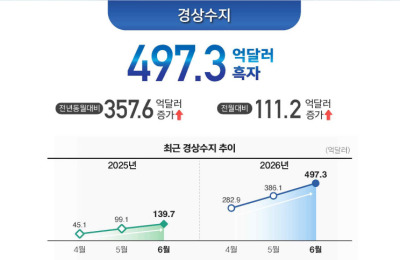
[서울=뉴스핌] 박가연 기자 = 지난 6월 우리나라의 경상수지가 전월에 이어 역대 최대 흑자를 기록했다. 반도체를 중심으로 한 정보기술(IT) 품목 수출 호조로 월간 상품수출이 처음으로 1000억달러를 넘어선 영향이다.
[자료=한국은행]
한국은행이 6일 발표한 '2026년 6월 국제수지(잠정)'에 따르면 지난 6월 경상수지는 497억3000만달러 흑자로 집계됐다. 전월(386억1000만달러)에 이어 두 달 연속 월간 기준 역대 최대 기록을 갈아치웠다. 이에 따라 올해 상반기 누적 경상수지 흑자는 1910억1000만달러를 기록했다.
경상수지 흑자를 견인한 것은 상품수지다. 6월 상품수지는 478억9000만달러 흑자를 기록하며 전월에 이어 역대 최대를 다시 썼다. 국제수지 기준 상품수출은 1123억7000만달러로 전년 동월 대비 84.5% 증가하며 월간 기준 처음으로 1000억달러를 넘어섰다. 상품수입은 644억8000만달러로 38.6% 늘었다.
통관 기준으로는 반도체 수출이 전년 동월 대비 196.9% 급증했고 컴퓨터·주변기기(SSD)는 282.7% 증가했다. IT 품목 수출은 160.4% 늘었으며 비IT 품목도 ▲석유제품(47.5%) ▲화공품(18.6%) ▲철강제품(17.9%) ▲승용차(6.1%) 등을 중심으로 18.6% 증가했다. 통관 기준 수입은 ▲원자재(30.5%) ▲자본재(35.3%) ▲소비재(16.4%)가 모두 늘었다.
서비스수지는 12억9000만달러 적자를 기록해 전월(-10억9000만달러)보다 적자 폭이 확대됐다. 여행수지는 외국인 입국자 증가와 유류할증료 인상 등에 따른 출국자 감소로 4억4000만달러 흑자를 기록했지만 지식재산권사용료수지는 전월 흑자에서 4억4000만달러 적자로 전환됐다.
본원소득수지는 배당소득을 중심으로 32억7000만달러 흑자를 기록해 전월(21억7000만달러)보다 흑자 폭이 확대됐다. 배당소득수지는 배당수입이 늘어난 데다 전월 분기배당에 따른 기저효과로 배당지급이 줄면서 25억6000만달러 흑자를 나타냈다.
금융계정 순자산은 6월 중 467억1000만달러 증가해 월간 기준 역대 최대 증가 폭을 기록했다. 종전 최대였던 올해 3월(369억9000만달러)을 넘어선 것이다. 직접투자에서는 내국인의 해외투자가 80억1000만달러, 외국인의 국내투자가 46억3000만달러 각각 증가했다.
증권투자에서는 외국인의 국내 주식 매도세가 이어졌다. 외국인의 국내 주식 투자는 차익실현 매도 등의 영향으로 316억1000만달러 감소하며 전월(-310억5000만달러)에 이어 역대 최대 순매도 기록을 다시 경신했다.
외국인의 국내 채권투자는 세계국채지수(WGBI) 자금 유입에도 분기 말 만기도래 영향으로 증가 폭이 줄어든 52억9000만달러를 기록했다. 내국인의 해외 증권투자는 주식을 중심으로 35억6000만달러 증가했다.
eoyn2@newspim.com
2026-08-06 08:00