


Minutes of the Monetary Policy Meetingon May 18 and 19, 2006(English translation prepared by the Bank's staff based on the Japanese original) June 20, 2006Bank of JapanA Monetary Policy Meeting of the Bank of Japan Policy Board was held in the Head Office of the Bank of Japan in Tokyo on Thursday, May 18, 2006, from 2:00 p.m. to 3:53 p.m., and on Friday, May 19, from 9:00 a.m. to 12:03 p.m.1Policy Board Members PresentMr. T. Fukui, Chairman, Governor of the Bank of JapanMr. T. Muto, Deputy Governor of the Bank of JapanMr. K. Iwata, Deputy Governor of the Bank of JapanMs. M. SudaMr. S. NakaharaMr. H. HaruMr. T. FukumaMr. A. MizunoMr. K. G. NishimuraGovernment Representatives PresentMr. K. Akaba, Senior Vice Minister of Finance, Ministry of Finance2 Mr. K. Sugimoto, Deputy Vice Minister for Policy Planning and Coordination, Ministry of Finance3Mr. Y. Nakajo, Vice Minister for Policy Coordination, Cabinet OfficeReporting StaffMr. E. Hirano, Executive Director (Assistant Governor)Mr. M. Shirakawa, Executive DirectorMr. A. Yamamoto, Executive DirectorMr. M. Amamiya, Director-General, Monetary Affairs Department Mr. S. Uchida, Senior Economist, Monetary Affairs Department Mr. H. Nakaso, Director-General, Financial Markets DepartmentMr. H. Hayakawa, Director-General, Research and Statistics DepartmentMr. K. Momma, Deputy Director-General, Research and Statistics Department Mr. A. Horii, Director-General, International DepartmentSecretariat of the Monetary Policy MeetingMr. Y. Nakayama, Director-General, Secretariat of the Policy Board Mr. T. Kozu, Adviser to the Governor, Secretariat of the Policy Board Mr. K. Murakami, Director, Secretariat of the Policy Board Mr. K. Kamiyama, Senior Economist, Monetary Affairs Department Mr. K. Masaki, Senior Economist, Monetary Affairs Department 1 The minutes of this meeting were approved by the Policy Board at the Monetary Policy Meeting held on June 14 and 15, 2006 as "a document which contains an outline of the discussion at the meeting" stipulated in Article 20, Paragraph 1 of the Bank of Japan Law of 1997. Those present are referred to by their titles at the time of the meeting. 2 Mr. K. Akaba was present on May 19. 3 Mr. K. Sugimoto was present on May 18. I. Summary of Staff Reports on Economic and Financial Developments4A. Money Market Operations in the Intermeeting PeriodThe Bank conducted money market operations in accordance with the guideline decided at the previous meeting on April 28, 2006.5 The uncollateralized overnight call rate was stable at effectively zero percent. The outstanding balance of current accounts at the Bank had been decreasing gradually, and was in the 14-15 trillion yen range recently.4 Reports were made based on information available at the time of the meeting.5 The guideline was as follows: The Bank of Japan will encourage the uncollateralized overnight call rate to remain at effectively zero percent. B. Recent Developments in Financial MarketsIn the money market, interest rates on term instruments rose partly reflecting heightening of market expectations that the Bank might raise the target for the uncollateralized overnight call rate at an unexpectedly early timing. Interest rates on Euroyen futures temporarily increased for all delivery months but decreased thereafter, and were recently at around the same level as at the time of the previous meeting. Japanese stock prices declined, reflecting an appreciation of the yen against the U.S. dollar and a decline in U.S. stock prices. The Nikkei 225 Stock Average was recently moving in the range of 16,000-16,500 yen. Long-term interest rates temporarily rose to around 2 percent but declined thereafter. Recently they were moving at around 1.95 percent. The yen appreciated against the U.S. dollar partly because selling of the dollar had predominated over buying reflecting market participants' interpretation of the G-7 statement. The yen was recently being traded in the range of 109-111 yen to the dollar.C. Overseas Economic and Financial DevelopmentsThe U.S. economy continued to expand steadily at a pace around its potential growth rate, led mainly by household spending and business fixed investment. Although the pace of increase in prices was relatively fast due to high energy prices, inflation expectations had remained contained thus far in a situation where the Federal Reserve had carried out successive raises of the target for the federal funds rate. In the euro area, although the economy remained somewhat sluggish, the momentum for recovery had been gradually increasing as evidenced by the recovery in exports and production.With regard to East Asian economies, in China both domestic and external demand continued to expand strongly. The NIEs and ASEAN economies continued to expand at a moderate pace on the whole, although negative effects of high energy prices could be seen in some economic activity. In the United States, long-term interest rates rose and stock prices fell in a situation where energy prices remained high and labor market conditions continued to be tight. In Europe, long-term interest rates increased somewhat and stock prices weakened reflecting developments in U.S. financial markets. In emerging economies, stock prices and currencies fell.D. Economic and Financial Developments in Japan1. Economic developmentsExports had continued to increase against the background of the expansion of overseas economies, and were expected to continue to rise, as overseas economies expanded further, particularly in the United States and East Asia.As for domestic private demand, business fixed investment had continued to increase, and was expected to keep increasing since the expansion in domestic and external demand and the high level of corporate profits were likely to be maintained.Private consumption had been on an increasing trend. The number of new passenger-car registrations excluding small cars with engine sizes of 660 cc or less had been somewhat weak. However, the number of new passenger-car registrations including small cars had been picking up slightly so far this year, partly supported by the introduction of new models. Private consumption was likely to continue to increase steadily, mainly reflecting a gradual increase in household income.Industrial production had continued to increase against the background of the growth in domestic and external demand. Production was expected to continue its uptrend, as overseas economies would continue to expand and domestic demand would continue to be solid. According to anecdotal information, production for the April-June quarter was likely to continue to increase.As for the employment and income situation, household income had continued rising moderately, reflecting improvements in employment and wages, as various indicators for labor market conditions had been improving. The gradual increase in household income was likely to continue.Since the economic recovery had continued for more than four years, the conditions of persistent excess supply had been dispersed, and the output gap was currently close to zero and likely to gradually become positive.On the price front, domestic corporate goods prices had continued to increase, mainly reflecting the rise in international commodity prices. They were expected to continue increasing for the time being, mainly due to the effects of rising international commodity prices. The year-on-year rate of change in the consumer price index (CPI; excluding fresh food, on a nationwide basis) had been on a positive trend, and this trend was projected to continue, as the output gap was likely to gradually become positive.2. Financial environmentThe environment for corporate finance was accommodative. The issuing environment for CP and corporate bonds was favorable, and the lending attitude of private banks had continued to be accommodative. The decline in credit demand in the private sector had come to a halt. Under these circumstances, the year-on-year rate of increase in the amount outstanding of lending by private banks for April increased significantly from that for March. According to statistics on loans and discounts outstanding by sector at the end of March, the year-on-year rate of decline in loans to large firms had diminished and the year-on-year rate of change in loans to small and medium-sized firms had turned positive. Meanwhile, the year-on-year growth rate of the money stock (M2+CDs) had been at the 1.0-2.0 percent level.II. Summary of Discussions by the Policy Board on Economic and Financial DevelopmentsA. Economic DevelopmentsOn the current state of Japan's economy, members agreed that it continued to recover steadily, with domestic and external demand and also the corporate and household sectors well in balance, and that the conditions of persistent excess supply had been dispersed and the output gap was currently close to zero.As for the outlook, members agreed that the economy was likely to continue to grow, slightly exceeding its potential growth rate, in an environment in which a virtuous cycle of production, income, and expenditure would operate. On this basis, members concurred that it would be appropriate to express the overall assessment of the economic outlook as "Japan's economy was expected to expand moderately" in the May issue of the Monthly Report of Recent Economic and Financial Developments. Some members expressed the view that the change from "recovery" to "expansion" reflected the Bank's assessment that the output gap was likely to become positive as the level of economic activity increased, as fully explained in the April Outlook for Economic Activity and Prices (hereafter the Outlook Report), and did not necessarily imply faster economic growth. These members continued that, by adding the word "moderately" to "expand," the Bank could make clear that it expected economic growth to exceed the potential growth rate only slightly for some time.Members agreed that overseas economies, particularly those of the United States and East Asia, continued to expand, and were likely to keep expanding.On the U.S. economy, many members expressed the view that, although there were signs of deceleration, for example in housing sales, it continued to expand steadily, led mainly by household spending and business fixed investment, and was likely to keep expanding at a pace around its potential growth rate. One member said that the effects of a deceleration of housing investment on the U.S. economy were uncertain to some extent and they would require close monitoring. Regarding price developments, some members expressed the view that, given tight labor market conditions and the high capacity utilization rate, attention should be paid to the risk of a heightening of inflationary pressure reflecting the rise in commodity prices including crude oil prices. A few members commented that, as inflation risk had already started to become evident, the Federal Reserve's conduct of monetary policy had entered a more important phase. With regard to East Asian economies, members agreed that both domestic and external demand continued to expand strongly in China. Some members referred to the People's Bank of China's decision to raise the benchmark lending rates of financial institutions, as well as to strengthen its "window guidance" to control credit expansion, and commented that attention should be paid to the effects of such policy actions on, for example, fixed asset investment.Regarding Japan's economy, members agreed that exports had continued to increase, reflecting the expansion of overseas economies, and were likely to continue to rise.As for domestic private demand, members concurred that the strength in the corporate sector was benefiting the household sector.With regard to developments in the corporate sector, members agreed that business fixed investment was likely to keep increasing given that the perception among firms of having excess production capacity had dissipated and corporate profits remained high. A few members said that, although both shipments of capital goods and machinery orders, a coincident and a leading indicator of business fixed investment, respectively, were somewhat weak in the January-March quarter, business fixed investment seemed to be on an increasing trend given that investment plans were strong against the background of high corporate profits. One member pointed out that firms' stance on business fixed investment might not become as active as expected since some firms projected that their earnings for fiscal 2006 would decrease. A different member said that, in a situation where the extremely accommodative financial environment continued, business fixed investment by small nonmanufacturers, which were sensitive to interest rates, warranted attention. Some members said that the upward revision of business fixed investment plans for fiscal 2006 in the June Tankan (Short-Term Economic Survey of Enterprises in Japan) was expected to be small compared to that in fiscal 2005, and attention should be paid to the extent of the actual revision.Members concurred that private consumption had been on an increasing trend, and was likely to continue to recover steadily, mainly reflecting a gradual increase in household income. One member referred to the fact that some indicators of private consumption were somewhat sluggish in the January-March quarter, and said that this might be partly attributable to the plunge in prices of stocks listed on emerging stock exchanges, which had been gaining popularity among individual investors. Therefore, the effects of asset price developments on private consumption required close monitoring. A few members noted that consumer confidence was favorable, and expressed the view that the sluggishness of indicators of private consumption in the January-March quarter seemed to be a reaction to relatively strong rises in the previous quarter. One member commented that the figures in the Family Income and Expenditure Survey might be weaker than the actual developments due to a possible sample bias and should not be accepted at face value.Members agreed that production had continued to increase and was likely to increase further against the background of the growth in domestic and external demand. Members also concurred that inventories had been more or less in balance with shipments in the industrial sector as a whole. A few members referred to the fact that the year-on-year growth rate of inventories of electronic parts and devices had been gathering speed, and commented that there was a risk of unintended accumulation of inventories in the near future given the sector's aggressive stance on production. These members, however, added that such accumulation had not so far occurred.As for the employment and income situation, members agreed that the number of employees and wages had been increasing, and household income had continued to rise moderately, in a situation where labor market conditions had continued to improve and firms were more aware of the shortage of labor. Some members said that various surveys indicated that the rate of increase in wages was slightly greater in spring 2006 than in 2005, and thus the positive influence of the strength in the corporate sector on the household sector was becoming more evident.Members referred to the first preliminary estimate of GDP for the January-March quarter and agreed that developments in real GDP were firm, mainly led by private demand. One member noted that the year-on-year rate of decline in the GDP deflator was on a diminishing trend, partly reflecting the fact that the year-on-year decline in the deflator for domestic private demand had almost come to a halt, and therefore it was important to note when the deflator for private consumption turned positive.With regard to prices, members agreed that domestic corporate goods prices had continued to increase, mainly reflecting the rise in international commodity prices, and said that they were expected to continue increasing. Members agreed that the year-on-year rate of change in the CPI (excluding fresh food, on a nationwide basis) was likely to continue to follow a positive trend, as the output gap gradually became positive reflecting the steady economic recovery and as downward pressure from unit labor costs weakened due to the rise in wages. In relation to this, some members raised the following points. First, the year-on-year change in the CPI, excluding special factors such as petroleum product prices and electricity and telephone charges, had continued to be positive. Second, given the current level of crude oil prices, petroleum product prices were likely to continue to place upward pressure on the year-on year change in the CPI for some time. And third, the year-on-year change in the CPI for the Tokyo metropolitan area increased for April, particularly in services prices. A few members said that the effects of the revision of services prices at the turn of the fiscal year should be closely monitored.B. Financial DevelopmentsOn the financial front, members concurred that the financial environment remained extremely accommodative. With regard to developments in corporate finance, members agreed that the year-on-year rate of increase in the amount outstanding of lending by private banks was accelerating, and that the decline in firms' credit demand had come to a halt. Members discussed financial markets at home and abroad, which had been showing some nervousness recently. With regard to foreign exchange markets, many members said that the U.S. dollar continued to depreciate due partly to market speculation about a possible adjustment of global imbalances and a change in the outlook for interest rate differentials between the U.S. and other economies, and thus developments in foreign exchange markets would warrant attention for some time. Some members expressed the view that the depreciation of the U.S. dollar against the yen was unlikely to seriously affect corporate profits for the time being, considering the exchange rate assumed by firms. They added that the effect of such developments in foreign exchange rates on foreign and domestic economic activity as well as prices required close monitoring. Members pointed to the weak movements in stock prices at home and abroad, and agreed that they required careful monitoring in terms of not only their effects on economic activity but also the stability of international financial markets. A few members commented on the decline in prices of Japanese stocks that individual investors were losing their appetite for them due to uncertainty regarding firms' accounting in addition to the fall in stock prices overseas and concern that it might cause a decrease in inflow of foreign capital. One member commented that, although there seemed to be no change in market participants' perception that the fundamental environment surrounding Japanese stock prices was favorable, stock prices seemed to be undergoing slight adjustments following the rapid increase since the second half of 2005. A different member expressed the view that stock price adjustments were likely to be relatively small because stock markets in industrial countries had not been excessively bullish judging, for example, from negative yield spreads (government bond yields minus earnings-price ratios of stocks). Some members commented that there had been a massive inflow of funds even into smaller markets, for example, stock markets in emerging economies and commodity markets. A swing back was beginning to be observed in such markets, and the impact, if it gained momentum, should not be underestimated. Some members commented on the factors behind the rise in U.S. long-term interest rates that concerns about inflation remained strong in a situation where the policy interest rate was approaching what seemed to be a neutral level, and against this background there was uncertainty about future developments in economic activity and prices. III. Summary of Discussions on Monetary Policy for the Immediate FutureOn the monetary policy stance for the immediate future, members agreed that, based on their assessment of the economic and financial situation, it was appropriate to maintain the current guideline for money market operations that the Bank would encourage the uncollateralized overnight call rate to remain at effectively zero percent.Members noted that the outstanding balance of current accounts at the Bank had been reduced without difficulty so far, and agreed that the Bank would continue to closely monitor conditions in the money market in reducing the outstanding balance. Many members said that the pace of reduction would depend on conditions in the money market and financial institutions' funds management in the immediate future, and if the money market continued to be stable, it was likely that the process of reduction of the current account balance would be almost complete within the period of a few months projected when the quantitative easing policy was terminated, in other words, within a few weeks. A few members said that developments in short-term interest rates might become unstable as the current account balance declined closer to the level of required reserves, and thus the Bank should continue to exercise due care in conducting money market operations. A few other members commented that transactions in the money market were on an increasing trend in a situation where the reduction of the current account balance had been progressing, and were expected to continue to recover.Some members said that speculation that the Bank might raise the target for the uncollateralized overnight call rate at an unexpectedly early timing had increased temporarily in financial markets. They noted that market participants had become accustomed to an unusually explicit guideline for monetary policy, that based on the commitment on the CPI under the quantitative easing policy, and thus they were inclined to expect the Bank to provide a more specific criterion, and some were trying to predict the timing of a raise in the uncollateralized overnight call rate from, for example, the pace of reduction of the current account balance. A few members said that the Bank should explain again that the reduction of the current account balance and the raising of the target for the uncollateralized overnight call rate were two different issues.Members discussed the future conduct of monetary policy and the Bank's communication of its thinking.Members agreed that more market participants were coming to understand the Bank's thinking regarding the future course of monetary policy described in the April Outlook Report, which was as follows. First, it seemed probable that the accommodative financial conditions ensuing from very low interest rates would be maintained for some time following a period in which the uncollateralized overnight call rate was at effectively zero percent. And second, through and beyond this stage, the Bank would adjust the level of interest rates gradually in the light of developments in economic activity and prices. They agreed again on the following points. First, the future course of monetary policy described in the Outlook Report indicated the Bank's thinking regarding the pace of interest rate adjustments required to achieve sustained economic growth under price stability without large fluctuations over a time horizon of about two years ahead. And second, the timing of a change in monetary policy depended on future developments in economic activity and prices, and the Bank did not have a predetermined view regarding the future path of monetary policy.In relation to this point, members agreed that, in considering the future conduct of monetary policy, it was important to examine, based on various economic indicators and information, whether the economy would follow the path projected in the April Outlook Report. Some members pointed out that developments since the turn of fiscal 2006 in, for example, prices, wages and employment, and business fixed investment would be important factors in making that judgment. Members agreed again that it was important that the Bank examine economic activity and prices as a whole from the two perspectives and explain its assessment carefully, so that no specific indicator would attract excessive attention as the CPI had under the quantitative easing policy.Some members commented that the Bank should pay attention to market participants' views of the future path of the policy interest rate as well as changes in their views. One of these members noted that, although it was important to take into consideration market participants' views, the Bank should not automatically respond.One member said that the difference between the trend of real GDP growth rate and real short-term interest rates had expanded considerably, and thus the Bank should conduct monetary policy appropriately so as not to be too late, paying attention to the risk of monetary policy becoming too stimulative, given that economic activity and prices were expected to follow the path projected in the April Outlook Report. A different member commented that the Bank should conduct monetary policy giving consideration to the fact that the recent decline in stock prices at home and abroad and large fluctuations in international commodity prices were causing anxiety among market participants. Another member expressed the view that, although the effects of expected economic obsolescence of capital stock were weakening gradually, the current situation was still at a stage where the marginal rate of return on investment had only recently started to rise moderately from an extremely low level. This member continued that, although the Bank should not maintain the zero interest rate environment for too long, the pace of rises in interest rates consistent with maintaining price stability would be moderate, unless the inflation rate accelerated markedly.IV. Remarks by Government RepresentativesThe representative from the Ministry of Finance made the following remarks.(1) Japan's economy was recovering. However, given the large fluctuations in foreign exchange markets and the rise in interest rates and crude oil prices observed recently, their effects on domestic and overseas economies required careful attention. A comprehensive review of developments in prices suggested that the price situation was improving gradually, although the economy had not yet overcome deflation. The government considered that it was necessary to ensure that this improvement continued.(2) The government, together with the Bank, should continue policy efforts to ensure the sustainability of the economic recovery and the overcoming of deflation to prevent the economy from weakening again. The government would like the Bank to firmly support the economy from the financial side by maintaining a zero interest rate environment. (3) The government would like the Bank to conduct monetary policy in such a way as would ensure market stability. Specifically, the Bank needed to be more careful in lowering the outstanding balance of current accounts at the Bank, because market participants were beginning to feel that liquidity was less abundant with the progress in the reduction of the current account balance. The government would also like the Bank to closely monitor developments in overall interest rates including long-term interest rates. Furthermore, in order to prevent financial markets from becoming unstable due to speculation regarding future monetary policy, the government would like the Bank to clearly explain its view on economic activity and prices as well as its thinking regarding the future course of monetary policy to market participants and the public. The representative from the Cabinet Office made the following remarks.(1) Japan's economy was recovering. According to the first preliminary estimate of GDP for the January-March quarter released on May 19, the real GDP growth rate was 0.5 percent on a quarter-on-quarter basis, and 1.9 percent on an annualized quarter-on-quarter basis. The nominal GDP growth rate for the same quarter was 0.0 percent on a quarter-on-quarter basis, and 0.2 percent on an annualized quarter-on-quarter basis. Although the price situation had been showing some improvement, a comprehensive review of developments in prices suggested that moderate deflation persisted as evidenced by, for example, the GDP deflator, which continued to exhibit a year-on-year decrease. It was therefore vital to achieve the government's goal of overcoming deflation in fiscal 2006, as it had reiterated in such Cabinet statements as "Basic Policies for Economic and Fiscal Management and Structural Reform," "Structural Reform and Medium-Term Economic and Fiscal Perspectives," and "Economic Outlook and Basic Stance for Economic and Fiscal Management."(2) The Bank had been maintaining an accommodative financial environment by encouraging the uncollateralized overnight call rate to remain at effectively zero percent, taking consistency with the government's basic policy for the economy fully into consideration. The government would like to request that the Bank, in its future conduct of monetary policy, continue its policy efforts to overcome deflation together with the government and support the economy from the financial side responsibly, giving due consideration to downside risk to economic activity and prices as well as developments in financial markets. To prevent the financial markets from becoming unstable due to speculation regarding the future conduct of monetary policy, the government hoped that the Bank would explain more clearly its view on economic activity and prices and its outlook, thereby making it easier for market participants and the public to form an economic outlook and stabilizing their expectations.V. VotesBased on the above discussions, members agreed that it was appropriate to maintain the current guideline for money market operations, which encouraged the uncollateralized overnight call rate to remain at effectively zero percent.To reflect this view, the chairman formulated the following proposal and put it to the vote.The Chairman's Policy Proposal on the Guideline for Money Market Operations: The guideline for money market operations for the intermeeting period ahead will be as follows, and will be made public by the attached statement (see Attachment).The Bank of Japan will encourage the uncollateralized overnight call rate to remain at effectively zero percent. Votes for the proposal: Mr. T. Fukui, Mr. T. Muto, Mr. K. Iwata, Ms. M. Suda, Mr. S. Nakahara, Mr. H. Haru, Mr. T. Fukuma, Mr. A. Mizuno, and Mr. K. G. Nishimura.Votes against the proposal: None.VI. Discussion on the Bank's View of Recent Economic and Financial DevelopmentsMembers discussed "The Bank's View" in the Monthly Report of Recent Economic and Financial Developments (consisting of "The Bank's View" and "The Background"), and put it to the vote.The Policy Board decided, by unanimous vote, the text of "The Bank's View." It was confirmed that "The Bank's View" would be published on May 19, 2006 and the whole report on May 22, 2006.6 6 The English version of the whole report was published on May 23, 2006. VII. Approval of the Minutes of the Monetary Policy MeetingThe Policy Board approved unanimously the minutes of the Monetary Policy Meeting of April 10 and 11, 2006 for release on May 24, 2006.--------------------------------------------------------------------------------AttachmentMay 19, 2006Bank of JapanAt the Monetary Policy Meeting held today, the Bank of Japan decided, by unanimous vote, to set the following guideline for money market operations for the intermeeting period:The Bank of Japan will encourage the uncollateralized overnight call rate to remain at effectively zero percent.

[관련키워드]




[뉴스핌 베스트 기사]
 사진
사진
정동영 업무보고 논란
[서울=뉴스핌] 유신모 외교전문기자 = 청와대 영빈관에서 5일 열린 외교·안보 분야 정부 부처의 대통령 업무보고에서 정동영 통일부 장관의 '한반도 평화공존 발전 구상'과 업무보고 발언이 논란을 빚고 있다.
이날 정 장관의 발언 중에는 정부 내 조율을 거치지 않은 사안을 정책으로 추진하겠다고 공언한 것이 있는가 하면 사실 관계에 맞지 않은 설명도 있었다. 이재명 대통령은 공개적으로 신중을 기해 달라고 경고했고, 조현 외교부 장관은 '이상주의적 희망에 근거한 비현실적 구상'이라는 비판을 내놨다.
그동안 정 장관의 대북 정책 관련 발언이 물의를 빚은 적은 여러 번 있지만 대통령과 유관 부처 장관이 공개적으로 부정적 입장을 표명한 것은 이례적이다. 정 장관의 무리한 대북 접근법과 월권을 제어해야 한다는 목소리도 높아지고 있다.
[정동영 통일부 장관이 지난달 23일 오후 서울 종로구 정부서울청사에서 취임 1주년 기자간담회를 하고 있다. [사진=통일부] 2026.07.23
◆통일부 장관 권한 넘어선 주장
정 장관은 이날 업무보고에서 '한반도 평화공존 발전 구상'을 설명하면서 이재명 정부 2년차 핵심 과제로 상호 존중·평화적 갈등 해결·핵 없는 한반도 등 3대 기본 방향을 제시했다.
정 장관은 "대결과 혐오의 언어는 멈춰야 한다"면서 주적 용어 대체를 주장했다. 지난 25년간의 CVID(완전하고 검증가능하며 되돌릴 수 없는 비핵화) 구도는 이미 무너졌다고도 했다. 또 "현 시점에서 흘러간 선(先)비핵화만 되뇌는 것은 현실을 바꾸는 데 힘이 되지 않는다"고 주장했다. 정 장관은 또 "정전 체제를 평화 체제로 바꾸는 논의에 착수하겠다"면서 "북·미 정상회담 견인과 함께 4자 대화의 동력을 확보하기 위해 최선을 다할 것"이라고 말했다.
하지만 이 대통령은 정 장관의 구상에 대부분 제동을 걸었다. 이 대통령은 "평화공존 정책이 정치적으로 악용되는 측면이 있다"며 "많이 조심하셔야 한다"고 지적했다.
북한을 다른 이름으로 불러야 한다는 주장에는 "표현에 꼬투리가 잡혀 정쟁으로 휘몰아 들어가면 원래 하고자 했던 데에서 오히려 나쁜 상황이 초래될 수 있다"고 경고했다.
이 대통령은 남북 신뢰 구축을 위해 9·19 군사합의를 선제적으로 복원해야 한다는 정 장관의 주장에 대해서도 "우리의 선의대로 하는 게 과연 한반도의 평화와 안정에 플러스냐, 결론적으로 약간의 의문이 들 때도 있다"며 부정적으로 반응했다.
조현 외교부 장관은 업무보고 사후 브리핑에서 정 장관이 언급한 '4자 회담'에 대해 "이상주의에 근거한 어떤 희망이라 하더라도 그건 아직 조율되지 않은 방법"이라며 "여러분들께서 디스카운트해 주시면 좋겠다"고 선을 그었다.
정 장관이 9월 러시아 블라디보스토크에서 열리는 '동방경제포럼(EEF)'을 언급하며 "정부 차원에서 (참석을) 검토하고 있다"고 발언한 데 대해서도 조 장관은 "그것은 외교부의 몫"이라며 "아직 거기까지 진도가 나가지 않았다"고 잘랐다.
정 장관이 이날 소개한 대북 구상과 설명은 정부 내 조율을 거치지 않았다는 점에서 문제가 있다. 특히 주적 표현 대체와 국호 사용, 9·19 군사합의 복원, 4자회담 추진 등은 통일부 장관이 결정할 사안이 아니어서 월권이라는 지적이 나오고 있다. 이 대통령은 정 장관의 업무보고를 듣고 난 뒤 "여기 업무보고에 발표했다고 승인난 건 아니다"라고 재차 확인했다.
정부의 한 소식통은 "정 장관의 발언 내용은 대부분 국가안전보장회의(NSC)를 거쳐 결정된 사안이 아닌 정 장관의 개인적 생각에 가깝다"며 "안보 관련 부처 장관이 정부의 공식 정책이 아닌 사안을 추진하겠다고 업무보고를 하고 대통령의 면전에서 '국군통수권자가 나서야 한다'고 주장한 것은 심각한 문제"라고 지적했다.
이재명 대통령이 5일 청와대 영빈관에서 열린 통일 외교 국방 등 외교 안보 부처 업무보고에서 발언하고 있다. [사진=청와대] 2026.08.05
◆시대착오적 접근, 대북 인식 오류
더욱 문제인 것은 정 장관의 이같은 주장이 현 시점에서 이미 참고가 될 수 없는 과거의 경험 또는 사실과 다른 인식에 기반하고 있다는 것이다. 정 장관이 주장하는 구상은 급격히 변화하고 있는 북한의 전략과 한반도 및 국제 정세를 전혀 반영하지 못하고 있다는 비판이 제기되고 있다.
정 장관이 "흘러간 선(先)비핵화만 되뇌는 것은 현실을 바꾸지 못한다"고 언급한 것은 지금까지의 대북 접근법을 호도하고 있다. 북핵 위기 발발 이후 지금까지 모든 핵 협상에서 한국이나 미국은 북한에 선비핵화를 공식적으로 요구한 적이 없기 때문이다.
지금까지의 북핵 협상은 북한의 비핵화 조치에 한·미가 상응하는 대가를 제공하는 방식으로 이뤄졌다. 1994년 북·미 제네바 기본합의는 핵시설 동결과 중유 제공의 교환이었다. 2005년 9.19 공동성명도 북한의 비핵화 조치의 모든 단계에 상응조치를 제공하는 '행동 대 행동' 원칙이 적용됐다.
대북 협상에 관여했던 한 전직 관료는 "모든 북핵 협상은 북한의 비핵화 조치와 한·미가 제공하는 상응조치를 어떻게 정교하게 배열하느냐가 관건이었다"면서 "정 장관의 발언은 지금까지 한·미가 북한에 먼저 핵을 포기해야 대화할 수 있다는 정책을 고수해 현 상황에 이르게 됐다는 잘못된 인식에서 비롯된 것으로 보인다"고 말했다.
정 장관이 "지난 25년간의 CVID 구도가 무너졌다"고 말한 것도 비핵화의 개념에 대한 이해 부족이라는 비판이 제기되고 있다. 북핵 문제에 정통한 외교 소식통은 "어떤 명칭을 붙이든 핵을 제거한 뒤 이를 검증하고 재발 방지 조치를 하는 것은 비핵화에 반드시 포함되어야 하는 기본적 절차"라며 "CVID는 안 된다고 말하는 것은 북한의 비핵화 조치를 검증도 하지 않고 언제든 되돌릴 수 있도록 합의하자는 말과 같다"고 지적했다.
[서울=뉴스핌] 이길동 기자 = 조현 외교부 장관이 5일 오후 서울 종로구 정부서울청사 별관에서 2026년 하반기 업무보고 사후브리핑을 하고 있다. 2026.08.05 gdlee@newspim.com
◆안보 리스크 키우는 통일부 장관
정 장관은 지난해 취임 직후부터 청와대와 외교부를 제치고 통일부가 북한과 관련된 모든 정책을 주도해야 한다는 주장을 펴면서 단독 질주를 거듭해왔다.
북한의 '적대적 두 국가' 주장을 변형한 '평화적 두 국가'를 지향해야 한다고 주장하면서 이에 문제점을 지적하는 목소리를 무시했다. 외교부가 미국과 북한 문제를 논의하는 것에 대해 "한반도 정책과 남북관계는 주권의 영역이며 동맹국과 협의의 주체는 통일부"라고 주장해 물의를 빚었다. 문재인 정부 시절 한·미 워킹그룹이 남북관계 파탄 원인이었다고 사실과 다른 주장을 폈다.
지난해 업무보고에서는 국제정세를 감안하지 않고 남북대화 재개에만 초점을 맞춘 비현실적 내용으로 논란을 빚었다. 정부 내 조율도 거치지 않고 독자 대북제재인 5·24 조치를 해제하고 9·19 군사합의 비행금지구역 복원을 추진하겠다는 방침도 밝혔다.
지난 4월에는 평안북도 구성시에 우라늄 농축 시설이 있다고 말해 파장을 일으켰다. 미국은 이 발언을 계기로 한국과 대북정보 공유를 제한했다. 이 조치는 지금도 계속되고 있는 것으로 알려졌다.
정 장관이 이처럼 정부의 공식 결정을 거치지 않은 사안을 정부 정책인 것처럼 주장하며 좌충우돌하는 배경에 대해 여러가지 해석이 나온다. 북한 문제에서 조기에 성과를 거둬야 한다는 조급증과 자신의 존재감 과시 욕구가 작용하고 있다는 평가가 많다.
일각에서는 정 장관이 2007년 민주당 대선후보였을 때 이재명 대통령이 캠프에서 비서실 부실장으로 활동한 전력이 있다는 것을 들어 "정 장관이 아직도 이 대통령을 아랫사람으로 생각하고 있는 것 아니냐"는 비판을 내놓기도 한다.
한·미 관계와 북한 문제를 오래 다뤘던 전직 관료 출신의 한 전문가는 "정 장관 취임 후 지금까지의 언행은 잘못된 현실 인식에 따른 독단과 앞서 가기, 월권 등으로 점철돼 있다"면서 "통일부 장관이라는 중요한 직책에 있으면서 스스로 안보 리스크를 키우는 역할만 했다"고 비판했다.
opento@newspim.com
2026-08-06 06:10
 사진
사진
6월 경상수지 최대 흑자
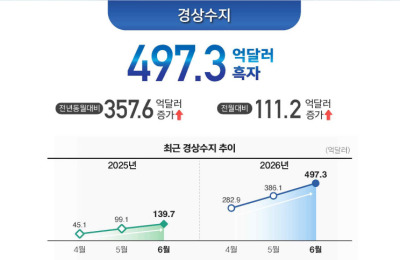
[서울=뉴스핌] 박가연 기자 = 지난 6월 우리나라의 경상수지가 전월에 이어 역대 최대 흑자를 기록했다. 반도체를 중심으로 한 정보기술(IT) 품목 수출 호조로 월간 상품수출이 처음으로 1000억달러를 넘어선 영향이다.
[자료=한국은행]
한국은행이 6일 발표한 '2026년 6월 국제수지(잠정)'에 따르면 지난 6월 경상수지는 497억3000만달러 흑자로 집계됐다. 전월(386억1000만달러)에 이어 두 달 연속 월간 기준 역대 최대 기록을 갈아치웠다. 이에 따라 올해 상반기 누적 경상수지 흑자는 1910억1000만달러를 기록했다.
경상수지 흑자를 견인한 것은 상품수지다. 6월 상품수지는 478억9000만달러 흑자를 기록하며 전월에 이어 역대 최대를 다시 썼다. 국제수지 기준 상품수출은 1123억7000만달러로 전년 동월 대비 84.5% 증가하며 월간 기준 처음으로 1000억달러를 넘어섰다. 상품수입은 644억8000만달러로 38.6% 늘었다.
통관 기준으로는 반도체 수출이 전년 동월 대비 196.9% 급증했고 컴퓨터·주변기기(SSD)는 282.7% 증가했다. IT 품목 수출은 160.4% 늘었으며 비IT 품목도 ▲석유제품(47.5%) ▲화공품(18.6%) ▲철강제품(17.9%) ▲승용차(6.1%) 등을 중심으로 18.6% 증가했다. 통관 기준 수입은 ▲원자재(30.5%) ▲자본재(35.3%) ▲소비재(16.4%)가 모두 늘었다.
서비스수지는 12억9000만달러 적자를 기록해 전월(-10억9000만달러)보다 적자 폭이 확대됐다. 여행수지는 외국인 입국자 증가와 유류할증료 인상 등에 따른 출국자 감소로 4억4000만달러 흑자를 기록했지만 지식재산권사용료수지는 전월 흑자에서 4억4000만달러 적자로 전환됐다.
본원소득수지는 배당소득을 중심으로 32억7000만달러 흑자를 기록해 전월(21억7000만달러)보다 흑자 폭이 확대됐다. 배당소득수지는 배당수입이 늘어난 데다 전월 분기배당에 따른 기저효과로 배당지급이 줄면서 25억6000만달러 흑자를 나타냈다.
금융계정 순자산은 6월 중 467억1000만달러 증가해 월간 기준 역대 최대 증가 폭을 기록했다. 종전 최대였던 올해 3월(369억9000만달러)을 넘어선 것이다. 직접투자에서는 내국인의 해외투자가 80억1000만달러, 외국인의 국내투자가 46억3000만달러 각각 증가했다.
증권투자에서는 외국인의 국내 주식 매도세가 이어졌다. 외국인의 국내 주식 투자는 차익실현 매도 등의 영향으로 316억1000만달러 감소하며 전월(-310억5000만달러)에 이어 역대 최대 순매도 기록을 다시 경신했다.
외국인의 국내 채권투자는 세계국채지수(WGBI) 자금 유입에도 분기 말 만기도래 영향으로 증가 폭이 줄어든 52억9000만달러를 기록했다. 내국인의 해외 증권투자는 주식을 중심으로 35억6000만달러 증가했다.
eoyn2@newspim.com
2026-08-06 08:00