


Understanding the FedWilliam Poole*President, Federal Reserve Bank of St. LouisDyer County Chamber of Commerce Annual Membership LuncheonDyersburg, Tenn.Aug. 31, 2006*I appreciate comments provided by my colleagues at the Federal Reserve Bank of St. Louis. Robert H. Rasche, senior vice president and director of research, provided special assistance. I take full responsibility for errors. The views expressed are mine and do not necessarily reflect official positions of the Federal Reserve System.--------------------------------------------------------------------------------Understanding the Fed People often ask me questions about the Fed, sometimes out of simple curiosity and sometimes out of a real need to know for business reasons. Portfolio managers, for example, have a real need to know. My remarks today reflect my effort to provide rather systematically some answers to common questions. And I will also answer questions that ought to be put to me, but usually are not. I hope that you will accumulate a list of questions I have not answered and pose them during the Q&A at the end of my speech. Please don’t hesitate to write to me with further questions or to dispute my answers. There is no reason why the Federal Reserve should be a mysterious organization—we ought to be responsive to your concerns, and we try to be.Obviously, I want to emphasize that the views I express here are mine and do not necessarily reflect official positions of the Federal Reserve System. I suspect that each of us involved in Federal Reserve policy would answer the questions somewhat differently and emphasize different things. In any event, I’ll offer my answers. I thank my colleagues at the Federal Reserve Bank of St. Louis for their comments, especially Robert H. Rasche, senior vice president and director of research, who provided special assistance. However, I retain full responsibility for errors.The Role of Economic Science in Monetary PolicyA very general question concerns the basis on which policy decisions are made. It is important to recognize that economists have developed a formal theory of monetary policy over the past 60 years or so and that this theory really does guide our thinking. The theory has two logical parts. One is a clear set of objectives, and the second is a specification of how policy affects the economy in pursuit of the objectives. The model of how the economy works is complicated, and I could not possibly begin to present it here. But I will say that our understanding of how the economy works is based on economic theory and an enormous body of empirical research that tests the theory. Our understanding is often qualitative and we know that we must attach standard errors to our numerical predictions. An active research program within the Federal Reserve and by academic and business economists continuously refines the theory and our empirical understanding. Let me use an analogy: Right now, at this time of year, we are in the most active part of the hurricane season. Hurricane forecasting has come a long way, but as anyone who watches the weather news knows the forecasts are not perfectly reliable. Ship captains have to make policy decisions on what courses to set, taking into account the forecasts and what is known about forecast accuracy. Economic policymakers have to make the same sorts of decisions based on incomplete knowledge.So, given policy objectives, and given a view about how policy decisions affect the economy, the central bank can in principle specify a policy rule, or response function, that guides policy. To achieve a good result, the general public and market participants need to understand the objectives and the response function so that the private economy can determine its activities with full knowledge of how the central bank will act. Of course, uncertainty is an inherent characteristic of the economic world. What should be predictable are the central bank’s responses to the never ending sequence of surprises that characterize the economic environment. Monetary Policy Objectives. Congress sets the mission of the Federal Reserve in the conduct of monetary policy. Originally, the Fed’s mission was specified in the Federal Reserve Act signed into law by President Woodrow Wilson in December 1913. The Fed’s current mandate, set formally in an amendment to the Federal Reserve Act in 1977 and reaffirmed in 2000, requires the Federal Reserve to pursue three objectives through its conduct of monetary policy. They are “maximum employment, stable prices and moderate long-term interest rates.”(1) Economists recognize that long-term interest rates incorporate a premium for expected inflation. Thus, the objectives of price stability and low long-term interest rates are essentially the same objective.This “dual mandate,” so-called because of its emphasis on both employment and price stability objectives, differs from that of some other central banks, especially the “inflation targeting” central banks that operate under an explicit agreement with their respective governments that defines price stability as the single objective and specifies a quantitative definition of the inflation objective. These banks include the Bank of Canada, the Bank of England and the Reserve Bank of New Zealand, among others. In a similar fashion, the European Central Bank is given a price stability mandate under the Maastricht Treaty, though the treaty does not give a numeric value or range to the European Central Bank. The ECB has interpreted its mandate to be inflation not to exceed two percent per annum over a “medium-term” horizon. Today, there is general agreement among professional economists and central bankers around the world that in the long run monetary policy cannot achieve a tradeoff between inflation and employment. Successive Fed chairman have emphasized that price stability not only is a mandated objective of monetary policy but also is the means by which monetary policy contributes to achieving the other two objectives. The view goes back at least to Chairman William McChesney Martin. “My interest in a monetary policy directed toward a dollar of stable value is not based on the feeling that price stability is a more important national objective than either maximum sustainable growth or a high level of employment, but rather on the reasoned conclusion that the objective of price stability is an essential prerequisite for their achievement.”(2) In his 1979 confirmation hearing, Chairman Paul Volcker stated: “I believe that ultimately the only sound foundation for continuing growth and prosperity of the American economy is much greater price stability.”(3) Early in his tenure, Chairman Alan Greenspan concurred in this view: “The Committee continued to focus on maintaining the economic expansion and on progress toward price stability, which was seen as a necessary condition for long-term sustained economic growth.”(4) In July 2006, Chairman Ben S. Bernanke acknowledged: The achievement of price stability is one of the objectives that make up the Congress’s mandate to the Federal Reserve. Moreover, in the long run, price stability is critical to achieving maximum employment and moderate long-term interest rates, the other parts of the congressional mandate.(5)I believe that we can go a step beyond these statements. In my view, the goal of price stability must be the primary goal for three reasons. First, in the long run employment and economic growth are maximized in an environment of price stability. Second, only in an environment of price stability and market confidence that the central bank will continue to maintain price stability will the central bank be in a position to act deliberately to offset many types of disturbances that would otherwise create fluctuations in employment and output. The Federal Reserve does not have the power to completely offset all such disturbances, but it can cushion their effects and thereby improve economic stability. Finally, price stability is a goal in its own right simply because price instability creates arbitrary and unfair redistributions of income and wealth.I have often noted that my own personal preference is to define “price stability” as a condition in which the rate of inflation, properly measured, is on average zero. I insert the qualifier “properly measured” to point out that actual price indexes may have statistical problems such that zero measured inflation on a particular price index might not in fact reflect a true state of zero inflation. Although my own preference is for zero inflation properly measured, I believe that a central bank consensus on some other numerical goal of reasonably low inflation is more important than the exact number chosen. Thus, I find that recent discussion of a “comfort zone” of 1-2 percent inflation measured by the price index for personal consumption expenditures, excluding the volatile food and energy components, is perfectly consistent with my own thinking.Note that the Congressional mandate to the Federal Reserve does not include any of numerous objectives that from time to time have been advocated by supporters of various interests; e.g. stable exchange rates, stable asset prices or housing investment. Clarity of objectives is an important attribute of monetary policy today and contributes greatly to its success.Systematic Policy. The dual nature of the Fed mandate is well summarized in “the Taylor rule.” In 1993, Stanford economist John Taylor proposed a simple formula relating the federal funds rate to: 1) a long-run inflation target, and 2) short-run deviations of inflation from that target and short-run deviations of real GDP from a measure of “potential real GDP.”(6) Taylor suggested that his simple relationship characterized in broad outline the actual behavior of the federal funds rate in the early years of the Greenspan FOMC. The essence of this relationship is that in the long-run the FOMC seeks to keep the federal funds rate roughly consistent with a level that is believed to produce a target level of inflation. Taylor assumed a target rate of inflation of 2 percent per year measured by the total Consumer Price Index (CPI). In the short run, the relationship implies that the FOMC adjusts the target federal funds rate up as either the observed inflation rate exceeds the target level of inflation or real GDP exceeds potential real GDP. Conversely, under the Taylor rule the FOMC reduces the target federal funds rate when inflation falls below its target and/or real GDP falls short of potential real GDP. Thus the relationship incorporates the primacy of a long-run inflation objective while incorporating short-run stabilization efforts. Figure 1 shows the actual value of the federal funds rate target on FOMC meeting dates starting in 1987 as well as a computed value based on Taylor’s original formula and the information available to the FOMC at the time of each meeting.(7) The inflation rate in the figure is the total CPI. Through 2000, the gap between real GDP and potential real GDP is the value measured by the staff of the Board of Governors at the time of each FOMC meeting. After 2000, the staff assumptions about the GDP gap are not yet publicly available, so the dotted line in the graph for this period is computed with the GDP gap as constructed by the Congressional Budget Office. Also beginning in 2000, the FOMC changed its inflation objective in two ways. First, the Committee emphasized the inflation rate as measured by changes in the price index for personal consumption expenditures—the PCE inflation rate—rather than the CPI inflation rate. Second, the Committee emphasized the core PCE index, which excludes the volatile food and energy components. Hence it is likely that after 2000 the Taylor formula does not accurately reflect the information used by the FOMC as input to its deliberations. Note that the target funds rate predicted by the Taylor formula generally tracks the actual funds rate through 2000, though there are sizable and persistent deviations of the funds rate from the values predicted by the formula. Nevertheless several of these episodes are consistent with a systematic monetary policy. First, in 1989 the FOMC increased the target funds rate more quickly than predicted by the formula suggesting that the Committee responded more vigorously to rising inflation than incorporated in the Taylor specification. Second, during 1990-91, the FOMC reduced the funds rate more quickly than predicted by the formula, suggesting a stronger response to the recession than incorporated in the Taylor specification. Third, between late September 1992 and February 1994 the target funds rate was held at a lower level (3 percent) than predicted by the Taylor specification. It was during this period that the FOMC expressed concern about “financial headwinds” that were restraining the recovery from the 1990-91 recession. Finally, in the fall of 1998 the FOMC lowered the funds rate when the Taylor specification predicted that the rate would be held constant. At this time, concern about financial stability figured strongly in policy deliberations in the wake of the Asian financial crisis, the Russian default and the near collapse of Long Term Capital Management, a large hedge fund. The FOMC, and certainly John Taylor himself, view the Taylor rule as a general guideline. Departures from the rule make good sense when information beyond that incorporated in the rule is available. For example, policy is forward-looking, which means that from time to time the economic outlook changes sufficiently that it makes sense for the FOMC to set a funds rate target either above or below the level called for in the Taylor Rule, which relies on observed recent data rather than on economic forecasts of future data. Other circumstances—an obvious example is 9/11—call for a policy response. These responses can be and generally are understood by the market. Thus, such responses can be every bit as systematic as the responses specified in the Taylor rule.Credibility of the Inflation Objective. A critical ingredient in the Taylor specification as a description of monetary policy is the long-run target rate of inflation. In practice, financial market participants and the public in general cannot adequately understand the Fed’s monetary policy—that is the strategic thinking that guides the sequence of individual policy actions—without a good understanding of what the FOMC considers to be an acceptable long-run average rate of inflation. When monetary policymakers articulate their goal for long-run inflation and pursue credible policies to achieve that goal, they provide the basis for “anchoring” the inflation expectations that guide consumption behavior of households and investment decisions of firms. Inflation expectations also determine the inflation premiums in nominal interest rates that are required to bring financial markets into balance.Evidence suggests, particularly in the U.S. economy, that the actual inflation experience is driven by inflation expectations, resource utilization—usually measured by a gap term as in the Taylor Rule—and “supply shocks” such as changes in the world market prices of energy and other commodities. Of these, the most significant factor historically has been the influence of inflation expectations. Hence, when the anchor for inflation expectations begins to drag, actual inflation becomes volatile, and the resulting distortions to economic activity and conditions in financial markets produce significant disruptions in the economy. The most recent severe example from our economic history of inflation expectations getting out of control occurred in 1977-79.It is a terrible thing if monetary policy makers lose credibility that they will maintain low and stable long-run inflation. Once credibility is impaired, it can only be reestablished the “old fashioned way”—policymakers have to earn it! Restoring credibility takes time in the face of substantial persistence in the actual inflation process. It took well over a decade to completely restore low inflation in the United States after the Great Inflation of the 1970s, and in the process the economy experienced the worst recession, 1981-82, since the Great Depression.Interpreting New Information Financial market participants form expectations with respect to the prospective state of the economy from evidence of the current state of the economy as indicated in regular data releases and other activities, such as political events and policy actions, that influence economic activity and market prices. The evidence for such forward looking expectations is widespread. Futures contracts in commodities, interest rates and foreign exchange are actively traded in large volume on organized exchanges. Surveys of forecasts of forthcoming data releases appear regularly (e.g. The Ticker which appears every Monday in the Wall Street Journal and the Calendar of Releases that appears each Friday on the cover page of U.S. Financial Data published by the Federal Reserve Bank of St. Louis).(8) Prices in financial markets respond to differences between the observed information on the economic situation and the expectations about such information—that is, markets respond to “news.”There are many claims but no convincing documented evidence of lagged responses to “news.” Economic theory suggests that market prices of assets should behave like random walks—that the accumulated information at a point in time should have no predictive power for future changes in prices. Put another way, new information is quickly reflected in market prices, leaving no remaining predictable change in market prices that would permit an investor to expect an above normal return from buying or selling the asset. A huge body of empirical research is broadly consistent with this hypothesis. Thus, market commentaries that today’s market adjustments are caused by, or due to, continuing concerns over implications of old information are of doubtful validity. Traders, financial journalists and economic pundits seem to believe that they have to attribute market adjustments to something, even when there is no evidence to support the asserted reasons. An analyst who is presumed to be an expert ought often to say that price changes appear inexplicable or random. But few experts, in fact, say such a thing. Therefore, I recommend that the wary observer be skeptical about purported explanations for price changes and should always check an explanation against behavior in other markets. In my experience, explanations for stock market fluctuations are especially suspect. In recent years I have often read claims that the stock market went down because of fears of rising interest rates only to find that interest rates in the bond market were unchanged, or went down instead of up. Given that so many institutions deal in both the equity and bond markets, it makes absolutely no sense that interest rate fears could drive down stock prices and have no effect on interest rates.This problem arises primarily because traders make the mistake when talking with reporters, who then pass along the mistake. My plea to reporters is to press traders about the logic of their arguments and to note in their stories when a claim about what caused a stock market adjustment seems not to be consistent with other information. And my plea to you is that you always check the consistency of claimed causes with other information.Traders do not confine their misleading causal statements to the Fed. As I happened to be working on this speech one afternoon in mid-August, the Dow Jones average closed that day down over 90 points, attributed by at least one report to “oil price fears.” Looking at trading in the oil markets, I discovered that September oil futures on the NYMEX exchange closed up only four cents and October futures closed down 19 cents. Does it make any sense to attribute a stock price drop to fears of oil price increases when oil prices did not increase?Clearly, Federal Reserve policy adjustments and market expectations about future policy adjustments do explain some stock market fluctuations. I accept that fact. Indeed, the transmission mechanism linking monetary policy decisions to changes in the inflation rate and employment require such effects in financial markets. But, I really don’t want to be held responsible for stock market fluctuations that occurred for other reasons or are simply inexplicable! So, next time you read that the stock market went down because of “interest-rate fears,” please do take a quick look at the bond tables to see if interest rates actually changed that day.New information drives both market adjustments and policy changes. Policy decisions ordinarily cannot be set long in advance because the FOMC must be open to changing its policy stance in response to new information, which is inherently unpredictable. To gain a sense of the impact of new information on interest rates, I’ll analyze data from the Eurodollar futures market. Eurodollar deposits are not federal funds, though changes in the two yields are highly correlated. To study market expectations about the federal funds rate over horizons of four or more months, it is best to use Eurodollar futures because these contracts are actively traded over far future horizons whereas trading of fed funds futures is relatively thin on horizons of more than a few months. Prices in the Eurodollar futures market provide direct information on market expectations of future FOMC policy actions setting the target federal funds rate. Consider the forecasting record on three-month and six-month horizons. Figure 2 focuses on the difference between the yield on a three-month Eurodollar futures contract with three months to maturity and the actual Eurodollar deposit yield. This difference is plotted on the horizontal axis against the actual change in the yield on Eurodollar deposits over the corresponding three months to the maturity date on the vertical axis. Thus, the three-month actual change in the Eurodollar deposit rate is plotted against the forecasted change in the Eurodollar deposit yield over the same time period. The observations are taken every three months starting in December 1994.(9) The same exercise is repeated at a six-month horizon in Figure 3.In each of the two graphs the diagonal line from the lower left to the upper right represents a line of perfect forecasts—if all the points lay along this line the Eurodollar futures market would never have made any errors in forecasting the change in the Eurodollar yield over the succeeding three (six) months. It is evident from the figures that the futures markets fall short of such perfection. In fact over the entire period the correlation between the forecast changes and the actual changes on a three-month horizon is only 0.65; on the six-month horizon the correlation falls to 0.54. As an aside, note that economists and statisticians usually measure forecasting accuracy by the square of the correlation coefficient, or R2. Thus, a correlation of 0.65 is an R2 of 0.42, which means that the forecasts embedded in the Eurodollar futures market explain 42 percent of the variance of fluctuations in the actual Eurodollar yield. Thus, unpredictable events even over a three-month horizon are responsible for more than half of the variance of the Eurodollar yield. Over a six-month horizon, the R2 is 0.29, which means that unpredictable events are responsible for more than 70 percent of the variance over a six-month horizon.The overall correlations mask some interesting details. The points plotted in red in each figure represent observations since the middle of 2003 when the FOMC started providing “forward guidance” regarding future policy actions. Note that these points scatter fairly tightly around the line of perfect forecasts—markets were not particularly surprised by the evolution of policy actions over this period. In contrast consider the forecasts for the first half of 1995. The three-month and six-month futures market forecasts in December 1994 were for large positive changes in the Eurodollar deposit rate over the succeeding three and six months. In the event, the Eurodollar deposit rate fell a bit over these horizons. The December 1994 futures prices were observed shortly after the FOMC increased the funds rate target by 75 basis points in November 1994 and the market had expected further substantial increases. In fact, the FOMC increased the funds rate target by only 50 basis points in the first half of 1995 (at the January FOMC meeting). Another large miss occurred in December 2000. At that time, the futures market forecasts were for a decline in the Eurodollar yield of 35 basis points over the following three months and a total of 67 basis points over the 6-month period. Instead, the FOMC acted aggressively to lower the funds rate target starting in January and continuing through May 2001 by a total of 250 basis points. The FOMC acted aggressively as incoming information pointed to growing weakness in economic activity. Both the FOMC and the markets were surprised by incoming information indicating that the economy was weakening quickly and significantly.It is rare that a single data report is decisive for the FOMC. The economic outlook is determined by numerous pieces of information. Important data such as the inflation and the employment reports are cross checked against other information. The FOMC is aware of possibility of data revisions and short-run anomalies. My key point is that market commentary indicating that the FOMC is unpredictable is off base. Typically the FOMC cannot be predictable because new information driving policy adjustments is not predictable. All of us would like to be able to predict the future. We in the Fed do the best we can, but the markets should not complain that the FOMC lacks clairvoyance! What the FOMC strives to do is to respond systematically to the new information. There is considerable evidence that market does successfully predict FOMC responses to the available information at the time of regularly scheduled meetings.(10) FOMC ProcessesThe Board of Governors and the Reserve banks are fortunate to have highly professional, non-political, staffs of economists. The role of the staff is to provide analysis of current economic conditions, forecasts of the evolution of the economy over a horizon of a couple of years and assessments of the risks to those forecasts. Such information is a valuable and valued input into policy discussions. I myself do not finally make up my mind on my policy position until I’ve heard both staff presentations and the views of other FOMC participants. More accurately, I go into each FOMC meeting with a view on the appropriate policy action given my assessment of the economic outlook, but I try to be as open as I can to having my view altered by discussion at the FOMC meeting. There are certainly instances when I have changed the view I took into the meeting as a consequence of the discussion.Distinction between members and participants. Except when there are vacancies in offices, there are 19 principals, or participants, at each FOMC meeting—the 7 members of the Board of Governors and the 12 Reserve bank presidents. All of these participants are fully engaged in presenting their views. They bring information from their business and academic contacts, comment on staff presentations, discuss analytical issues relevant to understanding the economy and policy issues, and present their views as to the most appropriate policy action. However, at any particular meeting there are only 12 voting members of the Committee. Each of the seven members of the Board of Governors is a permanent member of the FOMC. The president of the Federal Reserve Bank of New York is also a permanent member. The remaining Federal Reserve bank presidents rotate as members of the FOMC. As president of the Federal Reserve Bank of St. Louis, I am in a rotation group with the presidents of the Federal Reserve banks of Atlanta and Dallas. This structure of the FOMC dates from 1942. In the early years of the FOMC, not all the principals were allowed participate, or even attend, meetings at which they were not voting members of the committee.The purpose of FOMC meetings is to reach a consensus among the participants, and particularly among the members about the appropriate policy action (setting of the funds rate target) given policy goals and the outlook for the economy. Unanimous decisions, while desirable, are not required and members are free to dissent from the consensus view if they feel strongly that an alternative policy action is preferable. Indeed, I believe that it is my obligation under the Federal Reserve Act to dissent when I believe strongly that an alternative policy course would be better. Historically, dissents were not unusual though in the recent years they have been relatively rare.Communication. Once policy action has been set, it is absolutely necessary that communication to the public about the policy action not be garbled. Hence, the Chairman is the only participant who speaks officially for the Committee. He presents official Federal Reserve positions through testimony before Congressional committees and in public speeches. The minutes of each FOMC meeting also represent the official position of the committee. Incidentally, for many years the minutes were released just following the subsequent meeting but are now released in timely fashion three weeks after the meeting to which they apply. Participants other than the Chairman express their own views in speeches. These speeches often may seem to reflect a “party line” but are rarely centrally coordinated in any way. In my experience, the only time there has been a real effort to coordinate public comments by the participants was in the late summer of 1998. At that time financial markets were skittish as a result of the Russian default and financial troubles of Long-Term Capital Management. I recall an informal gathering in the late summer of 1998 with Chairman Greenspan and a couple of other FOMC members when the chairman made a request that we say very little given the rather tense state of the markets as the LTCM situation unfolded. Seeming coordination at other times is a consequence of the fact that FOMC participants ordinarily see things quite similarly. But most participants are not shy about expressing their differences. Differences are registered in a formal way through dissents at FOMC meetings, discount rate decisions of the boards of directors of the Reserve banks, which may or may not reflect the views of Reserve bank presidents, and informally through positions stated in speeches. Anyone can obtain an excellent feel for what goes on at an FOMC meeting by reading transcripts that are released with a lag of five years and are made available on the web site of the Board of Governors.Dealing with the Press Different FOMC participants have different attitudes and comfort levels in dealing with the press. I myself give many speeches and almost always talk with press after my speeches. I try to be as clear as I can, but from time to time I realize after the fact that I did not express myself as clearly as I would like. When reading press accounts, be aware that FOMC members misspeak from time to time and press interpretations are not always as intended. We all try to be as careful as possible but are not infallible. Be wary of headlines. Reporters will tell you that they are sometimes frustrated with the headlines that appear over their stories. Be aware also that wire service reporters, in an effort to emphasize the most market-relevant information, may not transmit all the nuances that an FOMC participant was trying to convey in an interview. Considerations behind policy adjustments are often complex—be cautious about simple interpretations. I believe that one of my responsibilities is to communicate to a wider audience through the press, doing the best I can to be accurate and to convey both policy fundamentals and policy nuances. A well-informed public is essential to an effective monetary policy. In my experience, press reports are generally, but not always, accurate. The financial journalists with whom I interact are genuinely interested in getting the story right. They do ask probing questions, as they should, but do not try to impose their own personal slant to the reports they publish. Inaccuracies are generally a consequence of the complexity of the subject and the need, on my part and the journalists’ part, to make reports simple enough for a wide audience to understand. When talking with the press, one of the points I emphasize is that I do not come to a firm conclusion about my policy position until just before the FOMC meeting, and even then do my best to maintain an open mind which can be changed by the staff presentation and general discussion at the meeting itself. I have already documented the most important reason for this policy of mine. Inherently unpredictable information can arrive right up to the day of the meeting. It would not be sound practice for policymakers to lock themselves into decisions impervious to new information. Another reason why I ordinarily do not have a settled policy position weeks before an FOMC meeting is this: I follow economic reports continuously between FOMC meetings, but do not ordinarily dig deeply into them until the period of intense preparation the week before an FOMC meeting. Thus, my views on incoming information are often tentative and incomplete; I know that I’ll be reviewing all available information in the intense preparation period. I believe that it would not be helpful to the markets for me to convey views that I know are tentative and incomplete; thus, I try not to speculate about the significance of new information for the policy decision to be debated at the next FOMC meeting. My responsibility is to convey accurate information and, equally, not to be a source of misleading or inaccurate interpretations of incoming information.Bottom LineThe Federal Reserve has a responsibility to provide leadership. The ideal situation is when the market can reasonably predict what the Fed is going to do because the Fed has provided the leadership to make clear its objectives and how it pursues those objectives. The Fed is not and ought not to be viewed as an adversary of the markets. Policy actions and statements do have market effects. Those are unavoidable, but the Fed strives to make policy as clear as it can so that what is really surprising the markets is not Fed actions but the arrival of new information that surprises the Fed and the market together.I’ve tried to answer questions that are commonly put to me, and to provide a general framework for better understanding of the Federal Reserve. I hope that I have provoked some additional questions—fire away. References1. Ben S. Bernanke, “Remarks,” Center for Economic Policy Studies, Woodrow Wilson School of Public and International Affairs, Princeton University, Princeton NJ, February 24, 2006: 2. Letter from W. McChesney Martin to Senator Paul Douglas, December 9, 1959, p.5. 3. “Hearings on the Nomination of Paul W. Volcker to be Chairman, Board of Governors of the Federal Reserve System,” Committee on Banking, Housing and Urban Affairs, United States Senate, Ninety-sixth Congress, first session, July 30, 1979, p. 20.4. Testimony, Committee on Banking, Finance and Urban Affairs, United States House of Representatives, February 28, 1988. Reprinted in the Federal Reserve Bulletin, April 1988, p. 227.5. Ben S. Bernanke, Testimony, Committee on Banking, Housing and Urban Affairs, U.S. Senate, July 19, 2006: 6. John B. Taylor, “Discretion versus Policy Rules in Practice,” Carnegie-Rochester Conference Series on Public Policy, 39, December 1993, pp.195-214. Taylor compared the values of his formula against the observed history of the funds rate from 1987 through 1992.7. In the figure, the Taylor formula is evaluated on the basis of “real–time” information that could have been used in reaching a policy decision. Since May 17, 1989, all changes in the intended funds rate have been 25 basis points or multiples thereof. Since April 18, 1994, all changes in the intended funds rate have been voted on by the FOMC either at a regularly scheduled meeting or on an intermeeting conference call.8. The latter data are from a survey conducted by Thomson Financial.9. Hence the observations are non-overlapping.10. See for example: William Poole, How Predictable is Fed Policy?, October 4, 2005,

[관련키워드]




[뉴스핌 베스트 기사]
 사진
사진
정동영 업무보고 논란
[서울=뉴스핌] 유신모 외교전문기자 = 청와대 영빈관에서 5일 열린 외교·안보 분야 정부 부처의 대통령 업무보고에서 정동영 통일부 장관의 '한반도 평화공존 발전 구상'과 업무보고 발언이 논란을 빚고 있다.
이날 정 장관의 발언 중에는 정부 내 조율을 거치지 않은 사안을 정책으로 추진하겠다고 공언한 것이 있는가 하면 사실 관계에 맞지 않은 설명도 있었다. 이재명 대통령은 공개적으로 신중을 기해 달라고 경고했고, 조현 외교부 장관은 '이상주의적 희망에 근거한 비현실적 구상'이라는 비판을 내놨다.
그동안 정 장관의 대북 정책 관련 발언이 물의를 빚은 적은 여러 번 있지만 대통령과 유관 부처 장관이 공개적으로 부정적 입장을 표명한 것은 이례적이다. 정 장관의 무리한 대북 접근법과 월권을 제어해야 한다는 목소리도 높아지고 있다.
[정동영 통일부 장관이 지난달 23일 오후 서울 종로구 정부서울청사에서 취임 1주년 기자간담회를 하고 있다. [사진=통일부] 2026.07.23
◆통일부 장관 권한 넘어선 주장
정 장관은 이날 업무보고에서 '한반도 평화공존 발전 구상'을 설명하면서 이재명 정부 2년차 핵심 과제로 상호 존중·평화적 갈등 해결·핵 없는 한반도 등 3대 기본 방향을 제시했다.
정 장관은 "대결과 혐오의 언어는 멈춰야 한다"면서 주적 용어 대체를 주장했다. 지난 25년간의 CVID(완전하고 검증가능하며 되돌릴 수 없는 비핵화) 구도는 이미 무너졌다고도 했다. 또 "현 시점에서 흘러간 선(先)비핵화만 되뇌는 것은 현실을 바꾸는 데 힘이 되지 않는다"고 주장했다. 정 장관은 또 "정전 체제를 평화 체제로 바꾸는 논의에 착수하겠다"면서 "북·미 정상회담 견인과 함께 4자 대화의 동력을 확보하기 위해 최선을 다할 것"이라고 말했다.
하지만 이 대통령은 정 장관의 구상에 대부분 제동을 걸었다. 이 대통령은 "평화공존 정책이 정치적으로 악용되는 측면이 있다"며 "많이 조심하셔야 한다"고 지적했다.
북한을 다른 이름으로 불러야 한다는 주장에는 "표현에 꼬투리가 잡혀 정쟁으로 휘몰아 들어가면 원래 하고자 했던 데에서 오히려 나쁜 상황이 초래될 수 있다"고 경고했다.
이 대통령은 남북 신뢰 구축을 위해 9·19 군사합의를 선제적으로 복원해야 한다는 정 장관의 주장에 대해서도 "우리의 선의대로 하는 게 과연 한반도의 평화와 안정에 플러스냐, 결론적으로 약간의 의문이 들 때도 있다"며 부정적으로 반응했다.
조현 외교부 장관은 업무보고 사후 브리핑에서 정 장관이 언급한 '4자 회담'에 대해 "이상주의에 근거한 어떤 희망이라 하더라도 그건 아직 조율되지 않은 방법"이라며 "여러분들께서 디스카운트해 주시면 좋겠다"고 선을 그었다.
정 장관이 9월 러시아 블라디보스토크에서 열리는 '동방경제포럼(EEF)'을 언급하며 "정부 차원에서 (참석을) 검토하고 있다"고 발언한 데 대해서도 조 장관은 "그것은 외교부의 몫"이라며 "아직 거기까지 진도가 나가지 않았다"고 잘랐다.
정 장관이 이날 소개한 대북 구상과 설명은 정부 내 조율을 거치지 않았다는 점에서 문제가 있다. 특히 주적 표현 대체와 국호 사용, 9·19 군사합의 복원, 4자회담 추진 등은 통일부 장관이 결정할 사안이 아니어서 월권이라는 지적이 나오고 있다. 이 대통령은 정 장관의 업무보고를 듣고 난 뒤 "여기 업무보고에 발표했다고 승인난 건 아니다"라고 재차 확인했다.
정부의 한 소식통은 "정 장관의 발언 내용은 대부분 국가안전보장회의(NSC)를 거쳐 결정된 사안이 아닌 정 장관의 개인적 생각에 가깝다"며 "안보 관련 부처 장관이 정부의 공식 정책이 아닌 사안을 추진하겠다고 업무보고를 하고 대통령의 면전에서 '국군통수권자가 나서야 한다'고 주장한 것은 심각한 문제"라고 지적했다.
이재명 대통령이 5일 청와대 영빈관에서 열린 통일 외교 국방 등 외교 안보 부처 업무보고에서 발언하고 있다. [사진=청와대] 2026.08.05
◆시대착오적 접근, 대북 인식 오류
더욱 문제인 것은 정 장관의 이같은 주장이 현 시점에서 이미 참고가 될 수 없는 과거의 경험 또는 사실과 다른 인식에 기반하고 있다는 것이다. 정 장관이 주장하는 구상은 급격히 변화하고 있는 북한의 전략과 한반도 및 국제 정세를 전혀 반영하지 못하고 있다는 비판이 제기되고 있다.
정 장관이 "흘러간 선(先)비핵화만 되뇌는 것은 현실을 바꾸지 못한다"고 언급한 것은 지금까지의 대북 접근법을 호도하고 있다. 북핵 위기 발발 이후 지금까지 모든 핵 협상에서 한국이나 미국은 북한에 선비핵화를 공식적으로 요구한 적이 없기 때문이다.
지금까지의 북핵 협상은 북한의 비핵화 조치에 한·미가 상응하는 대가를 제공하는 방식으로 이뤄졌다. 1994년 북·미 제네바 기본합의는 핵시설 동결과 중유 제공의 교환이었다. 2005년 9.19 공동성명도 북한의 비핵화 조치의 모든 단계에 상응조치를 제공하는 '행동 대 행동' 원칙이 적용됐다.
대북 협상에 관여했던 한 전직 관료는 "모든 북핵 협상은 북한의 비핵화 조치와 한·미가 제공하는 상응조치를 어떻게 정교하게 배열하느냐가 관건이었다"면서 "정 장관의 발언은 지금까지 한·미가 북한에 먼저 핵을 포기해야 대화할 수 있다는 정책을 고수해 현 상황에 이르게 됐다는 잘못된 인식에서 비롯된 것으로 보인다"고 말했다.
정 장관이 "지난 25년간의 CVID 구도가 무너졌다"고 말한 것도 비핵화의 개념에 대한 이해 부족이라는 비판이 제기되고 있다. 북핵 문제에 정통한 외교 소식통은 "어떤 명칭을 붙이든 핵을 제거한 뒤 이를 검증하고 재발 방지 조치를 하는 것은 비핵화에 반드시 포함되어야 하는 기본적 절차"라며 "CVID는 안 된다고 말하는 것은 북한의 비핵화 조치를 검증도 하지 않고 언제든 되돌릴 수 있도록 합의하자는 말과 같다"고 지적했다.
[서울=뉴스핌] 이길동 기자 = 조현 외교부 장관이 5일 오후 서울 종로구 정부서울청사 별관에서 2026년 하반기 업무보고 사후브리핑을 하고 있다. 2026.08.05 gdlee@newspim.com
◆안보 리스크 키우는 통일부 장관
정 장관은 지난해 취임 직후부터 청와대와 외교부를 제치고 통일부가 북한과 관련된 모든 정책을 주도해야 한다는 주장을 펴면서 단독 질주를 거듭해왔다.
북한의 '적대적 두 국가' 주장을 변형한 '평화적 두 국가'를 지향해야 한다고 주장하면서 이에 문제점을 지적하는 목소리를 무시했다. 외교부가 미국과 북한 문제를 논의하는 것에 대해 "한반도 정책과 남북관계는 주권의 영역이며 동맹국과 협의의 주체는 통일부"라고 주장해 물의를 빚었다. 문재인 정부 시절 한·미 워킹그룹이 남북관계 파탄 원인이었다고 사실과 다른 주장을 폈다.
지난해 업무보고에서는 국제정세를 감안하지 않고 남북대화 재개에만 초점을 맞춘 비현실적 내용으로 논란을 빚었다. 정부 내 조율도 거치지 않고 독자 대북제재인 5·24 조치를 해제하고 9·19 군사합의 비행금지구역 복원을 추진하겠다는 방침도 밝혔다.
지난 4월에는 평안북도 구성시에 우라늄 농축 시설이 있다고 말해 파장을 일으켰다. 미국은 이 발언을 계기로 한국과 대북정보 공유를 제한했다. 이 조치는 지금도 계속되고 있는 것으로 알려졌다.
정 장관이 이처럼 정부의 공식 결정을 거치지 않은 사안을 정부 정책인 것처럼 주장하며 좌충우돌하는 배경에 대해 여러가지 해석이 나온다. 북한 문제에서 조기에 성과를 거둬야 한다는 조급증과 자신의 존재감 과시 욕구가 작용하고 있다는 평가가 많다.
일각에서는 정 장관이 2007년 민주당 대선후보였을 때 이재명 대통령이 캠프에서 비서실 부실장으로 활동한 전력이 있다는 것을 들어 "정 장관이 아직도 이 대통령을 아랫사람으로 생각하고 있는 것 아니냐"는 비판을 내놓기도 한다.
한·미 관계와 북한 문제를 오래 다뤘던 전직 관료 출신의 한 전문가는 "정 장관 취임 후 지금까지의 언행은 잘못된 현실 인식에 따른 독단과 앞서 가기, 월권 등으로 점철돼 있다"면서 "통일부 장관이라는 중요한 직책에 있으면서 스스로 안보 리스크를 키우는 역할만 했다"고 비판했다.
opento@newspim.com
2026-08-06 06:10
 사진
사진
6월 경상수지 최대 흑자
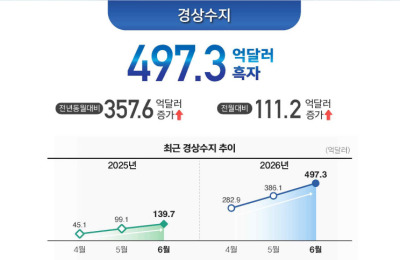
[서울=뉴스핌] 박가연 기자 = 지난 6월 우리나라의 경상수지가 전월에 이어 역대 최대 흑자를 기록했다. 반도체를 중심으로 한 정보기술(IT) 품목 수출 호조로 월간 상품수출이 처음으로 1000억달러를 넘어선 영향이다.
[자료=한국은행]
한국은행이 6일 발표한 '2026년 6월 국제수지(잠정)'에 따르면 지난 6월 경상수지는 497억3000만달러 흑자로 집계됐다. 전월(386억1000만달러)에 이어 두 달 연속 월간 기준 역대 최대 기록을 갈아치웠다. 이에 따라 올해 상반기 누적 경상수지 흑자는 1910억1000만달러를 기록했다.
경상수지 흑자를 견인한 것은 상품수지다. 6월 상품수지는 478억9000만달러 흑자를 기록하며 전월에 이어 역대 최대를 다시 썼다. 국제수지 기준 상품수출은 1123억7000만달러로 전년 동월 대비 84.5% 증가하며 월간 기준 처음으로 1000억달러를 넘어섰다. 상품수입은 644억8000만달러로 38.6% 늘었다.
통관 기준으로는 반도체 수출이 전년 동월 대비 196.9% 급증했고 컴퓨터·주변기기(SSD)는 282.7% 증가했다. IT 품목 수출은 160.4% 늘었으며 비IT 품목도 ▲석유제품(47.5%) ▲화공품(18.6%) ▲철강제품(17.9%) ▲승용차(6.1%) 등을 중심으로 18.6% 증가했다. 통관 기준 수입은 ▲원자재(30.5%) ▲자본재(35.3%) ▲소비재(16.4%)가 모두 늘었다.
서비스수지는 12억9000만달러 적자를 기록해 전월(-10억9000만달러)보다 적자 폭이 확대됐다. 여행수지는 외국인 입국자 증가와 유류할증료 인상 등에 따른 출국자 감소로 4억4000만달러 흑자를 기록했지만 지식재산권사용료수지는 전월 흑자에서 4억4000만달러 적자로 전환됐다.
본원소득수지는 배당소득을 중심으로 32억7000만달러 흑자를 기록해 전월(21억7000만달러)보다 흑자 폭이 확대됐다. 배당소득수지는 배당수입이 늘어난 데다 전월 분기배당에 따른 기저효과로 배당지급이 줄면서 25억6000만달러 흑자를 나타냈다.
금융계정 순자산은 6월 중 467억1000만달러 증가해 월간 기준 역대 최대 증가 폭을 기록했다. 종전 최대였던 올해 3월(369억9000만달러)을 넘어선 것이다. 직접투자에서는 내국인의 해외투자가 80억1000만달러, 외국인의 국내투자가 46억3000만달러 각각 증가했다.
증권투자에서는 외국인의 국내 주식 매도세가 이어졌다. 외국인의 국내 주식 투자는 차익실현 매도 등의 영향으로 316억1000만달러 감소하며 전월(-310억5000만달러)에 이어 역대 최대 순매도 기록을 다시 경신했다.
외국인의 국내 채권투자는 세계국채지수(WGBI) 자금 유입에도 분기 말 만기도래 영향으로 증가 폭이 줄어든 52억9000만달러를 기록했다. 내국인의 해외 증권투자는 주식을 중심으로 35억6000만달러 증가했다.
eoyn2@newspim.com
2026-08-06 08:00