


Remarks by Michael H. MoskowPresident and Chief Executive OfficerFederal Reserve Bank of ChicagoMcLean County Chamber of CommerceEconomic Vision LuncheonInterstate CenterBloomington, ILAugust 22, 2006 U.S. Economic Outlook*At its August meeting, the FOMC announced no change in the federal funds rate target, for the first time in 17 meetings. The front page headline of the Chicago Tribune was "Fed Stops Here." The Financial Times of London, however, had a different perspective. It argued that a careful reading of the statement accompanying the decision indicated just a pause in the rate cycle. To me these two stories illustrate the uncertainties of making monetary policy in today's complex economy.In addressing the current situation, three questions present themselves—regarding growth, inflation, and monetary policy. In terms of economic growth, the U.S. economy is decelerating from what have been relatively high growth rates over the last three and a half years. The first key question is: how will this deceleration in activity settle out? That is, will the current moderation in growth provide some counterweight against potential resource strains—or how likely is it that the moderation builds into a more significant slowing in economic activity?On the pricing front, core inflation has increased and now stands above the 1 to 2 percent range, which several policymakers—including myself—have identified as a comfort zone for inflation, or a zone consistent with price stability. So, the second key question is: when will inflation return to the comfort zone?In terms of monetary policy, the third key question is: how should policy react to these developments going forward? That is, against the backdrop of our policy goals, how should we assess the cross-currents and weigh the uncertainties about growth and inflation?In my remarks today, I'd like to give you my perspective on these three questions.Growth outlookTo start, it is useful to remember the Federal Reserve's policy mandate. In accordance with the Federal Reserve Act, the primary goals of monetary policy are to achieve maximum employment and price stability. For a variety of reasons, each of these goals requires some interpretation. One might take price stability to literally mean a flat level of prices, or zero inflation. But, as I'll discuss later, an inflation rate of zero isn't the best operational goal, so instead policymakers interpret price stability to be a low and stable rate of inflation. Similarly, maximum employment might be taken to literally mean that every person of working age has a job. But, at any given moment in time, many men and women voluntarily choose not to work and some are not employed because they are changing jobs. So instead, we focus on achieving maximum sustainable growth, which in turn creates the job opportunities that lead to the highest sustainable levels of employment.To set a benchmark for maximum sustainable growth, we often use a concept called potential output growth, or potential GDP growth. (GDP, or gross domestic product, is our broadest measure of economic output.) The potential growth rate of the economy depends primarily on two factors: how fast productivity grows and how fast the labor force grows.Productivity, which measures how much output can be produced by an hour's worth of work, receives most of the attention, in part because of the dramatic change we have seen in it during the past decade. Productivity growth had averaged less than 1-1/2 percent per year between the early 1970s and mid-1990s, but since then it has averaged over 2-1/2 percent per year.The sector with the most dramatic acceleration in productivity is manufacturing. Manufacturing productivity growth averaged 2.5 percent per year from the 1950s to the 1970s. But things changed beginning in the 1970s, as significant technological advancements spread through the manufacturing sector. For example, many manufacturers began investing in computer numerical code machine tools. These cut curves as easily as straight lines and build complex 3-D structures efficiently, thus reducing the number of machining steps that required human action. Other advances in technology, improvements in logistics, and better management of the workplace also created efficiency gains. Manufacturing productivity growth took off, averaging 2.9 percent per year in the 1980s, 3.8 percent in the 1990s, and then 5.0 percent during the past 5 years.These productivity gains are good for the country overall. But we should recognize that they aren't good for everyone. The human costs of this process can be significant, as individual workers are forced to change jobs or move into new industries. Many of these costs have been felt most acutely here in the Midwest.I do not want to minimize the impact of the job losses associated with changes in the economy, no matter what their source. We should strive to ease the transition for the impacted workers and their families, whether it is through financial assistance, retraining programs, or other efforts.But dynamic changes in the economy are important if we are to continue to increase overall incomes and our standard of living. Commentators often point to our manufacturing job losses as a sign that we are losing our edge in manufacturing. In fact, the job losses are an unfortunate consequence of the strength of productivity in the manufacturing sector. Even as the number of manufacturing jobs declines, factories in the United States are producing record volumes of machinery, computers, motor vehicles, plastics, and other manufactured goods—and in general they are producing them at lower costs—all due to strong productivity growth.Indeed, the underlying trends in productivity for manufacturing and other sectors of the economy remain quite solid today, and should continue to support a healthy growth rate of potential output.The other factor that affects potential output—the size of the available labor force—receives less attention. But, as our demographics change, it deserves more scrutiny. The growth in the labor force is slowing, reducing the potential growth rate of GDP. It also affects our benchmarks for one of the most closely watched economic statistics: payroll employment.There are two components to labor force growth: growth in the working-age population, and changes in how many people in that group participate in the labor force. Growth in the working-age population has slowed to 1.2 percent per year over the last 10 years, compared to a peak of nearly 2 percent in the mid-1970s. Over the next decade, it's projected to slow a bit further. These developments reflect the demographics of the baby boom and echo boom generations and patterns of immigration.The labor force participation rate, which measures the proportion of the population aged 16 and older that is working or actively looking for work, is also declining. The participation rate had been rising for many years, but it likely reached a peak in the late 1990s, and should continue to trend down over the next several years. Several factors are at work, but most importantly, labor force participation will be pushed down as the baby boomers wind down their careers, therefore increasing the share of the population that is retired. In addition, the long-running increase in women's participation has leveled off, and the long-running decline in men's participation continues.So the trends in both the growth of the population and labor force participation point to slower growth in the labor force. This has important implications for our benchmarks for the monthly employment statistics. Earlier in the decade, most economists estimated that job growth of about 150,000 per month was consistent with an economy expanding near potential. However, research at the Chicago Fed and elsewhere suggests that, given the slower growth in the labor force, monthly increases of roughly 100,000 are most likely consistent with potential.1 This transition has not yet been fully appreciated by market observers. In each of the past three months, financial markets have expected job growth of about 160,000 on average. When actual job growth averaged just above 100,000, many analysts interpreted this as a sign that the economy is growing slower than its potential. In contrast, we at the Chicago Fed see these numbers as actually consistent with an economy moving ahead at about its potential.That said, these changes in labor force growth also imply that, in the absence of changes in productivity trends, our estimates of potential GDP growth should be revised down 2 or 3 tenths of a percentage point to near 3 percent.Against this 3 percent figure, it is clear that the actual GDP growth rate of 3-1/2 percent that we experienced during the past few years is not sustainable. While it is natural for growth to be above trend for a time after a recession, the last recession ended almost five years ago. Consequently, a deceleration to average growth rates is only natural. If the economy continued to expand above potential, imbalances would develop that would lead to rising inflation and, possibly, the premature end of the expansion.On top of the natural deceleration in output, higher energy prices, the slowing in housing markets, and other factors should push near-term growth a bit below potential for a short period. However, I don't see evidence of a more worrisome downshift in activity. Importantly, the job market is solid: The unemployment rate is below 5 percent and, as I just noted, job creation has been consistent with potential output growth. And financing conditions appear reasonably accommodative. So businesses and consumers are likely to continue spending at a reasonably healthy rate.Of course, there are some risks. One relates to housing. The orderly declines that we've been expecting could become more significant. Housing had been an area of strength for an extended period during this business cycle. The large increases in home values added an indirect boost to household spending growth by increasing homeowners' wealth.Some analysts say that housing is overvalued and that prices are going to decline nationwide. To be sure, we currently are seeing a good deal of softening in housing markets, and home prices are increasing at a slower rate. Looking ahead, most forecasts for GDP growth factor in slow home price appreciation and marked declines in residential investment. But it seems unlikely that prices will actually decline for the nation overall. Housing markets are local in nature. Home prices have risen only modestly in Chicago, Bloomington, and most Midwestern cities; the largest increases have occurred in cities such as Miami, Phoenix, and Las Vegas. Even if there were large price declines in some cities, there probably would be little spillover to a more general drop in prices nationwide. And even if prices did decline nationally, history suggests that the impact on consumer spending would be modest and gradual.Another risk to the outlook relates to energy. Crude oil prices have more than doubled since 2002. Gas prices have moved well above $3 per gallon in many areas. And home heating and cooling costs are also elevated. Given the large amount we spend on imported energy, increases in oil and gas prices represent a sizable transfer of income from U.S. consumers to foreign producers, which can negatively affect economic growth.To date, the rapid increases in energy costs haven't led to much of a slowing in U.S. economic growth. Some of the negative effect of rising oil prices has been offset by solid productivity growth and accommodative monetary policy. Plus, the U.S. economy is less dependent on oil today. In 1980, it took the energy equivalent of 2-1/2 barrels of oil to produce one thousand dollars of real GDP; today, it takes the equivalent of 1-1/2 barrels. In addition, in the early 1980s, 11 cents of every dollar of consumer spending went to energy-related expenses; in 2005, it was only 8.5 cents. And, the increase in crude prices, after adjusting for inflation, is smaller than during the energy shock in the 1970s. The level remains below the peak reached in 1980 of $86 per barrel in 2005 dollars. Nevertheless, the cumulative effect of higher energy prices may yet have a more significant impact on economic activity going forward.Inflation outlookThe outlook for inflation also poses a number of concerns for policymakers. As I mentioned earlier, the Federal Reserve Act charges the FOMC with maintaining price stability, which is generally regarded as low and stable inflation.Many policymakers think about price stability as inflation staying within a certain comfort zone. For core PCE inflation—that is, for the Personal Consumption Expenditures index excluding food and energy prices—I set my comfort zone between 1 and 2 percent. That's the range of inflation rates I consider to be consistent with price stability. But that doesn't mean that I view the 1 to 2 percent range as a "zone of indifference." I think it's better to be in the middle of the range. In fact, some research suggests that an inflation rate of about 1-1/2 percent strikes a good balance between avoiding the costs of inflation with the value of having a cushion to push short-term real rates into negative territory in periods when the economy is weak.Given the shocks that are constantly hitting the economy, it's unrealistic to think we can always stay near 1-1/2 percent. So specifying a zone gives us a rough indication of where we should try to keep inflation, at least most of the time.For the past 27 months, the 12-month change in core PCE has been running at or above 2 percent, and is now 2.4 percent. One reason for core inflation being elevated has been the sharp run up in energy prices. Even though core inflation does not include energy prices directly, businesses may pass through higher energy costs to the prices of their products, thus raising core inflation. For example, airfares have increased because fuel costs have gone up. And the prices of other goods, such as sofas, have increased because they include foam cushions that are made with petrochemicals. In fact, the magnitude of the energy and commodity price increases has been large enough to account for a goodly portion of the increase in core inflation.Looking ahead, it's likely that core inflation will come down somewhat, but risks remain. The expected deceleration in economic growth will help avoid the inflation pressures from tightening resource constraints. Moreover, the oil futures market expects that oil prices will stabilize. Should this occur, once businesses adjust their own prices to cover the higher energy costs, overall inflation should return to its earlier rate.But there is a risk that core inflation could run above 2 percent for some time. We could yet see further cost shocks, and we no longer have excess capacity to help offset their effects on inflation. We also might not have seen the end of the effects of the highly accommodative policy that was in place during 2003 and 2004. As a result, economic growth could continue to average above potential for some time, putting further pressure on resources. And perhaps most importantly, inflation expectations could rise. Indeed, in recent weeks some financial market observers have questioned what a 1 to 2 percent inflation comfort zone means when core inflation has been above 2 percent for so long.Higher inflation expectations make it more difficult to keep inflation contained. If firms and workers expect inflation to be high, they will want to keep up with the perceived general increase in prices and costs. They will set higher prices and wages or build in plans for automatic increases. In this way, higher inflation expectations can boost actual inflation and become self-fulfilling. That is, they can lead to a persistently higher inflation rate, instead of simply a temporary increase. To date, inflation expectations appear to be contained. Nonetheless, we have to be vigilant in monitoring these expectations; if they did increase, it would be incumbent on the Federal Reserve to adjust policy in a way that would affirm our commitment to price stability.Policy implicationsOf course, the FOMC must consider both its goals of price stability and maximum sustainable growth in assessing risks to the outlook. We need to judge the likelihood of certain events occurring and understand the costs to the economy if they do. At the August meeting, the FOMC held the funds rate target at 5-1/4 percent, but it noted that "the extent and timing of any additional firming that may be needed to address these risks will depend on the evolution of the outlook for both inflation and economic growth, as implied by incoming information." By pausing at this time, the Committee will have more time to evaluate a variety of important developments. This was a constructive choice for a number of reasons.First, the amount of liquidity in financial markets. It continues to be difficult to judge just how restrictive or accommodative financial conditions are today. Despite the increase in the federal funds target from 1 percent to 5-1/4 percent, long-term interest rates remain low and financial liquidity appears to be deep . With more time, we'll be better able to determine the impact of past rate increases on financial conditions.Second, housing. While we factor a housing slowdown into our outlook, there is some evidence—such as higher rates of cancellation in homebuilding contracts—that the slowdown could be more extensive. Although it is only 5 percent of GDP, an unexpectedly sharp decline in residential investment could have significant implications for a number of other economic sectors. With more time, we can better assess the extent of the slowdown and possible spillover effects.Third, the resilience of growth. In the second quarter, GDP growth slowed to 2-1/2 percent, due to weaker household spending and business investment. I believe a good portion of this moderation was probably due to transitory and one-off events, such as the timing of shipments in transportation and communications equipment. But, more time will provide greater information about whether there is more fundamental weakening in the economy. Alternatively, growth could recover even more than expected.And finally, energy prices. Recent increases in core inflation have occurred at a time when energy and other commodity prices have been elevated. We expect these prices to a least level off. Accordingly, the passthrough effects on inflation from these cost increases should wane somewhat. More time and data will help us quantify the contribution of these effects.Of course, as I noted earlier, we are very concerned about inflation expectations. To date, they have been contained, even as core inflation has remained above 2 percent. This stability of expectations, so far, allowed us to wait and gain information on the other developments in the economy.Taking all of these factors into account, my assessment is that the risk of inflation remaining too high is greater than the risk of growth being too low. Thus some additional firming of policy may yet be necessary to bring inflation back into the comfort zone within a reasonable period of time. That decision will depend on how the incoming data affect the outlook. And we must remember that the typical lags are long between monetary policy actions and changes in inflation. So we need to balance the benefits of gaining new information against the costs of waiting too long. If inflation stays stubbornly high while we wait to see the effects of earlier policy actions, inflation expectations could increase—and that would be very costly.ConclusionIn conclusion, while the near-term policy path is uncertain, the FOMC's resolve to achieve price stability and sustainable growth remains certain. The credibility of the Federal Reserve is an important factor in the economy's long-term health, and it is an asset that we do not treat lightly. In the 1970s, we saw how rising inflation and eroding Fed credibility can disrupt the economy, and in the early 1980s, we saw the painful effects on American workers and businesses when the Fed had to act aggressively to lower inflation and inflation expectations.Looking ahead, I am optimistic about the fundamentals of the US economy. Together with our nation's core economic values—our belief in free markets and competition, our use of technology and innovation, and our openness to trade—the current environment of price stability, and the Fed's credibility to defend it, give the economy the ability to weather short-term challenges and provide a solid foundation to expand overtime.1 The methodology for forecasting labor force participation developed in Aaronson and Sullivan (2001) suggests that, currently, the participation rate is trending downward about 0.2 percentage point per year. Alternatively, Toosi (2005) forecasts a drop of about 0.1 percentage point per year over the next ten years, while Aaronson, et al (2006) predict a drop of about 0.3 percentage point per year. Given that the working-age population is growing at a rate of about 1.2% per year, the median of these estimates implies a labor force growth rate of about 0.9% per year. On a base of around 135 million, this suggests monthly increases of approximately 100,000 for nonfarm payroll employment. (135 million * 1.009 / 12 = 101,000.)Aaronson, Daniel and Daniel Sullivan (2001), "Growth in Worker Quality," Federal Reserve Bank of Chicago Economic Perspectives, 4th Quarter, pp. 53-74. http://www.chicagofed.org/publications/economicperspectives/2001/4qepart5.pdfTossi, Mitra (2005), "Labor Force Projections to 2014: Retiring Boomers," Monthly Labor Review, November, pp. 25-44. http://www.bls.gov/opub/mlr/2005/11/art3full.pdfAaronson, Stephanie, Bruce Fallick, Andrew Figura, Jonathon Pringle, and William Wascher (2006), "The Recent Decline in Labor Force Participation and its Implications for Potential Labor Supply," March, prepared for the Spring 2006 meeting of the Brookings Panel on Economic Activity. http://www.brookings.edu/es/commentary/journals/bpea_macro/200603bpea_aaronson.pdf*The views presented here are my own, and not necessarily those of the Federal Open Market Committee or the Federal Reserve System.

[관련키워드]




[뉴스핌 베스트 기사]
 사진
사진
정동영 업무보고 논란
[서울=뉴스핌] 유신모 외교전문기자 = 청와대 영빈관에서 5일 열린 외교·안보 분야 정부 부처의 대통령 업무보고에서 정동영 통일부 장관의 '한반도 평화공존 발전 구상'과 업무보고 발언이 논란을 빚고 있다.
이날 정 장관의 발언 중에는 정부 내 조율을 거치지 않은 사안을 정책으로 추진하겠다고 공언한 것이 있는가 하면 사실 관계에 맞지 않은 설명도 있었다. 이재명 대통령은 공개적으로 신중을 기해 달라고 경고했고, 조현 외교부 장관은 '이상주의적 희망에 근거한 비현실적 구상'이라는 비판을 내놨다.
그동안 정 장관의 대북 정책 관련 발언이 물의를 빚은 적은 여러 번 있지만 대통령과 유관 부처 장관이 공개적으로 부정적 입장을 표명한 것은 이례적이다. 정 장관의 무리한 대북 접근법과 월권을 제어해야 한다는 목소리도 높아지고 있다.
[정동영 통일부 장관이 지난달 23일 오후 서울 종로구 정부서울청사에서 취임 1주년 기자간담회를 하고 있다. [사진=통일부] 2026.07.23
◆통일부 장관 권한 넘어선 주장
정 장관은 이날 업무보고에서 '한반도 평화공존 발전 구상'을 설명하면서 이재명 정부 2년차 핵심 과제로 상호 존중·평화적 갈등 해결·핵 없는 한반도 등 3대 기본 방향을 제시했다.
정 장관은 "대결과 혐오의 언어는 멈춰야 한다"면서 주적 용어 대체를 주장했다. 지난 25년간의 CVID(완전하고 검증가능하며 되돌릴 수 없는 비핵화) 구도는 이미 무너졌다고도 했다. 또 "현 시점에서 흘러간 선(先)비핵화만 되뇌는 것은 현실을 바꾸는 데 힘이 되지 않는다"고 주장했다. 정 장관은 또 "정전 체제를 평화 체제로 바꾸는 논의에 착수하겠다"면서 "북·미 정상회담 견인과 함께 4자 대화의 동력을 확보하기 위해 최선을 다할 것"이라고 말했다.
하지만 이 대통령은 정 장관의 구상에 대부분 제동을 걸었다. 이 대통령은 "평화공존 정책이 정치적으로 악용되는 측면이 있다"며 "많이 조심하셔야 한다"고 지적했다.
북한을 다른 이름으로 불러야 한다는 주장에는 "표현에 꼬투리가 잡혀 정쟁으로 휘몰아 들어가면 원래 하고자 했던 데에서 오히려 나쁜 상황이 초래될 수 있다"고 경고했다.
이 대통령은 남북 신뢰 구축을 위해 9·19 군사합의를 선제적으로 복원해야 한다는 정 장관의 주장에 대해서도 "우리의 선의대로 하는 게 과연 한반도의 평화와 안정에 플러스냐, 결론적으로 약간의 의문이 들 때도 있다"며 부정적으로 반응했다.
조현 외교부 장관은 업무보고 사후 브리핑에서 정 장관이 언급한 '4자 회담'에 대해 "이상주의에 근거한 어떤 희망이라 하더라도 그건 아직 조율되지 않은 방법"이라며 "여러분들께서 디스카운트해 주시면 좋겠다"고 선을 그었다.
정 장관이 9월 러시아 블라디보스토크에서 열리는 '동방경제포럼(EEF)'을 언급하며 "정부 차원에서 (참석을) 검토하고 있다"고 발언한 데 대해서도 조 장관은 "그것은 외교부의 몫"이라며 "아직 거기까지 진도가 나가지 않았다"고 잘랐다.
정 장관이 이날 소개한 대북 구상과 설명은 정부 내 조율을 거치지 않았다는 점에서 문제가 있다. 특히 주적 표현 대체와 국호 사용, 9·19 군사합의 복원, 4자회담 추진 등은 통일부 장관이 결정할 사안이 아니어서 월권이라는 지적이 나오고 있다. 이 대통령은 정 장관의 업무보고를 듣고 난 뒤 "여기 업무보고에 발표했다고 승인난 건 아니다"라고 재차 확인했다.
정부의 한 소식통은 "정 장관의 발언 내용은 대부분 국가안전보장회의(NSC)를 거쳐 결정된 사안이 아닌 정 장관의 개인적 생각에 가깝다"며 "안보 관련 부처 장관이 정부의 공식 정책이 아닌 사안을 추진하겠다고 업무보고를 하고 대통령의 면전에서 '국군통수권자가 나서야 한다'고 주장한 것은 심각한 문제"라고 지적했다.
이재명 대통령이 5일 청와대 영빈관에서 열린 통일 외교 국방 등 외교 안보 부처 업무보고에서 발언하고 있다. [사진=청와대] 2026.08.05
◆시대착오적 접근, 대북 인식 오류
더욱 문제인 것은 정 장관의 이같은 주장이 현 시점에서 이미 참고가 될 수 없는 과거의 경험 또는 사실과 다른 인식에 기반하고 있다는 것이다. 정 장관이 주장하는 구상은 급격히 변화하고 있는 북한의 전략과 한반도 및 국제 정세를 전혀 반영하지 못하고 있다는 비판이 제기되고 있다.
정 장관이 "흘러간 선(先)비핵화만 되뇌는 것은 현실을 바꾸지 못한다"고 언급한 것은 지금까지의 대북 접근법을 호도하고 있다. 북핵 위기 발발 이후 지금까지 모든 핵 협상에서 한국이나 미국은 북한에 선비핵화를 공식적으로 요구한 적이 없기 때문이다.
지금까지의 북핵 협상은 북한의 비핵화 조치에 한·미가 상응하는 대가를 제공하는 방식으로 이뤄졌다. 1994년 북·미 제네바 기본합의는 핵시설 동결과 중유 제공의 교환이었다. 2005년 9.19 공동성명도 북한의 비핵화 조치의 모든 단계에 상응조치를 제공하는 '행동 대 행동' 원칙이 적용됐다.
대북 협상에 관여했던 한 전직 관료는 "모든 북핵 협상은 북한의 비핵화 조치와 한·미가 제공하는 상응조치를 어떻게 정교하게 배열하느냐가 관건이었다"면서 "정 장관의 발언은 지금까지 한·미가 북한에 먼저 핵을 포기해야 대화할 수 있다는 정책을 고수해 현 상황에 이르게 됐다는 잘못된 인식에서 비롯된 것으로 보인다"고 말했다.
정 장관이 "지난 25년간의 CVID 구도가 무너졌다"고 말한 것도 비핵화의 개념에 대한 이해 부족이라는 비판이 제기되고 있다. 북핵 문제에 정통한 외교 소식통은 "어떤 명칭을 붙이든 핵을 제거한 뒤 이를 검증하고 재발 방지 조치를 하는 것은 비핵화에 반드시 포함되어야 하는 기본적 절차"라며 "CVID는 안 된다고 말하는 것은 북한의 비핵화 조치를 검증도 하지 않고 언제든 되돌릴 수 있도록 합의하자는 말과 같다"고 지적했다.
[서울=뉴스핌] 이길동 기자 = 조현 외교부 장관이 5일 오후 서울 종로구 정부서울청사 별관에서 2026년 하반기 업무보고 사후브리핑을 하고 있다. 2026.08.05 gdlee@newspim.com
◆안보 리스크 키우는 통일부 장관
정 장관은 지난해 취임 직후부터 청와대와 외교부를 제치고 통일부가 북한과 관련된 모든 정책을 주도해야 한다는 주장을 펴면서 단독 질주를 거듭해왔다.
북한의 '적대적 두 국가' 주장을 변형한 '평화적 두 국가'를 지향해야 한다고 주장하면서 이에 문제점을 지적하는 목소리를 무시했다. 외교부가 미국과 북한 문제를 논의하는 것에 대해 "한반도 정책과 남북관계는 주권의 영역이며 동맹국과 협의의 주체는 통일부"라고 주장해 물의를 빚었다. 문재인 정부 시절 한·미 워킹그룹이 남북관계 파탄 원인이었다고 사실과 다른 주장을 폈다.
지난해 업무보고에서는 국제정세를 감안하지 않고 남북대화 재개에만 초점을 맞춘 비현실적 내용으로 논란을 빚었다. 정부 내 조율도 거치지 않고 독자 대북제재인 5·24 조치를 해제하고 9·19 군사합의 비행금지구역 복원을 추진하겠다는 방침도 밝혔다.
지난 4월에는 평안북도 구성시에 우라늄 농축 시설이 있다고 말해 파장을 일으켰다. 미국은 이 발언을 계기로 한국과 대북정보 공유를 제한했다. 이 조치는 지금도 계속되고 있는 것으로 알려졌다.
정 장관이 이처럼 정부의 공식 결정을 거치지 않은 사안을 정부 정책인 것처럼 주장하며 좌충우돌하는 배경에 대해 여러가지 해석이 나온다. 북한 문제에서 조기에 성과를 거둬야 한다는 조급증과 자신의 존재감 과시 욕구가 작용하고 있다는 평가가 많다.
일각에서는 정 장관이 2007년 민주당 대선후보였을 때 이재명 대통령이 캠프에서 비서실 부실장으로 활동한 전력이 있다는 것을 들어 "정 장관이 아직도 이 대통령을 아랫사람으로 생각하고 있는 것 아니냐"는 비판을 내놓기도 한다.
한·미 관계와 북한 문제를 오래 다뤘던 전직 관료 출신의 한 전문가는 "정 장관 취임 후 지금까지의 언행은 잘못된 현실 인식에 따른 독단과 앞서 가기, 월권 등으로 점철돼 있다"면서 "통일부 장관이라는 중요한 직책에 있으면서 스스로 안보 리스크를 키우는 역할만 했다"고 비판했다.
opento@newspim.com
2026-08-06 06:10
 사진
사진
6월 경상수지 최대 흑자
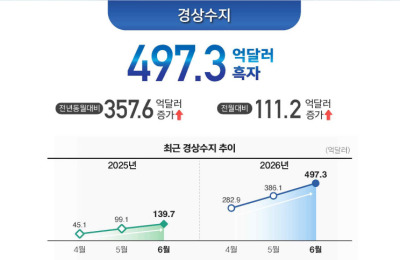
[서울=뉴스핌] 박가연 기자 = 지난 6월 우리나라의 경상수지가 전월에 이어 역대 최대 흑자를 기록했다. 반도체를 중심으로 한 정보기술(IT) 품목 수출 호조로 월간 상품수출이 처음으로 1000억달러를 넘어선 영향이다.
[자료=한국은행]
한국은행이 6일 발표한 '2026년 6월 국제수지(잠정)'에 따르면 지난 6월 경상수지는 497억3000만달러 흑자로 집계됐다. 전월(386억1000만달러)에 이어 두 달 연속 월간 기준 역대 최대 기록을 갈아치웠다. 이에 따라 올해 상반기 누적 경상수지 흑자는 1910억1000만달러를 기록했다.
경상수지 흑자를 견인한 것은 상품수지다. 6월 상품수지는 478억9000만달러 흑자를 기록하며 전월에 이어 역대 최대를 다시 썼다. 국제수지 기준 상품수출은 1123억7000만달러로 전년 동월 대비 84.5% 증가하며 월간 기준 처음으로 1000억달러를 넘어섰다. 상품수입은 644억8000만달러로 38.6% 늘었다.
통관 기준으로는 반도체 수출이 전년 동월 대비 196.9% 급증했고 컴퓨터·주변기기(SSD)는 282.7% 증가했다. IT 품목 수출은 160.4% 늘었으며 비IT 품목도 ▲석유제품(47.5%) ▲화공품(18.6%) ▲철강제품(17.9%) ▲승용차(6.1%) 등을 중심으로 18.6% 증가했다. 통관 기준 수입은 ▲원자재(30.5%) ▲자본재(35.3%) ▲소비재(16.4%)가 모두 늘었다.
서비스수지는 12억9000만달러 적자를 기록해 전월(-10억9000만달러)보다 적자 폭이 확대됐다. 여행수지는 외국인 입국자 증가와 유류할증료 인상 등에 따른 출국자 감소로 4억4000만달러 흑자를 기록했지만 지식재산권사용료수지는 전월 흑자에서 4억4000만달러 적자로 전환됐다.
본원소득수지는 배당소득을 중심으로 32억7000만달러 흑자를 기록해 전월(21억7000만달러)보다 흑자 폭이 확대됐다. 배당소득수지는 배당수입이 늘어난 데다 전월 분기배당에 따른 기저효과로 배당지급이 줄면서 25억6000만달러 흑자를 나타냈다.
금융계정 순자산은 6월 중 467억1000만달러 증가해 월간 기준 역대 최대 증가 폭을 기록했다. 종전 최대였던 올해 3월(369억9000만달러)을 넘어선 것이다. 직접투자에서는 내국인의 해외투자가 80억1000만달러, 외국인의 국내투자가 46억3000만달러 각각 증가했다.
증권투자에서는 외국인의 국내 주식 매도세가 이어졌다. 외국인의 국내 주식 투자는 차익실현 매도 등의 영향으로 316억1000만달러 감소하며 전월(-310억5000만달러)에 이어 역대 최대 순매도 기록을 다시 경신했다.
외국인의 국내 채권투자는 세계국채지수(WGBI) 자금 유입에도 분기 말 만기도래 영향으로 증가 폭이 줄어든 52억9000만달러를 기록했다. 내국인의 해외 증권투자는 주식을 중심으로 35억6000만달러 증가했다.
eoyn2@newspim.com
2026-08-06 08:00