


The Role of Anecdotal Information in Monetary PolicyWilliam Poole*President, Federal Reserve Bank of St. LouisThe Bank of Korea International Conference on Monetary Policy in an Environment of Low InflationSeoul, KoreaConference Session “General Discussion” June 16, 2006*I appreciate comments provided by my colleagues at the Federal Reserve Bank of St. Louis. Robert H. Rasche, senior vice president and director of research, provided special assistance. I take full responsibility for errors. The views expressed are mine and do not necessarily reflect official positions of the Federal Reserve System.--------------------------------------------------------------------------------The Role of Anecdotal Information in Monetary PolicyI’ll use my discussion time to make a simple argument—that in a low inflation environment, further improvements in reducing the variances of inflation and employment will require increased attention to informal, or anecdotal information. Before developing that argument, I offer the usual Fed disclaimer that the views I express here are mine and do not necessarily reflect official positions of the Federal Reserve System. I thank my colleagues at the Federal Reserve Bank of St. Louis for their comments, especially Robert Rasche, but I retain full responsibility for errors.Central bankers around the world are currently faced with a challenge not experienced in over 40 years: maintaining low and stable inflation now that it has been achieved for more than a passing quarter or two. In the aftermath of the Great Inflation, the primary objective of monetary policy was clear and distinctly one-sided: Bring inflation down to achieve a low and stable long-term rate of inflation. In the early 1990s, inflation subsided to levels that are widely regarded as roughly consistent with price stability, and the short-run volatility of inflation became substantially smaller. This observation applies to countries that adopted formal inflation targets and to countries such as the United States where monetary policy inflation objectives are asserted only qualitatively.Today central banks are concerned with two-sided risk with respect to their inflation objective. On the one hand, no one wants to see an upward drift of inflation, either sudden or gradual, and on the other hand no central bank wants a systemic deflationary environment. In the United States it is likely that the inflation rate bottomed out in 2003, around the time that the FOMC expressed concern that “...the probability of an unwelcome substantial fall in inflation, though minor, exceeds that of a pickup in inflation from its already low level.” (1)Now, approximately three years later, after a period of strong economic growth in many parts of the world and demand driven increases in energy prices, the perceived risk has shifted in the other direction. The current assessment of the FOMC is summarized in its statement following its meeting in May 2006:As yet, the run-up in the prices of energy and other commodities appears to have had only a modest effect on core inflation, ongoing productivity gains have helped to hold the growth of unit labor costs in check, and inflation expectations remain contained. Still, possible increases in resource utilization, in combination with the elevated prices of energy and other commodities, have the potential to add to inflation pressures.(2)Meeting the challenge of sustaining a low-inflation environment may require new approaches to policy analysis. Policymakers understand that their actions do not generate immediate responses in the economy, which is why they must look out into the future. Perfect foresight may be a useful construct for theoretical analyses, but policymakers in practice must make their decisions with full knowledge of the normal range of forecast errors. Economic forecasts are rooted in statistical models estimated from historical data and the model forecasts are then modified, often substantially, through the application of expert judgment. Experience indicates that forecasting inflation is hardly precise and that forecasting models are not robust. Stock and Watson summarize their experiments with numerous forecasting models for inflation across seven industrial economies:These forecasting successes, however, are isolated and sporadic.... For example, the seasonal no-change forecast works well in the United States in the second period but poorly in the first, a similar pattern as in Canada (but the opposite pattern as in the United Kingdom). (3)The only set of predictors that usually improves upon the AR [autoregressive] forecasts is the measures of economic activity. For example, the IP [Industrial Production] and unemployment gaps both improve on the AR (or are little worse than the AR) for both periods for Canada, Germany and the United States. Even for these predictors, however, the improvement is neither universal nor always stable. (4)Economists have long understood that control theory implies that the more successful a central bank is in achieving and maintaining a low inflation environment, the smaller are the correlations between the control objective—here, the inflation rate—and the instruments that a policymaker has available to affect the economy. Years ago Solow and Kareken provided a straightforward illustration of this proposition:Suppose that by heroic (and perhaps even cyclical) variation in the money supply and its rate of change, the Federal Reserve manages deftly to counter all disturbing impulses and to stabilize the level of economic activity absolutely. Then an observer following the Friedman method would see peaks and troughs of monetary change accompanied by a steady level of aggregate activity. He would presumably conclude that monetary policy has no effects at all, which would be precisely the opposite of the truth. (5)The observation that correlations are changing or disappearing does not mean that the economy has fundamentally changed. In particular, it is likely that the correlation between the growth of monetary aggregates and the inflation rate (or even nominal income growth) will be small in low inflation environments. Yet central bankers who fail to monitor the growth rates of monetary aggregates do so at their own peril. History illustrates that rapid and accelerating monetary growth, positive or negative, is a recipe for the demise of the low inflation regime into inflation or deflation. Just because a low inflation environment has been established, central bankers cannot print money without restraint. Large correlations, then, provide evidence that the central bank has failed to exploit relevant information; as policy becomes more effective, correlations tend toward zero.In a low inflation environment, the stability of expectations of long-run inflation is certainly one, and perhaps the single most important, element in the continued success of the low inflation policy. Of first importance is that such expectations remain “well contained” or “well anchored.” In rational expectations models of the macroeconomy, monetary policy rules specified with a nominal interest rate instrument require a constant expected long-term (or equilibrium) expected rate of inflation to assure the existence of an equilibrium rate of inflation. The familiar “Taylor Rule” contains a π* term, the desired rate of inflation of the monetary authorities. Note that in the Taylor Rule the term is π* not π*t.(6) In such models, π* is the “anchor” on which the long-term expected inflation rate of private agents is based. If the inflation objective is time-varying, or is perceived by private agents as time-varying, then long-term inflation expectations become unglued and the inflation rate will not remain low and stable; indeed depending on how the desired inflation rate of the policymakers is perceived, inflation can become a self-fulfilling explosive process.Such models provide insight into how to conduct monetary policy that will successfully sustain a low and stable inflation environment: the monetary authorities must clearly communicate their inflation policy objectives. The communication must be symmetric: private agents must understand what rates of inflation are unacceptably high and what are unacceptably low to the central bank. Central banks that announce explicit numeric inflation objectives go a long way towards satisfying this communication objective. However announcements must be confirmed by deeds. Central banks must demonstrate that they are prepared to act decisively against sustained deviations from their announced objective. Further, to preserve the credibility of the announced inflation objective, changes in the announced objective must be undertaken sparingly and infrequently, and certainly not in directions away from low rates of inflation. If the central bank loses credibility with respect to the announced inflation target, then long-term inflation expectations of private agents will become disconnected from the target, and the economy will begin to drag its nominal anchor.Central bankers may be reluctant to take decisive policy actions as actual inflation approaches a perceived boundary of price stability because of their imprecise forecasts of inflation and economic activity. Faced with an uncertain view of the future, the natural tendency of policymakers is to wait for further information on the state of the economy. In the absence of decisive policy actions, central bankers may be able to stabilize long-term inflation expectations by clarifying their vision of price stability. The text in the minutes of the May 2003 FOMC meeting is an example of such a clarification: Given the pressure of a considerable amount of unused resources, any adverse developments that held down economic expansion would increase the probability of further disinflation. Members commented that substantial additional disinflation would be unwelcome because of the likely negative effects on economic activity and the functioning of financial institutions and markets, and the increased difficulty of conducting an effective monetary policy, at least potentially in the event the economy was subjected to adverse shocks. (7)Note that these minutes provide symmetry to the concerns of FOMC participants about inflation: they reveal that the implicit inflation objective of the Committee evaluated downside as well as upside risk.A difficult question facing central bankers is how to judge when inflation expectations remain anchored. One way to approach this question it to ask what critical data might be expected to show different characteristics when inflation expectations are “well anchored” compared to when they are coming unglued. Most such data will require direct or indirect measures of inflation expectations. Survey data on inflation expectations provide some evidence, but typically have limitations such as small sample size, nonscientific sample design and a restricted population from which survey respondents are drawn. The introduction, over the past decade in a number of countries, of inflation-indexed long-term government debt instruments and the emergence of liquid secondary markets in such securities offers additional information.In an economy with well-anchored inflation expectations, it can be expected that those expectations would not be highly responsive to changes in the observed rate of inflation. A limitation of survey data in this respect is that historically they have been characterized by strong persistence. For example, in the 34 quarterly Surveys of Professional Forecasters conducted by the Federal Reserve Bank of Philadelphia since the second quarter of 1998, the average 10 year-ahead forecast of CPI inflation has differed from 2.5 percent on only five occasions. On those five occasions, the range of the average forecast was from 2.3 percent to 2.6 percent.In contrast, with highly liquid markets for both nominal and indexed government debt of comparable maturity, it is possible to observe both real interest rates and inflation compensation. If inflation expectations are well-anchored, the correlation between changes in yields on nominal securities and indexed securities should be quite high. At the opposite end of the spectrum, if inflation expectations become unanchored, then the correlation between changes in these yields should be much lower. In the extreme of highly unstable inflation expectations, changes in nominal yields will be dominated by changes in inflation expectations and the correlation of changes in nominal and real yields will approach zero.In the absence of precise statistical forecasting models, another potentially useful source of information to assess the stability of inflation expectations and the likely course of the real economy is real-time anecdotal information. The drawback of anecdotal information is that there is no scientific basis for the sample. Yet the accumulation of forward-looking anecdotal information at critical times can be informative. An example can be drawn from the recently released transcripts of the FOMC meetings of October, November and December, 2000. At that time, the best inference from statistical forecasting models was that economic growth in the U.S. would gradually slow from the very high rate of the first half of the year to rates that were regarded as more sustainable. Yet, also at that time, more and more FOMC participants were reporting stories indicating sharply slowing conditions from an ever increasing number of respondents. We now measure real growth in the second half of 2000 as less than 1 percent (annual rate), with negative growth in the third quarter. In this instance the anecdotes gave a better early warning signal of the turn in activity than did the forecasting models.A similar situation may prevail today. Statistical studies to detect pass-through from recent energy price increases have failed to show significant effects in U.S. price data but stories about widespread pass-through are becoming increasingly common. We may—and I emphasize “may” because my purpose is to make a general point and not to conduct a full analysis of the current situation—face more inflation pressure than currently shows up in formal data. The general point is that the more successful are policymakers in exploiting regularities in formal data, the more they will have to rely on anecdotal information to make further progress in stabilizing inflation. Refining collection and analysis of anecdotal information promises earlier policy responses to changing economic conditions. The Federal Reserve already devotes substantial resources to making judgmental adjustments to its formal forecasting model but my hunch is that there will be significant improvements in policy analysis from strengthening our sources of anecdotal information.Back to top.--------------------------------------------------------------------------------Footnotes1. FOMC Press Release, May 6, 2003. 2. FOMC Press Release, May 10, 2006. 3. J.H. Stock and M.W. Watson, “Forecasting Output and Inflation: The Role of Asset Prices,” Journal of Economic Literature, September, 2003, 41, p. 805. 4. J.H. Stock and M.W. Watson, “Forecasting Output and Inflation: The Role of Asset Prices,” Journal of Economic Literature, September, 2003, 41, p. 808. 5. R. M. Solow and J. Kareken, “Lags in Monetary Policy”, in A. Ando, E.C. Brown, R.M. Solow and J. Kareken, “Lags in Fiscal and Monetary Policy,” in Commission on Money and Credit, Stabilization Policies, Englewood Cliffs NJ: Prentice-Hall, 1963, p. 16. 6. There is an ongoing debate in the monetary policy literature over “instrument rules” versus “targeting rules.” See for example, B.T. McCallum and E. Nelson, “Targeting versus Instrument Rules for Monetary Policy,” Federal Reserve Bank of St. Louis Review, September/October 2005, 87(5), pp.597-612 and L.E.O. Svensson, “Targeting versus Instrument Rules for Monetary Policy: What is Wrong with McCallum and Nelson?” Federal Reserve Bank of St. Louis Review, September/October 2005, 87(5), pp.613-626. In both approaches it is important that the policy rules specify π*, not π*t. 7. Minutes, FOMC Meeting of May 6, 2003, www.federalreserve.gov/fomc/minutes/20030506.htm.

[관련키워드]




[뉴스핌 베스트 기사]
 사진
사진
정동영 업무보고 논란
[서울=뉴스핌] 유신모 외교전문기자 = 청와대 영빈관에서 5일 열린 외교·안보 분야 정부 부처의 대통령 업무보고에서 정동영 통일부 장관의 '한반도 평화공존 발전 구상'과 업무보고 발언이 논란을 빚고 있다.
이날 정 장관의 발언 중에는 정부 내 조율을 거치지 않은 사안을 정책으로 추진하겠다고 공언한 것이 있는가 하면 사실 관계에 맞지 않은 설명도 있었다. 이재명 대통령은 공개적으로 신중을 기해 달라고 경고했고, 조현 외교부 장관은 '이상주의적 희망에 근거한 비현실적 구상'이라는 비판을 내놨다.
그동안 정 장관의 대북 정책 관련 발언이 물의를 빚은 적은 여러 번 있지만 대통령과 유관 부처 장관이 공개적으로 부정적 입장을 표명한 것은 이례적이다. 정 장관의 무리한 대북 접근법과 월권을 제어해야 한다는 목소리도 높아지고 있다.
[정동영 통일부 장관이 지난달 23일 오후 서울 종로구 정부서울청사에서 취임 1주년 기자간담회를 하고 있다. [사진=통일부] 2026.07.23
◆통일부 장관 권한 넘어선 주장
정 장관은 이날 업무보고에서 '한반도 평화공존 발전 구상'을 설명하면서 이재명 정부 2년차 핵심 과제로 상호 존중·평화적 갈등 해결·핵 없는 한반도 등 3대 기본 방향을 제시했다.
정 장관은 "대결과 혐오의 언어는 멈춰야 한다"면서 주적 용어 대체를 주장했다. 지난 25년간의 CVID(완전하고 검증가능하며 되돌릴 수 없는 비핵화) 구도는 이미 무너졌다고도 했다. 또 "현 시점에서 흘러간 선(先)비핵화만 되뇌는 것은 현실을 바꾸는 데 힘이 되지 않는다"고 주장했다. 정 장관은 또 "정전 체제를 평화 체제로 바꾸는 논의에 착수하겠다"면서 "북·미 정상회담 견인과 함께 4자 대화의 동력을 확보하기 위해 최선을 다할 것"이라고 말했다.
하지만 이 대통령은 정 장관의 구상에 대부분 제동을 걸었다. 이 대통령은 "평화공존 정책이 정치적으로 악용되는 측면이 있다"며 "많이 조심하셔야 한다"고 지적했다.
북한을 다른 이름으로 불러야 한다는 주장에는 "표현에 꼬투리가 잡혀 정쟁으로 휘몰아 들어가면 원래 하고자 했던 데에서 오히려 나쁜 상황이 초래될 수 있다"고 경고했다.
이 대통령은 남북 신뢰 구축을 위해 9·19 군사합의를 선제적으로 복원해야 한다는 정 장관의 주장에 대해서도 "우리의 선의대로 하는 게 과연 한반도의 평화와 안정에 플러스냐, 결론적으로 약간의 의문이 들 때도 있다"며 부정적으로 반응했다.
조현 외교부 장관은 업무보고 사후 브리핑에서 정 장관이 언급한 '4자 회담'에 대해 "이상주의에 근거한 어떤 희망이라 하더라도 그건 아직 조율되지 않은 방법"이라며 "여러분들께서 디스카운트해 주시면 좋겠다"고 선을 그었다.
정 장관이 9월 러시아 블라디보스토크에서 열리는 '동방경제포럼(EEF)'을 언급하며 "정부 차원에서 (참석을) 검토하고 있다"고 발언한 데 대해서도 조 장관은 "그것은 외교부의 몫"이라며 "아직 거기까지 진도가 나가지 않았다"고 잘랐다.
정 장관이 이날 소개한 대북 구상과 설명은 정부 내 조율을 거치지 않았다는 점에서 문제가 있다. 특히 주적 표현 대체와 국호 사용, 9·19 군사합의 복원, 4자회담 추진 등은 통일부 장관이 결정할 사안이 아니어서 월권이라는 지적이 나오고 있다. 이 대통령은 정 장관의 업무보고를 듣고 난 뒤 "여기 업무보고에 발표했다고 승인난 건 아니다"라고 재차 확인했다.
정부의 한 소식통은 "정 장관의 발언 내용은 대부분 국가안전보장회의(NSC)를 거쳐 결정된 사안이 아닌 정 장관의 개인적 생각에 가깝다"며 "안보 관련 부처 장관이 정부의 공식 정책이 아닌 사안을 추진하겠다고 업무보고를 하고 대통령의 면전에서 '국군통수권자가 나서야 한다'고 주장한 것은 심각한 문제"라고 지적했다.
이재명 대통령이 5일 청와대 영빈관에서 열린 통일 외교 국방 등 외교 안보 부처 업무보고에서 발언하고 있다. [사진=청와대] 2026.08.05
◆시대착오적 접근, 대북 인식 오류
더욱 문제인 것은 정 장관의 이같은 주장이 현 시점에서 이미 참고가 될 수 없는 과거의 경험 또는 사실과 다른 인식에 기반하고 있다는 것이다. 정 장관이 주장하는 구상은 급격히 변화하고 있는 북한의 전략과 한반도 및 국제 정세를 전혀 반영하지 못하고 있다는 비판이 제기되고 있다.
정 장관이 "흘러간 선(先)비핵화만 되뇌는 것은 현실을 바꾸지 못한다"고 언급한 것은 지금까지의 대북 접근법을 호도하고 있다. 북핵 위기 발발 이후 지금까지 모든 핵 협상에서 한국이나 미국은 북한에 선비핵화를 공식적으로 요구한 적이 없기 때문이다.
지금까지의 북핵 협상은 북한의 비핵화 조치에 한·미가 상응하는 대가를 제공하는 방식으로 이뤄졌다. 1994년 북·미 제네바 기본합의는 핵시설 동결과 중유 제공의 교환이었다. 2005년 9.19 공동성명도 북한의 비핵화 조치의 모든 단계에 상응조치를 제공하는 '행동 대 행동' 원칙이 적용됐다.
대북 협상에 관여했던 한 전직 관료는 "모든 북핵 협상은 북한의 비핵화 조치와 한·미가 제공하는 상응조치를 어떻게 정교하게 배열하느냐가 관건이었다"면서 "정 장관의 발언은 지금까지 한·미가 북한에 먼저 핵을 포기해야 대화할 수 있다는 정책을 고수해 현 상황에 이르게 됐다는 잘못된 인식에서 비롯된 것으로 보인다"고 말했다.
정 장관이 "지난 25년간의 CVID 구도가 무너졌다"고 말한 것도 비핵화의 개념에 대한 이해 부족이라는 비판이 제기되고 있다. 북핵 문제에 정통한 외교 소식통은 "어떤 명칭을 붙이든 핵을 제거한 뒤 이를 검증하고 재발 방지 조치를 하는 것은 비핵화에 반드시 포함되어야 하는 기본적 절차"라며 "CVID는 안 된다고 말하는 것은 북한의 비핵화 조치를 검증도 하지 않고 언제든 되돌릴 수 있도록 합의하자는 말과 같다"고 지적했다.
[서울=뉴스핌] 이길동 기자 = 조현 외교부 장관이 5일 오후 서울 종로구 정부서울청사 별관에서 2026년 하반기 업무보고 사후브리핑을 하고 있다. 2026.08.05 gdlee@newspim.com
◆안보 리스크 키우는 통일부 장관
정 장관은 지난해 취임 직후부터 청와대와 외교부를 제치고 통일부가 북한과 관련된 모든 정책을 주도해야 한다는 주장을 펴면서 단독 질주를 거듭해왔다.
북한의 '적대적 두 국가' 주장을 변형한 '평화적 두 국가'를 지향해야 한다고 주장하면서 이에 문제점을 지적하는 목소리를 무시했다. 외교부가 미국과 북한 문제를 논의하는 것에 대해 "한반도 정책과 남북관계는 주권의 영역이며 동맹국과 협의의 주체는 통일부"라고 주장해 물의를 빚었다. 문재인 정부 시절 한·미 워킹그룹이 남북관계 파탄 원인이었다고 사실과 다른 주장을 폈다.
지난해 업무보고에서는 국제정세를 감안하지 않고 남북대화 재개에만 초점을 맞춘 비현실적 내용으로 논란을 빚었다. 정부 내 조율도 거치지 않고 독자 대북제재인 5·24 조치를 해제하고 9·19 군사합의 비행금지구역 복원을 추진하겠다는 방침도 밝혔다.
지난 4월에는 평안북도 구성시에 우라늄 농축 시설이 있다고 말해 파장을 일으켰다. 미국은 이 발언을 계기로 한국과 대북정보 공유를 제한했다. 이 조치는 지금도 계속되고 있는 것으로 알려졌다.
정 장관이 이처럼 정부의 공식 결정을 거치지 않은 사안을 정부 정책인 것처럼 주장하며 좌충우돌하는 배경에 대해 여러가지 해석이 나온다. 북한 문제에서 조기에 성과를 거둬야 한다는 조급증과 자신의 존재감 과시 욕구가 작용하고 있다는 평가가 많다.
일각에서는 정 장관이 2007년 민주당 대선후보였을 때 이재명 대통령이 캠프에서 비서실 부실장으로 활동한 전력이 있다는 것을 들어 "정 장관이 아직도 이 대통령을 아랫사람으로 생각하고 있는 것 아니냐"는 비판을 내놓기도 한다.
한·미 관계와 북한 문제를 오래 다뤘던 전직 관료 출신의 한 전문가는 "정 장관 취임 후 지금까지의 언행은 잘못된 현실 인식에 따른 독단과 앞서 가기, 월권 등으로 점철돼 있다"면서 "통일부 장관이라는 중요한 직책에 있으면서 스스로 안보 리스크를 키우는 역할만 했다"고 비판했다.
opento@newspim.com
2026-08-06 06:10
 사진
사진
6월 경상수지 최대 흑자
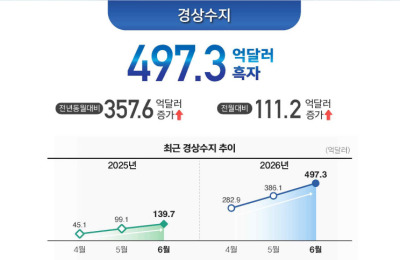
[서울=뉴스핌] 박가연 기자 = 지난 6월 우리나라의 경상수지가 전월에 이어 역대 최대 흑자를 기록했다. 반도체를 중심으로 한 정보기술(IT) 품목 수출 호조로 월간 상품수출이 처음으로 1000억달러를 넘어선 영향이다.
[자료=한국은행]
한국은행이 6일 발표한 '2026년 6월 국제수지(잠정)'에 따르면 지난 6월 경상수지는 497억3000만달러 흑자로 집계됐다. 전월(386억1000만달러)에 이어 두 달 연속 월간 기준 역대 최대 기록을 갈아치웠다. 이에 따라 올해 상반기 누적 경상수지 흑자는 1910억1000만달러를 기록했다.
경상수지 흑자를 견인한 것은 상품수지다. 6월 상품수지는 478억9000만달러 흑자를 기록하며 전월에 이어 역대 최대를 다시 썼다. 국제수지 기준 상품수출은 1123억7000만달러로 전년 동월 대비 84.5% 증가하며 월간 기준 처음으로 1000억달러를 넘어섰다. 상품수입은 644억8000만달러로 38.6% 늘었다.
통관 기준으로는 반도체 수출이 전년 동월 대비 196.9% 급증했고 컴퓨터·주변기기(SSD)는 282.7% 증가했다. IT 품목 수출은 160.4% 늘었으며 비IT 품목도 ▲석유제품(47.5%) ▲화공품(18.6%) ▲철강제품(17.9%) ▲승용차(6.1%) 등을 중심으로 18.6% 증가했다. 통관 기준 수입은 ▲원자재(30.5%) ▲자본재(35.3%) ▲소비재(16.4%)가 모두 늘었다.
서비스수지는 12억9000만달러 적자를 기록해 전월(-10억9000만달러)보다 적자 폭이 확대됐다. 여행수지는 외국인 입국자 증가와 유류할증료 인상 등에 따른 출국자 감소로 4억4000만달러 흑자를 기록했지만 지식재산권사용료수지는 전월 흑자에서 4억4000만달러 적자로 전환됐다.
본원소득수지는 배당소득을 중심으로 32억7000만달러 흑자를 기록해 전월(21억7000만달러)보다 흑자 폭이 확대됐다. 배당소득수지는 배당수입이 늘어난 데다 전월 분기배당에 따른 기저효과로 배당지급이 줄면서 25억6000만달러 흑자를 나타냈다.
금융계정 순자산은 6월 중 467억1000만달러 증가해 월간 기준 역대 최대 증가 폭을 기록했다. 종전 최대였던 올해 3월(369억9000만달러)을 넘어선 것이다. 직접투자에서는 내국인의 해외투자가 80억1000만달러, 외국인의 국내투자가 46억3000만달러 각각 증가했다.
증권투자에서는 외국인의 국내 주식 매도세가 이어졌다. 외국인의 국내 주식 투자는 차익실현 매도 등의 영향으로 316억1000만달러 감소하며 전월(-310억5000만달러)에 이어 역대 최대 순매도 기록을 다시 경신했다.
외국인의 국내 채권투자는 세계국채지수(WGBI) 자금 유입에도 분기 말 만기도래 영향으로 증가 폭이 줄어든 52억9000만달러를 기록했다. 내국인의 해외 증권투자는 주식을 중심으로 35억6000만달러 증가했다.
eoyn2@newspim.com
2026-08-06 08:00