


Remarks by Governor Randall S. KrosznerAt the Bankers' Association for Finance and Trade, New York, New YorkJune 15, 2006 Why Are Yield Curves So Flat and Long Rates So Low Globally? Today I want to talk about some new and exciting developments in bond markets around the world. The motivation for my discussion is the current puzzling situation of a relatively flat yield curve combined with relatively low real and nominal long-term interest rates, which has occurred both in developed economies and in emerging markets. I will explore some possible explanations for the pattern and will focus on changes in the prospects for and risks to the long-term inflation outlook, particularly in emerging-market economies. In particular, I will highlight how financial innovations and international competitive pressures, combined with a better public understanding of the costs of inflation and changes in the institutions of central banking, have helped improve the credibility of central banks and inflation outcomes in many emerging markets. Until recently, many emerging-market countries simply did not have a yield curve because there was effectively no market for debt issued in domestic currency beyond a very short horizon. The credibility of central banks has been crucial to this deepening of the domestic capital market, which is typically associated with higher economic growth.I am optimistic that these developments will continue, as I believe that the move toward low inflation rates reflects important technological and institutional factors that are likely to persist. Nevertheless, there are still risks, which underscore the importance of continuing to reap the benefits of improved central bank behavior and credibility in emerging markets and around the world.Global Developments in the Bond MarketIn February 2005, former Federal Reserve Board Chairman Alan Greenspan noted a puzzle in the U.S. economy related to the slope of the yield curve and the level of the long-term interest rate.1 Long-term interest rates had remained low and stable despite a solid economic recovery and a sustained period of monetary policy tightening during which the target federal funds rate went from 1 percent to 2-1/2 percent. When he first publicly noted this "conundrum," as he called it, the ten-year Treasury yield was just over 4 percent. Today, despite an additional 250 basis points of increase in the target federal funds rate, the nominal ten-year Treasury yield is roughly 5 percent, still very low by historical standards, compared to an average of more than 7-1/2 percent since 1980. The combination of a rising short rate and a relatively stable long rate has led to a very flat yield curve. During the last quarter-century, for example, the difference between the yield on the ten-year Treasury note and the yield on the three-month Treasury bill has been roughly 1-3/4 percent (or, to be exact, 179 basis points from 1980 to the present). During the last year, that difference has been less than 50 basis points and is currently less than half of that. Thus, this essentially flat slope is atypical in U.S. experience. I am sure that you are all familiar with the simple relationship between short-term and long-term interest rates. The yield on a ten-year bond, for instance, can be thought of as a series of consecutive forward rates. If you could borrow and lend at the same rate as the U.S. Treasury, then you could lock in a three-month loan ten years from now by borrowing for ten years and three months and simultaneously lending the same principal for ten years. The difference between the interest you pay and the interest you earn on this transaction determines the implied forward rate ten years from today.2 The forward rate reflects not only the market expectation of the future short-term interest rate but also a "term premium" to compensate for the risk in committing to extend credit so far in the future, including the risk of future inflation.3At any point in time, then, we can calculate the short-term forward rate ten years ahead based on the yield curve of U.S. Treasury coupon securities.4 This "far forward" rate makes the conundrum even more puzzling because it reached historically low levels of almost 4-1/4 percent last year, more than 200 basis points below its average since 1990, and has rebounded only somewhat this year. In real terms, the far forward rate calculated from inflation-indexed securities is similarly below its long run average.The U.S. bond market conundrum has occurred in parallel with similar developments in foreign bond markets. In major industrial countries, bond yields have trended down, in some cases reaching historical lows recently. Yields are also low in real terms, as measured by inflation-indexed bonds. Far-forward short rates in recent years have also reached unusually low levels in many industrial countries.The most interesting and, I believe, perhaps least studied recent developments in the bond markets concern the changes in emerging markets. While it is well known that the yield spreads on dollar-denominated bonds of emerging-market governments included in the EMBI+ index are near all time lows (even taking into account the recent rise), two phenomena in emerging markets have received less attention. One is the development of markets for longer-dated fixed-coupon bonds issued in local currencies. This phenomenon is, from my perspective, quite remarkable and belies the assertion that the "original sins" of bad policy from the past have doomed the development of domestic currency bond markets in many emerging markets. The recent lengthening of maturities of domestic-currency debt markets has, in many cases, not only extended a yield curve but effectively created a local currency yield curve that simply did not exist earlier. Since 2000, ten-year nominal fixed-coupon bonds in local currency have been introduced in Brazil, Colombia, Indonesia, Mexico, and Russia, while Korea issued a ten-year fixed coupon bond in 1995. To illustrate in more detail, the governments of Mexico and Korea have been able extend the average maturity of their local-currency debt significantly in just the past few years. The Mexican government issued ten-year maturities in 2001 and then 20-year maturities in 2003. The proportion of local-currency debt in Mexico maturing within one year was nearly 90 percent in 2002 and is now below 75 percent. (I have included floating rate debt in the one-year maturity category.) The Korean government continues to increase the proportion of its domestic currency debt in longer maturities, with the one-year-and-under segment falling from roughly one-half in 1999 to one-quarter by the end of last year. Two, bond yields in local currencies of emerging-market countries have also declined. It is perhaps not surprising that, given their high rates of saving and generally high level of economic development, the governments of Hong Kong and Korea can borrow at close to industrial-country levels. More notable, however, is that the Mexican government can borrow in pesos at a ten-year maturity at rates that have averaged roughly 9 percent. And Mexico is not unique in this regard. Other middle-income emerging markets with ten-year local-currency fixed rate bond yields in the single digits include Chile, Malaysia, Russia, and Thailand, to name but a few. For countries with longer maturities, implied short-term interest rates five years ahead also have been declining and have reached very low levels, although there have been some increases in the past few months.What is driving these changes? There are a number of complementary, not alternative, explanations.Explanations for the Low Real Bond YieldsChairman Bernanke has suggested that an excess of ex ante global savings relative to global investment, sometimes referred to as a global savings glut, has held down real interest rates around the world and encouraged capital inflows to the United States.5 Some of the factors behind this savings glut include the surge in revenues of oil and commodity exporters, a reduction in fiscal deficits in some Latin American countries, and a retreat in Asian investment demand from the boom that preceded the late 1990s financial crises while saving rates stayed high in Asia. The savings glut story helps to explain the real component of low bond yields as well as the pattern of global capital flows, which was Chairman Bernanke’s focus. Another factor behind declining real yields in some emerging markets is that their improved fiscal situation not only increases national saving but also calms fears about the ability of governments to service their debt. However, there is also a nominal aspect of low global bond yields. In the rest of my talk, I would like to emphasize the worldwide decline of inflation and perceived inflation risk as a key contributor to low nominal bond yields.Explanations for the Low Nominal Bond Yields Inflation rates in major industrial and developing regions have trended down over the past twenty-five years. Compared with the period 1980 to 1999, median inflation rates from 2000 to 2004 fell from 5 percent to 2 percent in industrialized countries and from 14 percent to 4-1/2 percent in emerging markets, according to the most recent statistics from the International Monetary Fund. Not long ago, annual inflation rates in Brazil and Mexico at times exceeded 100 percent. But during the past decade, Brazilian and Mexican inflation rates have remained low. In particular, inflation in Brazil did not spike up after its financial crises and sharp currency depreciations in the late 1990s. Given Brazil’s history of hyperinflation, this stability is especially remarkable. Brazil did experience a small spike of inflation around its presidential election in 2002, but even this was minor by historical standards. The pattern of low inflation is seen across many countries, large and small.A few years ago I did some research that showed how inflation rates around the world have fallen significantly since the 1970s and 1980s, both in terms of averages and medians.6 Indeed, the IMF’s April 2006 World Economic Outlook notes that average inflation rates in both the industrial countries and the developing countries in recent years are at their lowest levels since at least the early 1970s. More important, I found that the worst inflation performers (specifically the 10 percent of the countries of the world experiencing the highest inflation) had much lower inflation rates than the worst performers from the 1970s, 1980s, and 1990s. Thus, the worst behavior is not as bad as it once was.Do markets expect low inflation to persist in the long run? To answer this question, we can look at measures of expected inflation. Consensus Economics surveys hundreds of professional forecasters in numerous countries each April. The surveys allow us to examine forecasts of inflation around the world six to ten years ahead beginning in 1996. The latest observation, in April 2006, for example, is the forecast of a given country’s average consumer price inflation rate from 2012 through 2016. For both a representative sample of industrial economies (Euro area, Japan, the United States, and the United Kingdom) and emerging-market economies (Brazil, China, Korea, and Mexico), we observe substantial declines from the late 1990s to today. These forecasts have been low and stable in both industrial and many important developing countries in recent years. The surveys thus provide one indication that markets do expect low inflation to persist.The volatility of inflation has also declined notably, suggesting that perceived inflation risk may have declined as well. For the industrial countries, inflation volatility (measured as a twenty-quarter rolling standard deviation of consumer price inflation) has declined from the 1980s to the 1990s to the period since 2000. Although it has since drifted up just a bit due to volatility in oil prices, it remains at or near its lowest level in the last quarter-century. For the emerging markets, the decline in volatility is even more dramatic. Brazil, in particular, was off the chart much of the time before the late 1990s. Volatility of inflation in China, Korea, and Mexico is now at levels similar to those of the industrial countries, and volatility in Brazil is not much higher. Overall, the combination of lower and less volatile inflation around the world has led to a reduction in inflation expectations and lower perceived inflation risk, hence a lower inflation uncertainty premium in long rates. I believe that these factors have been important contributors to the lower long-term yields and the flattening of yield curves, particularly in emerging markets. The existence of markets for long-term nominal government and corporate debt is powerful evidence of the faith that investors place in a future environment of price stability. Factors Behind the Global Move to Price StabilityFour broad factors lie behind the move to price stability, especially in emerging markets, and these factors tend to reinforce each other. Each factor affects the cost-benefit tradeoff of pursuing a high-inflation policy.The first factor, which gets surprisingly little attention in my view, is financial innovation that alters the ability and incentive of a government to pursue a high-inflation policy.7 I put the innovations into two main categories, developments in information technology and physical dollarization, both of which effectively increase potential competition among currencies. Financial innovations make it easier for citizens to move their assets out of the local currency should their government resort to an inflation tax. The dollarizations that followed the high-inflation episodes in Latin America and the former Soviet Union, for example, significantly reduced the costs of switching away from a local currency for small-value transactions. The specific channels by which financial innovations could have affected competition among currencies are many: Electronic trading and payments technologies enabled investors and banks to shift assets quickly away from currencies prone to inflation and related risks. In the 1990s, many countries--including Brazil, Korea, and Mexico--implemented real-time gross settlement payment systems, which allowed markets to rapidly settle payments and other obligations with finality during the day. Financial innovations such as credit card networks and money market mutual funds allow households and firms to minimize their holdings of cash and central bank reserves, thus shrinking the base of the inflation tax. Increased circulation of banknotes in dollars or other hard currencies enable citizens to conduct transactions without holding inflationary currency. Data published on the Federal Reserve’s website show a dramatic increase in the fraction of U.S. Federal Reserve notes that are estimated to be held in foreign countries. The fraction of U.S. Federal Reserve notes held abroad rose from under 20 percent in 1980 to almost 50 percent in the late 1990s. Given these innovations, a government that pressures a central bank to pursue an inflationary policy gets much less benefit for each unit increase in inflation because people can more easily switch out of the local currency. In other words, the inflation tax becomes much more difficult and costly to levy because citizens can more easily avoid the tax by using an alternative money.The second and closely related factor behind disinflation is deregulation and competition in a globalized marketplace. The collapse of the centrally-planned economies has led many countries to turn increasingly to private markets to deliver growth and progress and reduce the role of government. Technology has helped to increase global competition by shrinking the barriers of time and distance. Again, there are several channels by which globalization and competition may have affected the cost-benefit tradeoff in pursing inflation:As Kenneth Rogoff pointed out at the 2003 Jackson Hole conference sponsored by the Federal Reserve Bank of Kansas City, greater competition leads to more-flexible prices.8 When prices are more flexible, a central bank’s ability to temporarily influence output is diminished while its influence on inflation is enhanced. Thus, more-competitive markets naturally help central banks achieve price stabilization. Increased travel has expanded the opportunities for citizens to set up financial accounts in foreign countries, thereby contributing to currency competition in a manner similar to financial innovation. Satellite television and the internet have heightened public awareness of conditions abroad, educated citizens about financial opportunities elsewhere, and raised pressure on politicians not to place limits on these opportunities. Deregulation of the financial sector spurs the types of financial innovation that I have already discussed and allows for more cross-border flows and greater competition among different types of currencies and assets. The third factor is that economists and the public have learned from painful experience about the costs of inflation.9 The end of the Bretton Woods gold standard in the early 1970s was associated with the first global and sustained peacetime inflation in history. Although the specific experiences differed across countries, public opinion eventually turned strongly against allowing inflation to continue, and policymakers responded to this pressure by taking stronger measures to achieve price stability. This learning process helped to drive some of the financial innovations that I discussed earlier, which, in turn, helped households and businesses to economize on holding inflationary assets. Economists and central bankers also devoted great attention to understanding the causes and consequences of inflation, providing the intellectual underpinning to policies oriented toward price stability. The fourth factor I wish to mention relates to changes in the institutions of central banking that may have increased the costs of pursuing high-inflation policies. The most notable change is the increased independence of many central banks and the corresponding reduced control of the fiscal authorities over monetary policy. Central bank independence reduces the ability of a government to "raid the cookie jar" through a surprise inflation tax. In most cases, central bank independence can be reversed by a majority vote of parliament. But having to resort to such a vote is a greater obstacle to inflationary finance than previous arrangements allowed, especially given the public’s increased sensitivity and aversion to inflation.Central bank independence has typically been granted in conjunction with an explicit mandate that makes achieving low and stable inflation one of the goals of monetary policy. Central bank independence with a mandate that includes price stability increases the credibility of monetary policy with regard to achieving low inflation. Policy is credible because the central bank’s objectives are clear to the public and the central bank can be held accountable for failing to achieve its objectives. When citizens are more aware of the costs of inflation and when governments would reap lower benefits from a high-inflation policy, institutional reforms that will make central banks more credible and independent may be more likely to be adopted and sustained.10 The fundamental forces I mentioned earlier--financial innovation, deregulation, globalization, and public understanding about the costs of inflation--provided the impetus for fighting inflation and opened the political path to institutional reforms, such as central bank independence, that enhance central bank credibility. Once in place, these reforms made further progress against inflation easier and raised the costs of backsliding. As the benefits of stable prices accrue and as financial markets deepen and become more sophisticated, the benefits of sound economic policies will help to create support for institutional reforms that make returning to inflation harder for future governments. Benefits of Price StabilityWhile it is well known that low and stable inflation improves the environment for investment planning and avoids many costs and disruptions associated with frequent price adjustments, I want to focus on a few of the many benefits that are particularly relevant for emerging markets.Price stability boosts growth through deepening financial markets. With stable prices, savers and investors have more confidence about the ultimate value of their deposits and loans. Stable prices encourage the growth of financial intermediaries and financial markets. As noted above, many emerging markets have recently experienced a deepening of their local financial markets with greater issuance of longer-dated paper. According to numerous studies, there is a strong link between financial market development and economic growth. Thus, the greater credibility of central banks that permits more development of the local markets can have an economic benefit beyond the financial sector.11The development of long-term local-currency bond markets may also help governments and firms plan long-term infrastructure and investment projects that boost economic development. Although such debt markets are only one of many factors that can lower the costs of long-term planning and enhance the ability to undertake long-term investments, the development of these markets, particularly when accompanied by lower real rates, help to support longer-horizon projects and reduce the effect of foreign exchange movements on such activities.A better fiscal outlook, which might arise from higher and more stable growth as well as better long-term planning, also increases financial market confidence and development and thus further boosts growth and reinforces prospects for continued price stability. This virtuous cycle appears to be happening in key emerging markets that were long plagued with poor fiscal situations, such as Brazil and Mexico. In the 1980s and early 1990s, for example, public sector deficits in these countries often exceeded 10 percent of GDP. Since the late 1990s, deficits have been diminished.Maintaining this ProgressAlthough I am an optimist, I would be remiss if I did not point out some risks to this otherwise rosy scenario. The difficulty of reaching agreement in the Doha Round of trade negotiations highlights the risk of renewed protectionism. Trade barriers reduce both domestic and international competition, one of the key factors behind low inflation, and make all countries poorer. Barriers to free flow of goods, services, and capital would also diminish the force of other factors outlined above that help to reduce inflationary pressures.We must not forget the examples of high inflation and hyperinflation from the past: They hold important lessons about the costs of not maintaining price stability. That sound policies are the basis for solid economic growth should not be forgotten.--------------------------------------------------------------------------------Footnotes1. Alan Greenspan (2005), statement before the Senate Committee on Banking, Housing, and Urban Affairs, presenting the Federal Reserve Board’s "Monetary Policy Report to the Congress," February 16. 2. Strictly speaking, this calculation requires the use of zero-coupon bonds, but it can be approximated using coupon securities. 3. Don H. Kim and Jonathan H. Wright (2005), "An Arbitrage-Free Three-Factor Term Structure Model and the Recent Behavior of Long-Term Yields and Distant-Horizon Forward Rates," Finance and Economics Discussion Series 2005-33 (Washington: Board of Governors of the Federal Reserve System, August). 4. Typically we calculate an "instantaneous" forward rate, which is the limiting value of a sequence of forward rates with maturities declining toward zero. 5. Ben S. Bernanke (2005), "The Global Saving Glut and the U.S. Current Account Deficit," Sandridge Lecture at the Virginia Association of Economics, March 10. 6. Randall S. Kroszner (2003), "Currency Competition in the Digital Age," in David E. Altig and Bruce D. Smith, eds., Evolution and Procedures in Central Banking (New York: Cambridge University Press), pp. 275–99. 7. I discussed aspects of this factor in my presentation at a May 2001 conference at the Federal Reserve Bank of Cleveland, cited above. 8. Kenneth S. Rogoff (2003), "Globalization and Global Disinflation," in Monetary Policy and Uncertainty: Adapting to a Changing Economy: A Symposium (Federal Reserve Bank of Kansas City, Aug. 28–30), pp. 77–112. 9. This hypothesis was raised in the discussion of Rogoff (2003). See Guillermo Ortíz, chair, "General Discussion: Globalization and Global Disinflation," in Monetary Policy and Uncertainty: Adapting to a Changing Economy: A Symposium (Federal Reserve Bank of Kansas City, Aug. 28–30), pp. 119–130. For evidence that voters in Latin America have punished politicians for bad inflation outcomes in recent years, see Eduardo Lora and Mauricio Oliveira (2005), "The Electoral Consequences of the Washington Consensus," Economía, vol. 5 (Spring), pp. 1–61. 10. In a paper with Douglas Irwin, I documented a similar dynamic at work in the gradual reversal of protectionist policies in the United States in the 1930s and 1940s. See Douglas A. Irwin and Randall S. Kroszner (1999), "Interests, Institutions, and Ideology in Securing Policy Change: The Republican Conversion to Trade Liberalization after Smoot-Hawley," Journal of Law and Economics, vol. 42 (October), pp. 643–73. 11. See Ross Levine (2005), "Finance and Growth: Theory and Evidence," Philippe Aghion and Steven Durlauf, eds., Handbook of Economic Growth (New York: Elsevier); and Randall S. Kroszner and Philip E. Strahan (2006), "Regulation and Deregulation of the U.S. Banking Industry: Causes, Consequences, and Implications of the Future," unpublished paper.

[관련키워드]




[뉴스핌 베스트 기사]
 사진
사진
정동영 업무보고 논란
[서울=뉴스핌] 유신모 외교전문기자 = 청와대 영빈관에서 5일 열린 외교·안보 분야 정부 부처의 대통령 업무보고에서 정동영 통일부 장관의 '한반도 평화공존 발전 구상'과 업무보고 발언이 논란을 빚고 있다.
이날 정 장관의 발언 중에는 정부 내 조율을 거치지 않은 사안을 정책으로 추진하겠다고 공언한 것이 있는가 하면 사실 관계에 맞지 않은 설명도 있었다. 이재명 대통령은 공개적으로 신중을 기해 달라고 경고했고, 조현 외교부 장관은 '이상주의적 희망에 근거한 비현실적 구상'이라는 비판을 내놨다.
그동안 정 장관의 대북 정책 관련 발언이 물의를 빚은 적은 여러 번 있지만 대통령과 유관 부처 장관이 공개적으로 부정적 입장을 표명한 것은 이례적이다. 정 장관의 무리한 대북 접근법과 월권을 제어해야 한다는 목소리도 높아지고 있다.
[정동영 통일부 장관이 지난달 23일 오후 서울 종로구 정부서울청사에서 취임 1주년 기자간담회를 하고 있다. [사진=통일부] 2026.07.23
◆통일부 장관 권한 넘어선 주장
정 장관은 이날 업무보고에서 '한반도 평화공존 발전 구상'을 설명하면서 이재명 정부 2년차 핵심 과제로 상호 존중·평화적 갈등 해결·핵 없는 한반도 등 3대 기본 방향을 제시했다.
정 장관은 "대결과 혐오의 언어는 멈춰야 한다"면서 주적 용어 대체를 주장했다. 지난 25년간의 CVID(완전하고 검증가능하며 되돌릴 수 없는 비핵화) 구도는 이미 무너졌다고도 했다. 또 "현 시점에서 흘러간 선(先)비핵화만 되뇌는 것은 현실을 바꾸는 데 힘이 되지 않는다"고 주장했다. 정 장관은 또 "정전 체제를 평화 체제로 바꾸는 논의에 착수하겠다"면서 "북·미 정상회담 견인과 함께 4자 대화의 동력을 확보하기 위해 최선을 다할 것"이라고 말했다.
하지만 이 대통령은 정 장관의 구상에 대부분 제동을 걸었다. 이 대통령은 "평화공존 정책이 정치적으로 악용되는 측면이 있다"며 "많이 조심하셔야 한다"고 지적했다.
북한을 다른 이름으로 불러야 한다는 주장에는 "표현에 꼬투리가 잡혀 정쟁으로 휘몰아 들어가면 원래 하고자 했던 데에서 오히려 나쁜 상황이 초래될 수 있다"고 경고했다.
이 대통령은 남북 신뢰 구축을 위해 9·19 군사합의를 선제적으로 복원해야 한다는 정 장관의 주장에 대해서도 "우리의 선의대로 하는 게 과연 한반도의 평화와 안정에 플러스냐, 결론적으로 약간의 의문이 들 때도 있다"며 부정적으로 반응했다.
조현 외교부 장관은 업무보고 사후 브리핑에서 정 장관이 언급한 '4자 회담'에 대해 "이상주의에 근거한 어떤 희망이라 하더라도 그건 아직 조율되지 않은 방법"이라며 "여러분들께서 디스카운트해 주시면 좋겠다"고 선을 그었다.
정 장관이 9월 러시아 블라디보스토크에서 열리는 '동방경제포럼(EEF)'을 언급하며 "정부 차원에서 (참석을) 검토하고 있다"고 발언한 데 대해서도 조 장관은 "그것은 외교부의 몫"이라며 "아직 거기까지 진도가 나가지 않았다"고 잘랐다.
정 장관이 이날 소개한 대북 구상과 설명은 정부 내 조율을 거치지 않았다는 점에서 문제가 있다. 특히 주적 표현 대체와 국호 사용, 9·19 군사합의 복원, 4자회담 추진 등은 통일부 장관이 결정할 사안이 아니어서 월권이라는 지적이 나오고 있다. 이 대통령은 정 장관의 업무보고를 듣고 난 뒤 "여기 업무보고에 발표했다고 승인난 건 아니다"라고 재차 확인했다.
정부의 한 소식통은 "정 장관의 발언 내용은 대부분 국가안전보장회의(NSC)를 거쳐 결정된 사안이 아닌 정 장관의 개인적 생각에 가깝다"며 "안보 관련 부처 장관이 정부의 공식 정책이 아닌 사안을 추진하겠다고 업무보고를 하고 대통령의 면전에서 '국군통수권자가 나서야 한다'고 주장한 것은 심각한 문제"라고 지적했다.
이재명 대통령이 5일 청와대 영빈관에서 열린 통일 외교 국방 등 외교 안보 부처 업무보고에서 발언하고 있다. [사진=청와대] 2026.08.05
◆시대착오적 접근, 대북 인식 오류
더욱 문제인 것은 정 장관의 이같은 주장이 현 시점에서 이미 참고가 될 수 없는 과거의 경험 또는 사실과 다른 인식에 기반하고 있다는 것이다. 정 장관이 주장하는 구상은 급격히 변화하고 있는 북한의 전략과 한반도 및 국제 정세를 전혀 반영하지 못하고 있다는 비판이 제기되고 있다.
정 장관이 "흘러간 선(先)비핵화만 되뇌는 것은 현실을 바꾸지 못한다"고 언급한 것은 지금까지의 대북 접근법을 호도하고 있다. 북핵 위기 발발 이후 지금까지 모든 핵 협상에서 한국이나 미국은 북한에 선비핵화를 공식적으로 요구한 적이 없기 때문이다.
지금까지의 북핵 협상은 북한의 비핵화 조치에 한·미가 상응하는 대가를 제공하는 방식으로 이뤄졌다. 1994년 북·미 제네바 기본합의는 핵시설 동결과 중유 제공의 교환이었다. 2005년 9.19 공동성명도 북한의 비핵화 조치의 모든 단계에 상응조치를 제공하는 '행동 대 행동' 원칙이 적용됐다.
대북 협상에 관여했던 한 전직 관료는 "모든 북핵 협상은 북한의 비핵화 조치와 한·미가 제공하는 상응조치를 어떻게 정교하게 배열하느냐가 관건이었다"면서 "정 장관의 발언은 지금까지 한·미가 북한에 먼저 핵을 포기해야 대화할 수 있다는 정책을 고수해 현 상황에 이르게 됐다는 잘못된 인식에서 비롯된 것으로 보인다"고 말했다.
정 장관이 "지난 25년간의 CVID 구도가 무너졌다"고 말한 것도 비핵화의 개념에 대한 이해 부족이라는 비판이 제기되고 있다. 북핵 문제에 정통한 외교 소식통은 "어떤 명칭을 붙이든 핵을 제거한 뒤 이를 검증하고 재발 방지 조치를 하는 것은 비핵화에 반드시 포함되어야 하는 기본적 절차"라며 "CVID는 안 된다고 말하는 것은 북한의 비핵화 조치를 검증도 하지 않고 언제든 되돌릴 수 있도록 합의하자는 말과 같다"고 지적했다.
[서울=뉴스핌] 이길동 기자 = 조현 외교부 장관이 5일 오후 서울 종로구 정부서울청사 별관에서 2026년 하반기 업무보고 사후브리핑을 하고 있다. 2026.08.05 gdlee@newspim.com
◆안보 리스크 키우는 통일부 장관
정 장관은 지난해 취임 직후부터 청와대와 외교부를 제치고 통일부가 북한과 관련된 모든 정책을 주도해야 한다는 주장을 펴면서 단독 질주를 거듭해왔다.
북한의 '적대적 두 국가' 주장을 변형한 '평화적 두 국가'를 지향해야 한다고 주장하면서 이에 문제점을 지적하는 목소리를 무시했다. 외교부가 미국과 북한 문제를 논의하는 것에 대해 "한반도 정책과 남북관계는 주권의 영역이며 동맹국과 협의의 주체는 통일부"라고 주장해 물의를 빚었다. 문재인 정부 시절 한·미 워킹그룹이 남북관계 파탄 원인이었다고 사실과 다른 주장을 폈다.
지난해 업무보고에서는 국제정세를 감안하지 않고 남북대화 재개에만 초점을 맞춘 비현실적 내용으로 논란을 빚었다. 정부 내 조율도 거치지 않고 독자 대북제재인 5·24 조치를 해제하고 9·19 군사합의 비행금지구역 복원을 추진하겠다는 방침도 밝혔다.
지난 4월에는 평안북도 구성시에 우라늄 농축 시설이 있다고 말해 파장을 일으켰다. 미국은 이 발언을 계기로 한국과 대북정보 공유를 제한했다. 이 조치는 지금도 계속되고 있는 것으로 알려졌다.
정 장관이 이처럼 정부의 공식 결정을 거치지 않은 사안을 정부 정책인 것처럼 주장하며 좌충우돌하는 배경에 대해 여러가지 해석이 나온다. 북한 문제에서 조기에 성과를 거둬야 한다는 조급증과 자신의 존재감 과시 욕구가 작용하고 있다는 평가가 많다.
일각에서는 정 장관이 2007년 민주당 대선후보였을 때 이재명 대통령이 캠프에서 비서실 부실장으로 활동한 전력이 있다는 것을 들어 "정 장관이 아직도 이 대통령을 아랫사람으로 생각하고 있는 것 아니냐"는 비판을 내놓기도 한다.
한·미 관계와 북한 문제를 오래 다뤘던 전직 관료 출신의 한 전문가는 "정 장관 취임 후 지금까지의 언행은 잘못된 현실 인식에 따른 독단과 앞서 가기, 월권 등으로 점철돼 있다"면서 "통일부 장관이라는 중요한 직책에 있으면서 스스로 안보 리스크를 키우는 역할만 했다"고 비판했다.
opento@newspim.com
2026-08-06 06:10
 사진
사진
6월 경상수지 최대 흑자
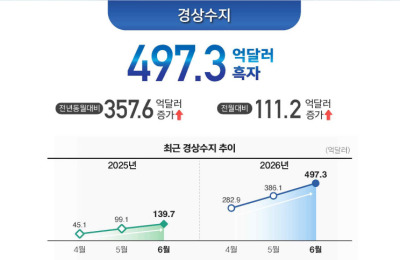
[서울=뉴스핌] 박가연 기자 = 지난 6월 우리나라의 경상수지가 전월에 이어 역대 최대 흑자를 기록했다. 반도체를 중심으로 한 정보기술(IT) 품목 수출 호조로 월간 상품수출이 처음으로 1000억달러를 넘어선 영향이다.
[자료=한국은행]
한국은행이 6일 발표한 '2026년 6월 국제수지(잠정)'에 따르면 지난 6월 경상수지는 497억3000만달러 흑자로 집계됐다. 전월(386억1000만달러)에 이어 두 달 연속 월간 기준 역대 최대 기록을 갈아치웠다. 이에 따라 올해 상반기 누적 경상수지 흑자는 1910억1000만달러를 기록했다.
경상수지 흑자를 견인한 것은 상품수지다. 6월 상품수지는 478억9000만달러 흑자를 기록하며 전월에 이어 역대 최대를 다시 썼다. 국제수지 기준 상품수출은 1123억7000만달러로 전년 동월 대비 84.5% 증가하며 월간 기준 처음으로 1000억달러를 넘어섰다. 상품수입은 644억8000만달러로 38.6% 늘었다.
통관 기준으로는 반도체 수출이 전년 동월 대비 196.9% 급증했고 컴퓨터·주변기기(SSD)는 282.7% 증가했다. IT 품목 수출은 160.4% 늘었으며 비IT 품목도 ▲석유제품(47.5%) ▲화공품(18.6%) ▲철강제품(17.9%) ▲승용차(6.1%) 등을 중심으로 18.6% 증가했다. 통관 기준 수입은 ▲원자재(30.5%) ▲자본재(35.3%) ▲소비재(16.4%)가 모두 늘었다.
서비스수지는 12억9000만달러 적자를 기록해 전월(-10억9000만달러)보다 적자 폭이 확대됐다. 여행수지는 외국인 입국자 증가와 유류할증료 인상 등에 따른 출국자 감소로 4억4000만달러 흑자를 기록했지만 지식재산권사용료수지는 전월 흑자에서 4억4000만달러 적자로 전환됐다.
본원소득수지는 배당소득을 중심으로 32억7000만달러 흑자를 기록해 전월(21억7000만달러)보다 흑자 폭이 확대됐다. 배당소득수지는 배당수입이 늘어난 데다 전월 분기배당에 따른 기저효과로 배당지급이 줄면서 25억6000만달러 흑자를 나타냈다.
금융계정 순자산은 6월 중 467억1000만달러 증가해 월간 기준 역대 최대 증가 폭을 기록했다. 종전 최대였던 올해 3월(369억9000만달러)을 넘어선 것이다. 직접투자에서는 내국인의 해외투자가 80억1000만달러, 외국인의 국내투자가 46억3000만달러 각각 증가했다.
증권투자에서는 외국인의 국내 주식 매도세가 이어졌다. 외국인의 국내 주식 투자는 차익실현 매도 등의 영향으로 316억1000만달러 감소하며 전월(-310억5000만달러)에 이어 역대 최대 순매도 기록을 다시 경신했다.
외국인의 국내 채권투자는 세계국채지수(WGBI) 자금 유입에도 분기 말 만기도래 영향으로 증가 폭이 줄어든 52억9000만달러를 기록했다. 내국인의 해외 증권투자는 주식을 중심으로 35억6000만달러 증가했다.
eoyn2@newspim.com
2026-08-06 08:00