


Remarks by Governor Susan Schmidt BiesAt the Mortgage Bankers Association Presidents Conference, Half Moon Bay, CaliforniaJune 14, 2006 A Supervisor's Perspective on Mortgage Markets and Mortgage Lending Practices Good morning. It is a pleasure to be here today, and I thank you for the invitation. It almost goes without saying that over the past several years, residential housing markets have been attracting considerable attention, and they have been a strong contributor to the overall growth of the U.S. economy. Today I would like to offer some thoughts on the current state of both residential and commercial mortgage markets and then discuss some ways in which U.S. bank supervisors are trying to ensure that bank lending in those markets is safe and sound. Conditions in Real Estate MarketsResidential Real Estate MarketsActivity in U.S. housing markets is slowing. Incoming data point to a decided, but so far moderate, cooling. Starts of single-family houses fell appreciably in March and April. Because construction had been spurred in the preceding months by unusually mild weather, some slowing in the spring was natural. However, the level of housing starts lately has fallen below not just the elevated winter pace but also the pace of last fall. Indeed, construction permit issuance for single-family homes, which is less affected by the weather, has been declining since September. Sales of new and existing homes have dropped noticeably from their highs of last year. In addition, inventories of unsold homes have increased, and your own MBA index of loan applications for home purchases has trended lower in recent months.Although a slowdown in housing activity is apparent in a wide range of indicators, it seems to be occurring in a gradual way. Notwithstanding their recent slip, both home construction and home sales are still at relatively high levels. The underlying fundamentals of housing demand also remain favorable. Real disposable income is growing at a solid pace. In the aggregate, household balance sheets appear to be in a good position, even though risks clearly exist for some households. Long-term mortgage rates, although up substantially from last summer's level, remain low relative to their historical experience.The latest data on house prices from the Office of Federal Housing Enterprise Oversight suggest that house-price appreciation has moderated but that prices in the aggregate continue to move up. Between the first quarter of 2005 and the first quarter of this year, the price index for existing homes sold in repeat transactions increased 10 percent--a solid gain but down a bit from the record pace for the period mid-2004 to mid-2005. Focusing on the first quarter of 2006 alone, prices increased at an annual rate of 7.3 percent. However, quarterly figures should be treated with a good degree of caution given the volatility of this data series.Given the slowing conditions in the housing market, spending for the construction of new housing is unlikely to be an important direct source of overall GDP growth this year, after having contributed close to ½ percentage point last year. In addition, the slackening of house-price appreciation could hold back growth in consumption spending through the so-called wealth effect, or the effect that lower overall housing wealth has on consumption. Estimates from various econometric models of consumer spending suggest that each dollar of change in wealth is associated with a change in consumption of approximately 3½ cents, with roughly half of the effect occurring within a year.Of course, these consumption estimates are just that--estimates. Beyond the usual issues of measurement and interpretation associated with any statistical estimate, one can easily point to some specific risks in estimating how housing wealth affects spending. First, econometric modeling has had difficulty distinguishing between the effects of movements in housing wealth and movements in other components of household balance sheets, even though housing may be a unique asset in a number of ways. Thus, the estimate of change in consumption that I cited is based on the historical relationship between spending and changes in overall wealth. Changes in housing wealth may have a somewhat different effect. Second, the linkages between housing wealth and consumption may change over time. For example, these linkages may be stronger now than in the past because financial innovation has made it easier and less costly for households to tap their accumulated housing equity. Third, a pronounced deceleration in house prices could have an outsized effect on consumer confidence, and such a decline in confidence could be an additional damping force on consumption.Another housing-related issue that bears watching is mortgage debt accumulation. Since the end of 2002, home mortgage debt outstanding has risen about 50 percent. The increase has substantially pushed up homeowners' mortgage payments in relation to their income, in spite of historically low mortgage rates, the growing use of interest-only mortgages, and the lengthening of average loan maturities over the past few years. That said, homeowners appear to be able to manage these higher payments: we have seen only a little deterioration in mortgage credit quality as yet, and overall delinquency rates remain low. Going forward, I expect aggregate homeowner mortgage payments to continue to rise, especially as adjustable-rate mortgages reach their initial reset dates. However, these reset adjustments are expected to be gradual, and only a modest number of outstanding mortgages are expected to reset during 2006 and 2007. To date, consumers appear to be managing changes in their mortgage payments quite well. One area of potential concern relates to the portion of home sales accounted for by investors, as opposed to owner-occupants. Historically, only around 5 percent of U.S. homes were purchased each year by investors; in 2005, it appears that figure was considerably higher. In many cases, investors purchased homes because they believed prices were going to rise further, not necessarily because they wanted to retain the property over time for rental income. As prices level off or even decline, it will be important to see whether this investor activity subsides significantly, and if so, the impact on mortgage markets more broadly.Commercial Real Estate MarketsIn addition to monitoring residential markets, the Federal Reserve keeps a close watch on developments in commercial real estate markets. Overall, conditions in this sector appear to be improving. Demand for commercial space has been growing moderately, while the construction of new space has generally remained tame, restrained in part by steep land prices and high construction costs. The result has been a widespread decline in vacancy rates over the past few years. Reflecting this improved balance between demand and supply, rents on commercial properties have been increasing after a prolonged period of softness.Although the level of commercial construction remains well below its peak in 2000, the latest data indicate what may be the beginning of a pickup. Census Bureau data on nonresidential construction put in place suggest that real spending rose in April for the sixth consecutive month. Leading indicators of commercial construction spending, such as billings by architectural firms for design work, point to further increases in activity in coming months. An upturn in commercial construction could offset part of what is anticipated to be a waning contribution to GDP growth from the housing sector.The performance of commercial real estate loans has generally been very good, due in large part to the low interest rates of recent years and the substantial appreciation of property values that has resulted in sizable equity positions for building owners. Delinquency rates on loans held by commercial banks and life insurance companies remain low by historical standards, and delinquencies on commercial mortgage-backed securities have reversed the modest increase that occurred from 2000 to 2003. The latest information on property prices hints at some moderation in price increases in the first quarter from the rapid price appreciation of last year. But, as in the housing market, commercial real estate prices are continuing to rise in the aggregate. Recent Supervisory Guidance Relating to Real Estate LendingThe Federal Reserve will continue to monitor developments in the residential and commercial real estate markets very closely. In addition to scrutinizing the effect of these developments on the economy, we are also, in our role as bank supervisors, monitoring banks' mortgage lending practices. Last year, the federal bank regulatory agencies issued draft guidance on both residential and commercial mortgage lending. The agencies have received many comments on the proposed guidance, including comments from your association, which we will consider as we discuss what steps to take next. I will address the guidance on residential mortgage lending first. Nontraditional Mortgage ProductsOver the past few years, the agencies have observed an increase in the number of residential mortgage loans that allow borrowers to defer repayment of principal and, sometimes, interest. These loans, often referred to as nontraditional mortgage loans, include interest-only (IO) mortgage loans, for which the borrower pays no loan principal for the first few years of the loan, and payment-option adjustable-rate mortgages (option ARMs), for which the borrower has flexible payment options--and which could result in negative amortization.IOs and option ARMs are estimated to have accounted for almost one-third of all U.S. mortgage originations in 2005, compared with fewer than 10 percent in 2003. Despite their recent growth, however, it is estimated that these products still account for less than 20 percent of aggregate domestic mortgages outstanding of nearly $9 trillion. Although the credit quality of residential mortgages generally remains strong, the Federal Reserve and the other banking supervisors are concerned that banks' current risk-management techniques may not fully address the level of risk inherent in nontraditional mortgages, a risk that would be heightened by a downturn in the housing market. Mortgages with some of the characteristics of nontraditional mortgage products have been available for many years; however, they have historically been offered to higher-income borrowers. More recently, nontraditional mortgages have been offered to a wider spectrum of consumers, including subprime borrowers, who may be less suited for these types of mortgages and may not fully recognize their embedded risks. These borrowers are more likely to experience an unmanageable payment shock during the life of the loan, meaning that they may be more likely to default on the loan. Further, nontraditional mortgage loans are becoming more prevalent in the subprime market at the same time risk tolerances in the capital markets have increased. Banks need to be prepared for the resulting impact on liquidity and pricing if and when risk spreads return to more "normal" levels and competition in the mortgage banking industry intensifies.Supervisors have also observed that lenders are increasingly combining nontraditional mortgage loans with weaker mitigating controls on credit exposures--for example, by accepting less documentation in evaluating an applicant's creditworthiness and not evaluating the borrower's ability to meet increasing monthly payments when amortization begins or when interest rates rise. These "risk layering" practices have become more and more prevalent in mortgage originations. Thus, although some banks may have used some elements of nontraditional mortgage products successfully in the past, the recent easing of traditional underwriting controls and the sale of nontraditional products to subprime borrowers may contribute to losses on these products.Supervisors are concerned that banks may not be fully aware of the potential risks of using risk-layering practices with nontraditional mortgage products. These practices may have become more widespread over the past couple of years as competition for borrowers and declining profit margins may have forced lenders to loosen their credit standards to maintain their loan volume. In the Federal Reserve Board's most recent Senior Loan Officer Survey, conducted this past April, more than 10 percent of the surveyed institutions reported having eased their underwriting standards for residential mortgage loans. Only one of the surveyed lenders reported having tightened standards. Additionally, information from other sources seems to show continued growth in the number of borrowers purchasing real estate with no equity using simultaneous second liens.Naturally, we are watching for any signs that defaults may be on the rise. Some industry evidence indicates that delinquencies may be on the uptick; delinquency rates for loans issued in 2005 are, in most cases, higher than those for comparable loans issued in earlier years. Some industry observers believe that the increase in delinquencies for loans issued in 2005 is directly related to the continued easing of underwriting standards and the increased use of risk-layering practices.The industry trends I have just described, taken together, were the justification for the issuance of draft guidance on nontraditional mortgage products by the Federal Reserve and the other banking agencies. The proposed guidance emphasizes that an institution's risk-management processes should allow it to adequately identify, measure, monitor, and control the risk associated with these products. It reminds lenders of the importance of assessing a borrower's ability to repay the loan, both now and when amortization begins and interest rates rise. Nontraditional mortgage products warrant a bank having strong risk-management standards as well as appropriate capital and loan-loss reserves. Further, bankers should consider the impact of prepayment penalties for ARMs. Lenders should provide enough information so that borrowers clearly understand, before choosing a product or payment option, the terms of and risks associated with these loans, particularly the extent to which monthly payments may rise and negative amortization may increase the amount owed above the amount originally borrowed. Lenders should recognize that certain nontraditional mortgage loans are untested in a stressed environment; for instance, nontraditional mortgage loans to investors that rely on collateral values could be particularly affected by a housing-price decline. As noted, investors have represented an unusually large share of recent home purchases. Past loan performance has indicated that investors are more likely than owner-occupants to default on a loan when housing prices decline. When credit standards are eased and risks are layered, institutions should compensate for the increased risk with mitigating factors that support the underwriting decision. Among other credit enhancements, these factors generally include requiring borrowers to have higher credit scores, lower loan-to-value and debt-to-income ratios, and significant liquidity and net worth. Finally, lenders should establish appropriate allowances for estimated credit losses in their nontraditional mortgage portfolios and hold capital commensurate with the risk characteristics inherent in these products.One final subject that is not addressed explicitly in our draft guidance, but that I believe is still important to supervisors and bankers, is mortgage fraud. There appears to have been a substantial upswing in suspected fraud related to residential mortgages in the past decade. Types of fraud include falsification of loan applications, identity theft, misuse of loan proceeds, and inflated appraisals. According to the Financial Crimes Enforcement Network, there were more than 18,000 reports of suspected mortgage fraud in 2004 (the latest year for which we have complete data), compared with fewer than 2,000 reports in 1997. And in the first six months of 2005 alone, there were more than 11,000 reports of suspected mortgage fraud. The increase may be attributable in part to an increase in the number of originators required to file Suspicious Activity Reports (SARs). Notably, the more widespread use of nontraditional loan products may present greater opportunity for fraud, as these products sometimes lack some of the quality checks typical of more-traditional mortgages. In general, we consider mortgage fraud to be a serious issue and one that bankers and supervisors must continue to confront. Of course, supervisors want to hear the industry's perspective on fraud in mortgage lending. Commercial Real EstateThe U.S. banking agencies recently issued proposed guidance on commercial real estate (CRE) lending. A major portion of that guidance focuses on CRE concentrations. Before I discuss the importance of managing CRE concentrations, I want to emphasize that the proposed CRE guidance relates to "true" CRE loans. It is not directed at commercial loans for which a bank looks to a business's cash flow as the source of repayment and accepts real estate collateral as a secondary source of repayment. The proposed guidance addresses bank loans for commercial real estate projects for which repayment depends on third-party rental income or on the sale, refinancing, or permanent financing of the property. The latter are "true" commercial real estate loans, in that repayment depends on the condition and performance of the real estate market.I also want to mention up front that the proposed guidance is not intended to cap or restrict banks' participation in the CRE sector but rather to remind institutions that proper risk management and appropriate capital are essential elements of a sound CRE lending strategy. In fact, many institutions already have both of these elements in place and may not need to adjust their practices very much. I believe we are all aware of the central role that CRE lending played in the banking problems of the late 1980s and early 1990s. One reason supervisors are proposing CRE guidance at this point is that we are seeing high and rising concentrations of CRE loans relative to capital. For certain groups of banks, such as those with assets of between $100 million and $1 billion, the average CRE concentration level is about 300 percent of total capital. In the late 1980s and early 1990s, the concentration level for this same bank group was about 150 percent, or half the current level. Therefore, banks should not be surprised by the emphasis in the proposed CRE guidance on concentrations and the importance of portfolio risk management. Historically, CRE has been a highly volatile asset class. In the past, problems in CRE, even at well-managed banks, have generally come at times when the broader market was encountering difficulties. In an effort to generate cash flow, borrowers and bankers with properties in distress may disrupt their local real estate market by cutting rents or offering leasehold improvements and other incentives to attract or keep tenants. These actions can have a negative effect on the entire local real estate market, including good projects. In most years, CRE credit losses are relatively low compared with many other types of bank loans. But in times of stress, the loss rate can jump considerably higher. Because CRE losses tend to be greater during times of stress, bankers must focus more intently on their risk appetite as their CRE concentration grows. Bankers must consider how much capital will be placed at risk if the CRE portfolio hits a stress period and compare that loss exposure with the relative returns of CRE lending. In other words, bankers need to practice risk management.While banks' underwriting standards are generally stronger than they were in the 1980s and 1990s, the agencies are proposing the guidance now to reinforce sound portfolio-management principles that a bank should have in place when pursuing a commercial real estate lending strategy. A bank should be monitoring performance both on an individual-loan basis as well as on a collective basis for loans collateralized by similar property types or in the same markets. Some institutions' strategic- and capital-planning processes may not adequately acknowledge the risks from their CRE concentrations. CRE lending in recent years has occurred under fairly benign credit conditions, but those conditions are unlikely to continue indefinitely. The ability of banks with significant concentrations to weather difficult market conditions will depend heavily on their risk-management processes and their level of capitalization. From a risk-management and capital perspective, institutions should generally focus on the emerging conditions in their real estate markets and on the potential cumulative impact on their portfolios if conditions deteriorate; they should also take other measures to help identify CRE vulnerabilities. Of course, these measures should vary according to the size of the organization and the level of the concentration. All of these steps are key elements of a sound strategy to manage concentrations. While supervisors continue to underscore the importance of having robust risk-management practices for CRE and other lending concentrations, we do acknowledge that banks may pursue a variety of approaches. In some cases, such as when there is not enough market data available or the relevant geographic market is small, banks may have to turn to less- quantitative approaches. Nonetheless, those approaches should be robust, well documented, and transparent. This is consistent with the broader theme that risk management should be scaled to the institution. Along those same lines, we are not necessarily expecting smaller banks to be able to conduct regular, extensive, and sophisticated quantitative stress tests around their lending concentrations. However, we do want bankers at smaller organizations to have clear and coherent methods for evaluating the various potential outcomes associated with their CRE concentrations and with all their exposures more broadly. ConclusionIn the past several decades, real estate markets, both residential and commercial, have affected the U.S. economy in both negative and positive ways. Naturally, the Federal Reserve monitors these markets to gauge their impact on broader economic activity. In addition, because banks are substantially involved in both residential and commercial real estate markets, as a supervisor, we must ensure that bank lending in these markets is conducted in a safe and sound manner. One tool we use to help maintain the safety and soundness of banks is supervisory guidance, which can point out areas requiring additional monitoring, suggest ways in which banks can improve risk management, and remind bankers that they should continue to exercise discipline in their lending activities to ensure that they are accounting for all their risks. The recently issued draft guidance on nontraditional mortgage products and on CRE lending, as I have noted, is not an attempt to stifle lending in these sectors, which, if conducted properly, can continue to be profitable businesses for bankers. Indeed, we recognize the important role that banks play in real estate lending. That is why we want to ensure that banks maintain good practices when operating in those markets. As a final point, if both sets of guidance are finalized, we aim to implement them as consistently as possible across institutions. We do understand bankers' concerns about this issue. Of course, it is always a challenge to ensure that there is consistent application of guidance throughout the industry, especially when bank-specific factors--such as portfolio concentrations and individual risk-management practices--might affect the manner in which the guidance needs to be applied to each bank. But if the guidance is indeed finalized, we plan to undertake considerable efforts across our agencies, including extensive communication and coordination, so that banks are not subject to needlessly differing treatment.

[관련키워드]




[뉴스핌 베스트 기사]
 사진
사진
정동영 업무보고 논란
[서울=뉴스핌] 유신모 외교전문기자 = 청와대 영빈관에서 5일 열린 외교·안보 분야 정부 부처의 대통령 업무보고에서 정동영 통일부 장관의 '한반도 평화공존 발전 구상'과 업무보고 발언이 논란을 빚고 있다.
이날 정 장관의 발언 중에는 정부 내 조율을 거치지 않은 사안을 정책으로 추진하겠다고 공언한 것이 있는가 하면 사실 관계에 맞지 않은 설명도 있었다. 이재명 대통령은 공개적으로 신중을 기해 달라고 경고했고, 조현 외교부 장관은 '이상주의적 희망에 근거한 비현실적 구상'이라는 비판을 내놨다.
그동안 정 장관의 대북 정책 관련 발언이 물의를 빚은 적은 여러 번 있지만 대통령과 유관 부처 장관이 공개적으로 부정적 입장을 표명한 것은 이례적이다. 정 장관의 무리한 대북 접근법과 월권을 제어해야 한다는 목소리도 높아지고 있다.
[정동영 통일부 장관이 지난달 23일 오후 서울 종로구 정부서울청사에서 취임 1주년 기자간담회를 하고 있다. [사진=통일부] 2026.07.23
◆통일부 장관 권한 넘어선 주장
정 장관은 이날 업무보고에서 '한반도 평화공존 발전 구상'을 설명하면서 이재명 정부 2년차 핵심 과제로 상호 존중·평화적 갈등 해결·핵 없는 한반도 등 3대 기본 방향을 제시했다.
정 장관은 "대결과 혐오의 언어는 멈춰야 한다"면서 주적 용어 대체를 주장했다. 지난 25년간의 CVID(완전하고 검증가능하며 되돌릴 수 없는 비핵화) 구도는 이미 무너졌다고도 했다. 또 "현 시점에서 흘러간 선(先)비핵화만 되뇌는 것은 현실을 바꾸는 데 힘이 되지 않는다"고 주장했다. 정 장관은 또 "정전 체제를 평화 체제로 바꾸는 논의에 착수하겠다"면서 "북·미 정상회담 견인과 함께 4자 대화의 동력을 확보하기 위해 최선을 다할 것"이라고 말했다.
하지만 이 대통령은 정 장관의 구상에 대부분 제동을 걸었다. 이 대통령은 "평화공존 정책이 정치적으로 악용되는 측면이 있다"며 "많이 조심하셔야 한다"고 지적했다.
북한을 다른 이름으로 불러야 한다는 주장에는 "표현에 꼬투리가 잡혀 정쟁으로 휘몰아 들어가면 원래 하고자 했던 데에서 오히려 나쁜 상황이 초래될 수 있다"고 경고했다.
이 대통령은 남북 신뢰 구축을 위해 9·19 군사합의를 선제적으로 복원해야 한다는 정 장관의 주장에 대해서도 "우리의 선의대로 하는 게 과연 한반도의 평화와 안정에 플러스냐, 결론적으로 약간의 의문이 들 때도 있다"며 부정적으로 반응했다.
조현 외교부 장관은 업무보고 사후 브리핑에서 정 장관이 언급한 '4자 회담'에 대해 "이상주의에 근거한 어떤 희망이라 하더라도 그건 아직 조율되지 않은 방법"이라며 "여러분들께서 디스카운트해 주시면 좋겠다"고 선을 그었다.
정 장관이 9월 러시아 블라디보스토크에서 열리는 '동방경제포럼(EEF)'을 언급하며 "정부 차원에서 (참석을) 검토하고 있다"고 발언한 데 대해서도 조 장관은 "그것은 외교부의 몫"이라며 "아직 거기까지 진도가 나가지 않았다"고 잘랐다.
정 장관이 이날 소개한 대북 구상과 설명은 정부 내 조율을 거치지 않았다는 점에서 문제가 있다. 특히 주적 표현 대체와 국호 사용, 9·19 군사합의 복원, 4자회담 추진 등은 통일부 장관이 결정할 사안이 아니어서 월권이라는 지적이 나오고 있다. 이 대통령은 정 장관의 업무보고를 듣고 난 뒤 "여기 업무보고에 발표했다고 승인난 건 아니다"라고 재차 확인했다.
정부의 한 소식통은 "정 장관의 발언 내용은 대부분 국가안전보장회의(NSC)를 거쳐 결정된 사안이 아닌 정 장관의 개인적 생각에 가깝다"며 "안보 관련 부처 장관이 정부의 공식 정책이 아닌 사안을 추진하겠다고 업무보고를 하고 대통령의 면전에서 '국군통수권자가 나서야 한다'고 주장한 것은 심각한 문제"라고 지적했다.
이재명 대통령이 5일 청와대 영빈관에서 열린 통일 외교 국방 등 외교 안보 부처 업무보고에서 발언하고 있다. [사진=청와대] 2026.08.05
◆시대착오적 접근, 대북 인식 오류
더욱 문제인 것은 정 장관의 이같은 주장이 현 시점에서 이미 참고가 될 수 없는 과거의 경험 또는 사실과 다른 인식에 기반하고 있다는 것이다. 정 장관이 주장하는 구상은 급격히 변화하고 있는 북한의 전략과 한반도 및 국제 정세를 전혀 반영하지 못하고 있다는 비판이 제기되고 있다.
정 장관이 "흘러간 선(先)비핵화만 되뇌는 것은 현실을 바꾸지 못한다"고 언급한 것은 지금까지의 대북 접근법을 호도하고 있다. 북핵 위기 발발 이후 지금까지 모든 핵 협상에서 한국이나 미국은 북한에 선비핵화를 공식적으로 요구한 적이 없기 때문이다.
지금까지의 북핵 협상은 북한의 비핵화 조치에 한·미가 상응하는 대가를 제공하는 방식으로 이뤄졌다. 1994년 북·미 제네바 기본합의는 핵시설 동결과 중유 제공의 교환이었다. 2005년 9.19 공동성명도 북한의 비핵화 조치의 모든 단계에 상응조치를 제공하는 '행동 대 행동' 원칙이 적용됐다.
대북 협상에 관여했던 한 전직 관료는 "모든 북핵 협상은 북한의 비핵화 조치와 한·미가 제공하는 상응조치를 어떻게 정교하게 배열하느냐가 관건이었다"면서 "정 장관의 발언은 지금까지 한·미가 북한에 먼저 핵을 포기해야 대화할 수 있다는 정책을 고수해 현 상황에 이르게 됐다는 잘못된 인식에서 비롯된 것으로 보인다"고 말했다.
정 장관이 "지난 25년간의 CVID 구도가 무너졌다"고 말한 것도 비핵화의 개념에 대한 이해 부족이라는 비판이 제기되고 있다. 북핵 문제에 정통한 외교 소식통은 "어떤 명칭을 붙이든 핵을 제거한 뒤 이를 검증하고 재발 방지 조치를 하는 것은 비핵화에 반드시 포함되어야 하는 기본적 절차"라며 "CVID는 안 된다고 말하는 것은 북한의 비핵화 조치를 검증도 하지 않고 언제든 되돌릴 수 있도록 합의하자는 말과 같다"고 지적했다.
[서울=뉴스핌] 이길동 기자 = 조현 외교부 장관이 5일 오후 서울 종로구 정부서울청사 별관에서 2026년 하반기 업무보고 사후브리핑을 하고 있다. 2026.08.05 gdlee@newspim.com
◆안보 리스크 키우는 통일부 장관
정 장관은 지난해 취임 직후부터 청와대와 외교부를 제치고 통일부가 북한과 관련된 모든 정책을 주도해야 한다는 주장을 펴면서 단독 질주를 거듭해왔다.
북한의 '적대적 두 국가' 주장을 변형한 '평화적 두 국가'를 지향해야 한다고 주장하면서 이에 문제점을 지적하는 목소리를 무시했다. 외교부가 미국과 북한 문제를 논의하는 것에 대해 "한반도 정책과 남북관계는 주권의 영역이며 동맹국과 협의의 주체는 통일부"라고 주장해 물의를 빚었다. 문재인 정부 시절 한·미 워킹그룹이 남북관계 파탄 원인이었다고 사실과 다른 주장을 폈다.
지난해 업무보고에서는 국제정세를 감안하지 않고 남북대화 재개에만 초점을 맞춘 비현실적 내용으로 논란을 빚었다. 정부 내 조율도 거치지 않고 독자 대북제재인 5·24 조치를 해제하고 9·19 군사합의 비행금지구역 복원을 추진하겠다는 방침도 밝혔다.
지난 4월에는 평안북도 구성시에 우라늄 농축 시설이 있다고 말해 파장을 일으켰다. 미국은 이 발언을 계기로 한국과 대북정보 공유를 제한했다. 이 조치는 지금도 계속되고 있는 것으로 알려졌다.
정 장관이 이처럼 정부의 공식 결정을 거치지 않은 사안을 정부 정책인 것처럼 주장하며 좌충우돌하는 배경에 대해 여러가지 해석이 나온다. 북한 문제에서 조기에 성과를 거둬야 한다는 조급증과 자신의 존재감 과시 욕구가 작용하고 있다는 평가가 많다.
일각에서는 정 장관이 2007년 민주당 대선후보였을 때 이재명 대통령이 캠프에서 비서실 부실장으로 활동한 전력이 있다는 것을 들어 "정 장관이 아직도 이 대통령을 아랫사람으로 생각하고 있는 것 아니냐"는 비판을 내놓기도 한다.
한·미 관계와 북한 문제를 오래 다뤘던 전직 관료 출신의 한 전문가는 "정 장관 취임 후 지금까지의 언행은 잘못된 현실 인식에 따른 독단과 앞서 가기, 월권 등으로 점철돼 있다"면서 "통일부 장관이라는 중요한 직책에 있으면서 스스로 안보 리스크를 키우는 역할만 했다"고 비판했다.
opento@newspim.com
2026-08-06 06:10
 사진
사진
6월 경상수지 최대 흑자
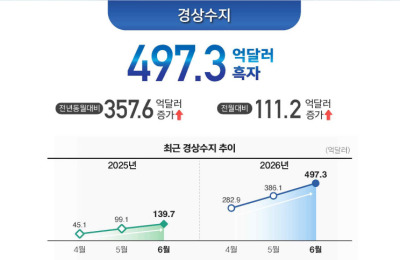
[서울=뉴스핌] 박가연 기자 = 지난 6월 우리나라의 경상수지가 전월에 이어 역대 최대 흑자를 기록했다. 반도체를 중심으로 한 정보기술(IT) 품목 수출 호조로 월간 상품수출이 처음으로 1000억달러를 넘어선 영향이다.
[자료=한국은행]
한국은행이 6일 발표한 '2026년 6월 국제수지(잠정)'에 따르면 지난 6월 경상수지는 497억3000만달러 흑자로 집계됐다. 전월(386억1000만달러)에 이어 두 달 연속 월간 기준 역대 최대 기록을 갈아치웠다. 이에 따라 올해 상반기 누적 경상수지 흑자는 1910억1000만달러를 기록했다.
경상수지 흑자를 견인한 것은 상품수지다. 6월 상품수지는 478억9000만달러 흑자를 기록하며 전월에 이어 역대 최대를 다시 썼다. 국제수지 기준 상품수출은 1123억7000만달러로 전년 동월 대비 84.5% 증가하며 월간 기준 처음으로 1000억달러를 넘어섰다. 상품수입은 644억8000만달러로 38.6% 늘었다.
통관 기준으로는 반도체 수출이 전년 동월 대비 196.9% 급증했고 컴퓨터·주변기기(SSD)는 282.7% 증가했다. IT 품목 수출은 160.4% 늘었으며 비IT 품목도 ▲석유제품(47.5%) ▲화공품(18.6%) ▲철강제품(17.9%) ▲승용차(6.1%) 등을 중심으로 18.6% 증가했다. 통관 기준 수입은 ▲원자재(30.5%) ▲자본재(35.3%) ▲소비재(16.4%)가 모두 늘었다.
서비스수지는 12억9000만달러 적자를 기록해 전월(-10억9000만달러)보다 적자 폭이 확대됐다. 여행수지는 외국인 입국자 증가와 유류할증료 인상 등에 따른 출국자 감소로 4억4000만달러 흑자를 기록했지만 지식재산권사용료수지는 전월 흑자에서 4억4000만달러 적자로 전환됐다.
본원소득수지는 배당소득을 중심으로 32억7000만달러 흑자를 기록해 전월(21억7000만달러)보다 흑자 폭이 확대됐다. 배당소득수지는 배당수입이 늘어난 데다 전월 분기배당에 따른 기저효과로 배당지급이 줄면서 25억6000만달러 흑자를 나타냈다.
금융계정 순자산은 6월 중 467억1000만달러 증가해 월간 기준 역대 최대 증가 폭을 기록했다. 종전 최대였던 올해 3월(369억9000만달러)을 넘어선 것이다. 직접투자에서는 내국인의 해외투자가 80억1000만달러, 외국인의 국내투자가 46억3000만달러 각각 증가했다.
증권투자에서는 외국인의 국내 주식 매도세가 이어졌다. 외국인의 국내 주식 투자는 차익실현 매도 등의 영향으로 316억1000만달러 감소하며 전월(-310억5000만달러)에 이어 역대 최대 순매도 기록을 다시 경신했다.
외국인의 국내 채권투자는 세계국채지수(WGBI) 자금 유입에도 분기 말 만기도래 영향으로 증가 폭이 줄어든 52억9000만달러를 기록했다. 내국인의 해외 증권투자는 주식을 중심으로 35억6000만달러 증가했다.
eoyn2@newspim.com
2026-08-06 08:00