


Economic Conditions and Monetary Policy Sandra PianaltoPresident and CEOFederal Reserve Bank of ClevelandBroadcast Cable Financial Management AssociationBuena Vista PalaceOrlando, FloridaJune 12, 2006As I am sure you are all very well aware, the Federal Reserve's policymaking body, the Federal Open Market Committee, or FOMC, will meet again at the end of this month to consider the course of U.S. monetary policy. Over the next couple of weeks, everyone involved with the FOMC will study a vast amount of data and many economic forecasts. During those same two weeks, we will also see a lot of speculation in the media and elsewhere about what the FOMC will do when we meet on June 28th and 29th. Today, I will talk about how I am thinking about current economic conditions and monetary policy.I will begin with some background on how we make monetary policy decisions. Next, I will explore how our economy's performance is influencing the Federal Reserve's monetary policy decisions. Finally, I will discuss a topic that is near and dear to both of our professions - communications - and talk about how clear communications can factor into the policymaking process.Please note that the opinions I express here today are mine alone. I do not presume to speak for any of my colleagues in the Federal Reserve System. I. What We Do at the Federal Reserve Let me begin, then, with a few words about what we do and how we operate at the Federal Reserve.When news reports talk about "the Fed," they are really talking about a combination of two entities: the seven-member Board of Governors based in Washington and led by Chairman Ben Bernanke, and the 12 Federal Reserve Banks around the country.I lead the Federal Reserve Bank of Cleveland - the Fourth District in the 12-district system. The Fourth District includes all of Ohio, western Pennsylvania, eastern Kentucky, and the panhandle of West Virginia. Like the other 11 Reserve Banks, the Federal Reserve Bank of Cleveland supervises banks; conducts research on economic conditions; provides financial services to banks and the U.S. Treasury; and serves as a resource for community economic development. And, yes, we also participate in conducting monetary policy-an area that has been dominating the headlines recently.Monetary policy is conducted by the FOMC, which brings together the seven governors and 12 Reserve Bank presidents. We meet eight times a year in Washington, D.C.Let me give you a quick run-through of a typical meeting. One of the first things we consider are projections for domestic and international economic conditions. These projections are developed by the economists at the Board of Governors and are contained in a document known as the Green Book. The projections are reviewed with the Committee, and we use this time on the agenda to raise questions about the projections and discuss issues associated with them.Next, we discuss what we have been hearing from business leaders in our respective districts about international, national and regional business conditions. In FOMC meetings, we have what we call a "go 'round." We literally go around the conference table, with each of the 19 members offering his or her viewpoint on economic conditions and the economic outlook. After each member has spoken, it is time to consider policy options, which are outlined for the Committee members in advance, in a document called the Blue Book. Then it is time for a second "go 'round," with members stating their views on which policy option should be adopted. If it is obvious that members generally agree, this "go 'round" can be fairly brief. Otherwise, a more in-depth discussion takes place. When we feel that we have enough information to make a decision on monetary policy, we proceed with a vote. Then we publish a public statement about our decision, summarizing what we did and why. Three weeks later, we publish the minutes of our meeting. Today, market watchers are focused on what we will decide to do later this month with our main policy instrument - the target for the federal funds rate. The federal funds rate is the rate at which banks lend each other money overnight. Movements in this rate have a powerful, if indirect, effect on the interest rates that have an impact on you and other consumers - on loans for cars, home mortgages, and business finance. The FOMC has a dual mandate: first, to maintain price stability over the long term, and, second, to promote maximum sustainable economic growth. Ultimately, we want the public to be confident that inflation will remain low and stable over time, and that the economy will continue to expand. II. How Economic Performance Influences Monetary Policy Now let me explain how we go about deciding where to set the target for the federal funds rate. Our national economy today is in reasonably good condition. But in order to set policy appropriately, we have to analyze not just where we are now, but also how we got here and where it looks like we're heading.So, how did the current business cycle unfold, and how did the FOMC respond? The economic downturn that began in 2001 called for a significantly lower federal funds rate. In light of weakening economic growth, falling market interest rates, and a general increase in perceived risks in the global economic outlook, the FOMC reduced the federal funds rate from 6½ percent to 1¼ percent by late 2002 - a level that had not been seen since 1961.In early 2003, in addition to maintaining an accommodative monetary policy to support the economic expansion, the FOMC also became concerned with the possible emergence of an unwelcome disinflation. In response, in June 2003, we lowered the federal funds rate one more time, to the historically low level of 1 percent. Starting in mid-2004, as the threat of unwelcome disinflation passed, and as economic conditions began to normalize, it made sense to begin the process of removing our policy accommodation. We accomplished that by raising our target for the federal funds rate. We did not know, at the time, how high we would have to raise the federal funds rate target. But we knew that the direction had to be considerably northwards. Step by step, in a series of 16 quarter-point adjustments, the FOMC has raised the federal funds rate to where it is today - 5 percent. Looking at the nation's current economic situation, do the data suggest that we have adjusted the federal funds rate appropriately? How are we doing in achieving our objectives of sustainable economic growth and price stability? Let's start by looking at economic growth. After a weak fourth quarter in 2005, mainly due to significant energy-price shocks and devastating hurricanes, the economy bounced back quite strongly in the first quarter of this year. Looking ahead, most forecasters are expecting economic growth to be about 3 percent for the second half of this year and for 2007. These growth rates, while consistent with a healthy economy, are lower than what we experienced for most of 2004 and 2005. The sectors of the economy that will support our economic growth this year are expected to be somewhat different from those that prevailed in the past few years. The housing market, after several years of strong expansion, is already showing signs of cooling off this year. Consumer sentiment has been deteriorating, according to the latest survey responses, and recent data show signs that consumer spending is softening from its strong first-quarter performance.Consumers have sustained their spending during the past several years, in part, by cashing out some of their home-equity dollars. This extra source of financing is likely to slow down in a softening housing market. Fortunately, though, I expect to see enough employment and income growth coming out of the labor market to keep consumer spending advancing at a moderate rate.On the business side, I look for capital spending to continue to expand at a decent pace again this year. Stronger economic growth abroad will also boost American exports. These two sectors - business spending and exports - are likely to mitigate the effects of a slowdown in the consumer and housing sectors.In summary, as the year progresses, I anticipate that the pace of economic expansion will slow from its rapid rate of growth in the first quarter. Nevertheless, I believe that we are on track to achieve our objective of sustainable economic growth.What about our objective of price stability? Inflation rates can be affected by all kinds of unusual events in the short term, especially large swings in energy prices. Of course, all of us are painfully aware of the huge increases we have seen in energy prices. We feel it every time we fill up our gas tanks. Americans are complaining that the energy-price increases have hit them hard - and they're right. The price of a barrel of oil has gone from about $20 in 2002 to roughly $70 today. Price pressures are also being felt across an array of other commodities, goods and services. As a result, the core rate of inflation has also been edging up lately. The Consumer Price Index has increased by 3.5 percent during the past year. The so-called core rate - that is, the CPI excluding food and energy - hasn't risen as much: It rose slightly more than 2 percent during the past year. But the core CPI has increased at an annualized rate of more than 3 percent during the past three months. This inflation picture, if sustained, exceeds my comfort level. Fortunately, the public is, for the most part, looking at this disappointing inflation news as a transitory development. Measures of long-term inflation expectations have been mixed lately, but, on the whole, I regard them as remaining contained. The FOMC's challenge is to make sure that they stay contained. The recent news on inflation troubles me, but the news has not come as a complete surprise. Last year I began to anticipate that we might confront some disappointing inflation data in the first half of this year, although I was not expecting quite as much inflation as we have seen. Still, I have been expecting price pressures to diminish. This juncture in the policymaking process is the most difficult. There is, after all, a time lag between monetary-policy actions and their ultimate effect on inflation. That is, even though the recently reported inflation numbers have been edging upward, I think that the current 5 percent level of the federal funds rate is near a point that is consistent with a gradual improvement in the inflation outlook. Of course, my current inflation outlook depends on the rest of the economy developing along the lines of my broader forecast. Specifically, I expect a flattening-out of energy prices, a cooling housing market, continued strong productivity growth, and a moderation in the overall pace of economic activity. III. Communications in Monetary Policy By now, it should be clear that setting monetary policy consists of several forward-looking elements - forecasts, inflation expectations, and the lagged effects of current and recent policy actions, to name just a few. Communications also play an important role in the entire enterprise of policymaking, especially in light of these forward-looking factors.Our communications not only inform the public of our interest rate actions, but also provide a context for understanding why the actions were taken, and, more broadly, help the public to form expectations about future economic and inflation conditions. For the FOMC to anchor the public's inflation expectations - which I have argued is essential to meeting our objectives of sustainable economic growth and price stability - our policy decisions and communications must give the public confidence that we will produce low inflation over the long run. The FOMC does not have long experience with frequent and detailed monetary policy communications. The Committee only began its current practice of immediately announcing its policy decisions in 1994. In a previous speech, I characterized the period since then as one in which the FOMC started learning how to talk.To me, that process is in some sense like a person learning how to walk through a dark room without knowing where the furniture is. You move very slowly, feeling your way. Sometimes you discover you're a bit off course. You may stumble, but you learn to adapt and move toward your destination. From my perspective, changes in the Committee's communications process since 1994 reflect an institution that is becoming more comfortable with greater transparency. Let me give you an example of how our more recent communications have evolved. Recall the episode that I mentioned earlier in my remarks, about our concern over unwelcome disinflation in 2003 and early 2004. To address that particular problem, the Committee explained that it expected to maintain its low federal funds rate for a considerable period. This language guided market participants to expect no policy changes for a while.As the threat of unwelcome disinflation passed, the language was gradually modified, eventually to be replaced by language suggesting that the accommodative policy could be removed at a measured pace. This phrase signaled that the funds rate would rise, but that it would be rise slowly and predictably.That language was altered once again last December, in an important way. Rather than repeating that accommodation could be removed at a measured pace, the Committee said that some further measured firming might be required. This change indicated, for the first time, that the Committee was focused on the risks of higher inflation. In January, the word "measured" was eliminated, signaling that the timing and magnitude of future actions would be less certain. As our experience demonstrates, communicating to markets is complicated because incoming data can affect not only how we evaluate current economic conditions, but also our view of where the economy is heading. Also, FOMC members may not all interpret the data in the same way at the same time. The minutes of our meetings, including the last one, indicate that there can be differences of opinion. Although these differences lead to better policy decisions over time, they add to the challenge we face as a Committee in communicating with the public.So, what are financial markets expecting? Well, as you may know, there is a market that deals with federal funds futures, and at the moment, market participants place much higher odds on another 25-basis-point rate hike than on a pause at the FOMC's meeting later this month. However, before the next FOMC meeting, more information on both prices and real economic activity will be available. Even if those numbers fail to change my outlook for inflation and economic growth, they may push my assessment of risks in one direction or another. New data, including statements from FOMC members, could also shift the odds that market participants place on the FOMC's upcoming decisions, in much the same way as they have during the past few weeks. It is important to emphasize that a good communication policy does not mean that the public will always be able to anticipate what the FOMC will do next. Sometimes the economic situation is simply too fluid to admit such certainty.What good communications can do is help people appreciate the Committee's objectives, understand how policymakers are thinking about the prospects for meeting those objectives, and consider how new information might affect policy choices.I hope that my remarks have given you a better understanding of how I think about economic conditions and the challenges we are facing as monetary policymakers.

[관련키워드]



[뉴스핌 베스트 기사]
 사진
사진
정동영 업무보고 논란
[서울=뉴스핌] 유신모 외교전문기자 = 청와대 영빈관에서 5일 열린 외교·안보 분야 정부 부처의 대통령 업무보고에서 정동영 통일부 장관의 '한반도 평화공존 발전 구상'과 업무보고 발언이 논란을 빚고 있다.
이날 정 장관의 발언 중에는 정부 내 조율을 거치지 않은 사안을 정책으로 추진하겠다고 공언한 것이 있는가 하면 사실 관계에 맞지 않은 설명도 있었다. 이재명 대통령은 공개적으로 신중을 기해 달라고 경고했고, 조현 외교부 장관은 '이상주의적 희망에 근거한 비현실적 구상'이라는 비판을 내놨다.
그동안 정 장관의 대북 정책 관련 발언이 물의를 빚은 적은 여러 번 있지만 대통령과 유관 부처 장관이 공개적으로 부정적 입장을 표명한 것은 이례적이다. 정 장관의 무리한 대북 접근법과 월권을 제어해야 한다는 목소리도 높아지고 있다.
[정동영 통일부 장관이 지난달 23일 오후 서울 종로구 정부서울청사에서 취임 1주년 기자간담회를 하고 있다. [사진=통일부] 2026.07.23
◆통일부 장관 권한 넘어선 주장
정 장관은 이날 업무보고에서 '한반도 평화공존 발전 구상'을 설명하면서 이재명 정부 2년차 핵심 과제로 상호 존중·평화적 갈등 해결·핵 없는 한반도 등 3대 기본 방향을 제시했다.
정 장관은 "대결과 혐오의 언어는 멈춰야 한다"면서 주적 용어 대체를 주장했다. 지난 25년간의 CVID(완전하고 검증가능하며 되돌릴 수 없는 비핵화) 구도는 이미 무너졌다고도 했다. 또 "현 시점에서 흘러간 선(先)비핵화만 되뇌는 것은 현실을 바꾸는 데 힘이 되지 않는다"고 주장했다. 정 장관은 또 "정전 체제를 평화 체제로 바꾸는 논의에 착수하겠다"면서 "북·미 정상회담 견인과 함께 4자 대화의 동력을 확보하기 위해 최선을 다할 것"이라고 말했다.
하지만 이 대통령은 정 장관의 구상에 대부분 제동을 걸었다. 이 대통령은 "평화공존 정책이 정치적으로 악용되는 측면이 있다"며 "많이 조심하셔야 한다"고 지적했다.
북한을 다른 이름으로 불러야 한다는 주장에는 "표현에 꼬투리가 잡혀 정쟁으로 휘몰아 들어가면 원래 하고자 했던 데에서 오히려 나쁜 상황이 초래될 수 있다"고 경고했다.
이 대통령은 남북 신뢰 구축을 위해 9·19 군사합의를 선제적으로 복원해야 한다는 정 장관의 주장에 대해서도 "우리의 선의대로 하는 게 과연 한반도의 평화와 안정에 플러스냐, 결론적으로 약간의 의문이 들 때도 있다"며 부정적으로 반응했다.
조현 외교부 장관은 업무보고 사후 브리핑에서 정 장관이 언급한 '4자 회담'에 대해 "이상주의에 근거한 어떤 희망이라 하더라도 그건 아직 조율되지 않은 방법"이라며 "여러분들께서 디스카운트해 주시면 좋겠다"고 선을 그었다.
정 장관이 9월 러시아 블라디보스토크에서 열리는 '동방경제포럼(EEF)'을 언급하며 "정부 차원에서 (참석을) 검토하고 있다"고 발언한 데 대해서도 조 장관은 "그것은 외교부의 몫"이라며 "아직 거기까지 진도가 나가지 않았다"고 잘랐다.
정 장관이 이날 소개한 대북 구상과 설명은 정부 내 조율을 거치지 않았다는 점에서 문제가 있다. 특히 주적 표현 대체와 국호 사용, 9·19 군사합의 복원, 4자회담 추진 등은 통일부 장관이 결정할 사안이 아니어서 월권이라는 지적이 나오고 있다. 이 대통령은 정 장관의 업무보고를 듣고 난 뒤 "여기 업무보고에 발표했다고 승인난 건 아니다"라고 재차 확인했다.
정부의 한 소식통은 "정 장관의 발언 내용은 대부분 국가안전보장회의(NSC)를 거쳐 결정된 사안이 아닌 정 장관의 개인적 생각에 가깝다"며 "안보 관련 부처 장관이 정부의 공식 정책이 아닌 사안을 추진하겠다고 업무보고를 하고 대통령의 면전에서 '국군통수권자가 나서야 한다'고 주장한 것은 심각한 문제"라고 지적했다.
이재명 대통령이 5일 청와대 영빈관에서 열린 통일 외교 국방 등 외교 안보 부처 업무보고에서 발언하고 있다. [사진=청와대] 2026.08.05
◆시대착오적 접근, 대북 인식 오류
더욱 문제인 것은 정 장관의 이같은 주장이 현 시점에서 이미 참고가 될 수 없는 과거의 경험 또는 사실과 다른 인식에 기반하고 있다는 것이다. 정 장관이 주장하는 구상은 급격히 변화하고 있는 북한의 전략과 한반도 및 국제 정세를 전혀 반영하지 못하고 있다는 비판이 제기되고 있다.
정 장관이 "흘러간 선(先)비핵화만 되뇌는 것은 현실을 바꾸지 못한다"고 언급한 것은 지금까지의 대북 접근법을 호도하고 있다. 북핵 위기 발발 이후 지금까지 모든 핵 협상에서 한국이나 미국은 북한에 선비핵화를 공식적으로 요구한 적이 없기 때문이다.
지금까지의 북핵 협상은 북한의 비핵화 조치에 한·미가 상응하는 대가를 제공하는 방식으로 이뤄졌다. 1994년 북·미 제네바 기본합의는 핵시설 동결과 중유 제공의 교환이었다. 2005년 9.19 공동성명도 북한의 비핵화 조치의 모든 단계에 상응조치를 제공하는 '행동 대 행동' 원칙이 적용됐다.
대북 협상에 관여했던 한 전직 관료는 "모든 북핵 협상은 북한의 비핵화 조치와 한·미가 제공하는 상응조치를 어떻게 정교하게 배열하느냐가 관건이었다"면서 "정 장관의 발언은 지금까지 한·미가 북한에 먼저 핵을 포기해야 대화할 수 있다는 정책을 고수해 현 상황에 이르게 됐다는 잘못된 인식에서 비롯된 것으로 보인다"고 말했다.
정 장관이 "지난 25년간의 CVID 구도가 무너졌다"고 말한 것도 비핵화의 개념에 대한 이해 부족이라는 비판이 제기되고 있다. 북핵 문제에 정통한 외교 소식통은 "어떤 명칭을 붙이든 핵을 제거한 뒤 이를 검증하고 재발 방지 조치를 하는 것은 비핵화에 반드시 포함되어야 하는 기본적 절차"라며 "CVID는 안 된다고 말하는 것은 북한의 비핵화 조치를 검증도 하지 않고 언제든 되돌릴 수 있도록 합의하자는 말과 같다"고 지적했다.
[서울=뉴스핌] 이길동 기자 = 조현 외교부 장관이 5일 오후 서울 종로구 정부서울청사 별관에서 2026년 하반기 업무보고 사후브리핑을 하고 있다. 2026.08.05 gdlee@newspim.com
◆안보 리스크 키우는 통일부 장관
정 장관은 지난해 취임 직후부터 청와대와 외교부를 제치고 통일부가 북한과 관련된 모든 정책을 주도해야 한다는 주장을 펴면서 단독 질주를 거듭해왔다.
북한의 '적대적 두 국가' 주장을 변형한 '평화적 두 국가'를 지향해야 한다고 주장하면서 이에 문제점을 지적하는 목소리를 무시했다. 외교부가 미국과 북한 문제를 논의하는 것에 대해 "한반도 정책과 남북관계는 주권의 영역이며 동맹국과 협의의 주체는 통일부"라고 주장해 물의를 빚었다. 문재인 정부 시절 한·미 워킹그룹이 남북관계 파탄 원인이었다고 사실과 다른 주장을 폈다.
지난해 업무보고에서는 국제정세를 감안하지 않고 남북대화 재개에만 초점을 맞춘 비현실적 내용으로 논란을 빚었다. 정부 내 조율도 거치지 않고 독자 대북제재인 5·24 조치를 해제하고 9·19 군사합의 비행금지구역 복원을 추진하겠다는 방침도 밝혔다.
지난 4월에는 평안북도 구성시에 우라늄 농축 시설이 있다고 말해 파장을 일으켰다. 미국은 이 발언을 계기로 한국과 대북정보 공유를 제한했다. 이 조치는 지금도 계속되고 있는 것으로 알려졌다.
정 장관이 이처럼 정부의 공식 결정을 거치지 않은 사안을 정부 정책인 것처럼 주장하며 좌충우돌하는 배경에 대해 여러가지 해석이 나온다. 북한 문제에서 조기에 성과를 거둬야 한다는 조급증과 자신의 존재감 과시 욕구가 작용하고 있다는 평가가 많다.
일각에서는 정 장관이 2007년 민주당 대선후보였을 때 이재명 대통령이 캠프에서 비서실 부실장으로 활동한 전력이 있다는 것을 들어 "정 장관이 아직도 이 대통령을 아랫사람으로 생각하고 있는 것 아니냐"는 비판을 내놓기도 한다.
한·미 관계와 북한 문제를 오래 다뤘던 전직 관료 출신의 한 전문가는 "정 장관 취임 후 지금까지의 언행은 잘못된 현실 인식에 따른 독단과 앞서 가기, 월권 등으로 점철돼 있다"면서 "통일부 장관이라는 중요한 직책에 있으면서 스스로 안보 리스크를 키우는 역할만 했다"고 비판했다.
opento@newspim.com
2026-08-06 06:10
 사진
사진
6월 경상수지 최대 흑자
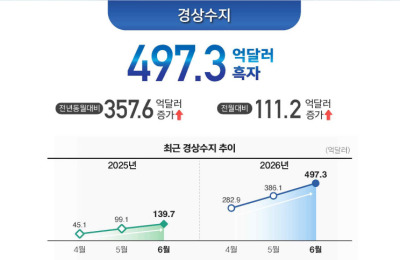
[서울=뉴스핌] 박가연 기자 = 지난 6월 우리나라의 경상수지가 전월에 이어 역대 최대 흑자를 기록했다. 반도체를 중심으로 한 정보기술(IT) 품목 수출 호조로 월간 상품수출이 처음으로 1000억달러를 넘어선 영향이다.
[자료=한국은행]
한국은행이 6일 발표한 '2026년 6월 국제수지(잠정)'에 따르면 지난 6월 경상수지는 497억3000만달러 흑자로 집계됐다. 전월(386억1000만달러)에 이어 두 달 연속 월간 기준 역대 최대 기록을 갈아치웠다. 이에 따라 올해 상반기 누적 경상수지 흑자는 1910억1000만달러를 기록했다.
경상수지 흑자를 견인한 것은 상품수지다. 6월 상품수지는 478억9000만달러 흑자를 기록하며 전월에 이어 역대 최대를 다시 썼다. 국제수지 기준 상품수출은 1123억7000만달러로 전년 동월 대비 84.5% 증가하며 월간 기준 처음으로 1000억달러를 넘어섰다. 상품수입은 644억8000만달러로 38.6% 늘었다.
통관 기준으로는 반도체 수출이 전년 동월 대비 196.9% 급증했고 컴퓨터·주변기기(SSD)는 282.7% 증가했다. IT 품목 수출은 160.4% 늘었으며 비IT 품목도 ▲석유제품(47.5%) ▲화공품(18.6%) ▲철강제품(17.9%) ▲승용차(6.1%) 등을 중심으로 18.6% 증가했다. 통관 기준 수입은 ▲원자재(30.5%) ▲자본재(35.3%) ▲소비재(16.4%)가 모두 늘었다.
서비스수지는 12억9000만달러 적자를 기록해 전월(-10억9000만달러)보다 적자 폭이 확대됐다. 여행수지는 외국인 입국자 증가와 유류할증료 인상 등에 따른 출국자 감소로 4억4000만달러 흑자를 기록했지만 지식재산권사용료수지는 전월 흑자에서 4억4000만달러 적자로 전환됐다.
본원소득수지는 배당소득을 중심으로 32억7000만달러 흑자를 기록해 전월(21억7000만달러)보다 흑자 폭이 확대됐다. 배당소득수지는 배당수입이 늘어난 데다 전월 분기배당에 따른 기저효과로 배당지급이 줄면서 25억6000만달러 흑자를 나타냈다.
금융계정 순자산은 6월 중 467억1000만달러 증가해 월간 기준 역대 최대 증가 폭을 기록했다. 종전 최대였던 올해 3월(369억9000만달러)을 넘어선 것이다. 직접투자에서는 내국인의 해외투자가 80억1000만달러, 외국인의 국내투자가 46억3000만달러 각각 증가했다.
증권투자에서는 외국인의 국내 주식 매도세가 이어졌다. 외국인의 국내 주식 투자는 차익실현 매도 등의 영향으로 316억1000만달러 감소하며 전월(-310억5000만달러)에 이어 역대 최대 순매도 기록을 다시 경신했다.
외국인의 국내 채권투자는 세계국채지수(WGBI) 자금 유입에도 분기 말 만기도래 영향으로 증가 폭이 줄어든 52억9000만달러를 기록했다. 내국인의 해외 증권투자는 주식을 중심으로 35억6000만달러 증가했다.
eoyn2@newspim.com
2026-08-06 08:00