


Uncertainty and Transparency in the Conduct of Monetary Policy May 31, 2006 Timothy F. Geithner, President and Chief Executive OfficerRemarks at Financial Services Leadership Forum Breakfast, New York CityAt the Jackson Hole Symposium in 2003, Alan Greenspan remarked that "uncertainty is not just an important feature of the monetary policy landscape; it is the defining characteristic of that landscape." Historically, this pervasive uncertainty was associated with a tendency toward opacity on the part of central bankers. But in recent years we've seen a rather dramatic reversal in this tendency as central bankers have come to recognize the potentially valuable role that communication with financial markets and the general public can play in the achievement of monetary policy goals. While transparency has emerged as one of the hallmarks of modern central banking, so too has an appreciation for the challenge of communicating about policy under uncertainty. This challenge can be substantial. It means conveying not only the most likely trajectory for key economic variables, but also the uncertainty around that trajectory and perhaps some indication of how policy might react under the myriad ways that the uncertainty could be resolved. I want to devote my remarks today to exploring what it means, and what it does not mean, for a central bank to communicate in an effective way about policy in the face of uncertainty.The issue of communication is particularly relevant in the current economic environment. For much of the past three years, financial markets have reflected a high degree of certainty about the near-term outlook for monetary policy in the United States. Market expectations in the weeks preceding each of the last 16 Federal Open Market Committee (FOMC) meetings attached a probability close to one that the FOMC would raise the target for the federal funds rate by 25 basis points. Also, there was very little probability attached to inter-meeting moves over this period, or to moves in increments larger than 25 basis points. And, although market expectations about how far the FOMC would ultimately move were revised significantly over the course of this period as the economic outlook was revised, these changes occurred without the Committee needing to deviate from the near-term path.This period of unusual certainty in the path of the fed funds rate was the result of a confluence of factors. When the Committee first moved to tighten policy in June 2004, the fed funds rate was at the historic low of 1 percent, and it was clear that policy would have to move a substantial distance to get back within the range of plausible estimates of the neutral rate. Over the course of the following months the incoming data tended to reinforce the case for a progressive move up in the target rate. And, the Committee made a conscious decision to signal that in view of the likely path of growth and inflation further tightening of monetary policy was necessary and could be achieved at a relatively gradual pace.We are now in the process of emerging from this rather exceptional period, and this provides us with an interesting context in which to reflect on uncertainty and how it affects the conduct of monetary policy and communications about monetary policy.The degree of confidence in the sign and shape of the near-term path of the fed funds rate we've seen in recent years is unlikely to be a common feature of monetary policy in the United States or in other countries. The simple reason for this is that the economic circumstances that precipitated the policy were also not typical. There are likely to be times when incoming data deviates substantially and persistently from our forecasts. In those situations, policymakers have to examine whether they have significantly misestimated certain fundamental features of the economy, such as the NAIRU or the trend productivity growth rate, that might alter the appropriate course of monetary policy.Central banks everywhere conduct policy in a state of limited knowledge about the economy and how best to achieve their objectives. The sources of uncertainty they confront are many and varied.Sometimes, what we think we know about how the economy works turns out to be wrong, either because certain features of the economy have changed, or because our understanding was not right in the first place. It was once widely held that monetary policy could achieve somewhat lower rates of unemployment by allowing somewhat higher rates of inflation, and that it could do this without risking a substantial acceleration of inflation. This view proved to be mistaken because it did not correctly account for the role inflation expectations played in inflation dynamics.Economic concepts that are critical to our understanding of the economy may be difficult or impossible to capture in practice. One such concept is the neutral or equilibrium interest rate, which is the rate that, if sustained over some period of time, is likely to be consistent with an economy growing at potential with low inflation. Plausible estimates for the prevailing level of this rate have a range of at least 100 basis points, and the center of the estimates tends to move around quite a bit.Another concept that is difficult to estimate precisely is the economy's potential, or sustainable, growth rate. The acceleration in productivity growth in the United States in the late 1990s, for example, led us to revise our estimates of how fast the economy was likely to be able to grow at that time without undermining price stability.We also face considerable ignorance about the precise channels through which policy actions ultimately affect the economy, as well as how long those effects will take to show up and how large they will be when they do show up. As you would expect, this makes it difficult to assess in advance, or even in real time, the amount of loosening or tightening that is likely to be necessary to achieve the goals of central banks.Even if we had precise knowledge of key economic relationships, our ability to assess economic conditions in real time would be impeded by data limitations. Though most modern central banks implicitly or explicitly target some measure of inflation, the host of issues surrounding the proper definition and measurement of inflation for policy purposes is daunting. In general, most economic data are subject to sampling error and so cannot simply be taken at face value. Also, many of the series we rely on are subject to revision as more or better information becomes available, and potentially can even be redefined in a way that makes the history of the series less useful for interpreting current movements. Finally, data are often reported with a significant enough delay to limit their use as a read on current conditions.But, even if we knew the model and data with certainty, it is impossible to perfectly predict the evolution of factors that are largely beyond the influence of current monetary policy but that would likely affect our policy today if we knew for sure how they would look tomorrow. One way to say this is that we simply cannot know what types of "shocks" are likely to hit the economy or when they will hit. And even as they impact the economy, the appropriate policy response may not be obvious because it may be difficult to assess in real time the probable duration of the shock and whether it is demand driven or supply driven.Even at a one-year horizon, which for policy purposes is not a very long time, there is considerable uncertainty surrounding forecasts of GDP growth. For example, the Survey of Professional Forecasters reports that on average 50 economists attach a 90 percent probability to an outcome for real GDP growth for 2007 that ranges from 1.0 percent to 5.0 percent. The width of this band of confidence or uncertainty is similar to that in the published forecasts of many central banks.The types of fundamental uncertainty I just reviewed are always present, but their impact on the appropriate near-term trajectory of rates, and hence on the degree of confidence the central bank can convey about that trajectory, may vary substantially over time.I want to mention a few other concrete examples of the uncertainty we currently face. The latest wave of global economic integration has influenced inflation and output dynamics around the world in ways that may be hard to understand fully in real time. Technological progress, along with the transition to greater labor force participation in emerging and developing economies has probably served to keep inflation low in many other countries and has served to increase the rate of growth in potential output globally. But the rapid growth in the market sectors of emerging and developing economies may also contribute to more rapid growth in global demand and inflation pressures. This changing configuration of world markets complicates the task of forecasting inflation and output within national economies.Energy prices have surprised us over the past few years, in terms of the extent of the rise in prices, the increase in volatility, and the limited negative effects to date on global economic growth. Our capacity to project future energy prices has proven to be very limited, as has our ability to convincingly ascertain the extent to which temporary supply factors, rather than an unrecognized strength in global demand, accounts for the energy price trajectory we've witnessed recently. The consequences of these limits to our knowledge may be even greater given the extent of the price increases already experienced.The unprecedented level of the U.S. current account deficit and dramatic rise in U.S. indebtedness adds to the normal degree of uncertainty that surrounds any medium-term forecast because of the dynamics that could accompany the path to a more sustainable pattern of capital flows.The process of adjustment that appears to be underway in the U.S. housing market, occurring as it is after a sustained and very substantial decline in the household savings rate, provides more than the usual challenge in predicting the future strength of consumer spending.It is also hard to assess the degree to which the current constellation of global monetary conditions has influenced the behavior of long-term interest rates. This makes it harder to assess the appropriateness of the current stance of monetary policy. And it may also mask some of the pressures on risk premiums we might expect to see given the deterioration of the U.S. long-term fiscal situation and the magnitude of the U.S. current account imbalance.In reviewing these dimensions of uncertainty, I want to emphasize that the fundamental conditions of the U.S. economy, and much of the world economy, are very strong today. But these aspects of uncertainly help illustrate what makes monetary policy interesting, and they help explain why central banks may confront wide bands of uncertainty around even a strong central outlook. They also emphasize the importance of the process we use to make decisions about policy in a state of limited knowledge.Policymakers can use a range of approaches to deal with uncertainty. In addition to making a very substantial investment in trying to capture changes in economic activity that may not be fully evident in the national data, we typically spend a lot of time looking at the assumptions that underpin the central forecast, and the sensitivity of that forecast to the possibility that those assumptions prove wrong.We regularly and systematically examine a range of alternative scenarios that attempt to capture a broad range of different paths for the main forces operating on the economy. These scenarios include those that seem highly implausible but might prove very damaging, as well as those that seem more plausible but might alter the outlook less. To complement this, we look at the implications for monetary policy of alternative scenarios for the outlook—what should we do if the world moves in a different direction. And we also look at the impact on the outlook for growth and inflation of different paths for the fed funds rate.These approaches help illustrate the size and sources of uncertainty we live with at any moment. They do not give us the capacity to attach precise probabilities to alternative scenarios or to quantify with precision the implications, but they help frame a discussion of the material risks to the outlook and the potential consequences of different types of policy mistakes. And they can help inform choices about how central banks should affect expectations about future interest rates.Along with these analytical tools, many central banks have adopted a decisionmaking structure that is designed to bring a diversity of independent perspectives to the table. Although the FOMC's discussions begin with the presentation of a forecast prepared by the staff of the Federal Reserve Board, the committee members bring to the discussion substantial information based on independent efforts to understand the underlying dynamics of demand and inflation and their implications for monetary policy. This can provide a stronger foundation for decisions, particularly where uncertainty is inherently great.Central banks have adopted different approaches to this challenge, even as there has been broad convergence toward the model of independent central banks, with explicit mandates that include price stability and greater disclosure and transparency.The central banks that publish quantitative forecasts for growth and inflation now typically show the confidence bands around their forecasts. In some cases, these forecasts use, as a conditioning assumption, financial market expectations for the path of short-term interest rates. In others, the central bank publishes a forecast that includes the central bank's assessment at that time of the likely path of monetary policy over some horizon. In the former case, the implications of the forecast for monetary policy are left implicit. In the latter case, the likely path of monetary policy is made explicit, but that path is heavily qualified or conditioned to make it clear that that expected path of short-term interest rates will change as conditions change.The FOMC's approach to communication differs in interesting and important ways from these other models. Although the Committee has introduced a gradual but marked increase in the degree of communication over the past two decades, it provides information about its forecast in quantitative terms less frequently and with less detail than has become typical of many other central banks. And yet, because of the unique circumstances over the past two to three years, it has provided more information about the near-term path for monetary policy than has been the practice of many of our counterparts.These differences in approaches to communication do not seem to reflect fundamental differences in perceptions of the degree or nature of uncertainty. The proponents of the regimes with the most explicit forecasts and greater disclosure about the future path of interest rates do not claim to have greater confidence in their ability to forecast. They do express, however, greater comfort with some of the potentially adverse consequences of such approaches, the tendency, for example, for observers to gravitate toward the central tendency of the forecast and to look past the uncertainty bands and qualifications. And they express less concern that these approaches to communication will end up limiting the flexibility of central banks to react as circumstances change without inducing damaging volatility into markets.And so, even as central banks have moved in varying degrees toward greater clarity about their goals, forecasts and policy decisions, they have also moved to being more explicit about uncertainty and about the need for flexibility in how policy should adjust over time.This reflects an evolving appreciation that there are limits to transparency. Transparency in monetary policy cannot mean that the central bank conveys more confidence in the outlook for growth and inflation than it can reasonably have, and it cannot provide more assurance about the likely future course of policy than it actually has.This seems self evident. And yet as central banks have moved to communicating more and disclosing more about monetary policy, transparency in monetary policy has been associated with rising expectations for clarity about the path of target interest rates over time. It might seem desirable in an ideal state of the world for expectations in financial markets about the future course of policy to closely track in real time those of the central bank. But given the degree of uncertainty that surrounds monetary policy making, this is unlikely to be possible, except in special circumstances.There will be circumstances when it is appropriate for the central bank to send a signal about the target rate that extends well beyond the immediate horizon. These circumstances are not likely to arise frequently, and will be appropriate in particular conditions when the benefits afforded by the effect on expectations clearly outweigh the cost imposed by the loss to flexibility.Central banks should be clear about what they are trying to achieve. They should be open with the knowledge and insight they possess. And they should provide the public with clarity where it is attainable. But they also need to convey the limits to their knowledge and avoid providing a sense of certainty they do not, or cannot, possess.Uncertainty strengthens the case for being open about what we do not know, and exploring the robustness of our decisions to a range of alternative scenarios. But uncertainty also reinforces the case for clarity in communications about the objectives that guide policy and the rationale for our decisions. Perhaps most crucially, this means preserving confidence in our commitment to keep underlying inflation low over time, and for retaining the capacity to respond with flexibility to the challenges we face in this uncertain world.Thank you.________________________________________________________Note: Figure in 3rd paragraph revised to read "...or to move in increments larger than 25 basis points." May 31, 2006

[관련키워드]




[뉴스핌 베스트 기사]
 사진
사진
정동영 업무보고 논란
[서울=뉴스핌] 유신모 외교전문기자 = 청와대 영빈관에서 5일 열린 외교·안보 분야 정부 부처의 대통령 업무보고에서 정동영 통일부 장관의 '한반도 평화공존 발전 구상'과 업무보고 발언이 논란을 빚고 있다.
이날 정 장관의 발언 중에는 정부 내 조율을 거치지 않은 사안을 정책으로 추진하겠다고 공언한 것이 있는가 하면 사실 관계에 맞지 않은 설명도 있었다. 이재명 대통령은 공개적으로 신중을 기해 달라고 경고했고, 조현 외교부 장관은 '이상주의적 희망에 근거한 비현실적 구상'이라는 비판을 내놨다.
그동안 정 장관의 대북 정책 관련 발언이 물의를 빚은 적은 여러 번 있지만 대통령과 유관 부처 장관이 공개적으로 부정적 입장을 표명한 것은 이례적이다. 정 장관의 무리한 대북 접근법과 월권을 제어해야 한다는 목소리도 높아지고 있다.
[정동영 통일부 장관이 지난달 23일 오후 서울 종로구 정부서울청사에서 취임 1주년 기자간담회를 하고 있다. [사진=통일부] 2026.07.23
◆통일부 장관 권한 넘어선 주장
정 장관은 이날 업무보고에서 '한반도 평화공존 발전 구상'을 설명하면서 이재명 정부 2년차 핵심 과제로 상호 존중·평화적 갈등 해결·핵 없는 한반도 등 3대 기본 방향을 제시했다.
정 장관은 "대결과 혐오의 언어는 멈춰야 한다"면서 주적 용어 대체를 주장했다. 지난 25년간의 CVID(완전하고 검증가능하며 되돌릴 수 없는 비핵화) 구도는 이미 무너졌다고도 했다. 또 "현 시점에서 흘러간 선(先)비핵화만 되뇌는 것은 현실을 바꾸는 데 힘이 되지 않는다"고 주장했다. 정 장관은 또 "정전 체제를 평화 체제로 바꾸는 논의에 착수하겠다"면서 "북·미 정상회담 견인과 함께 4자 대화의 동력을 확보하기 위해 최선을 다할 것"이라고 말했다.
하지만 이 대통령은 정 장관의 구상에 대부분 제동을 걸었다. 이 대통령은 "평화공존 정책이 정치적으로 악용되는 측면이 있다"며 "많이 조심하셔야 한다"고 지적했다.
북한을 다른 이름으로 불러야 한다는 주장에는 "표현에 꼬투리가 잡혀 정쟁으로 휘몰아 들어가면 원래 하고자 했던 데에서 오히려 나쁜 상황이 초래될 수 있다"고 경고했다.
이 대통령은 남북 신뢰 구축을 위해 9·19 군사합의를 선제적으로 복원해야 한다는 정 장관의 주장에 대해서도 "우리의 선의대로 하는 게 과연 한반도의 평화와 안정에 플러스냐, 결론적으로 약간의 의문이 들 때도 있다"며 부정적으로 반응했다.
조현 외교부 장관은 업무보고 사후 브리핑에서 정 장관이 언급한 '4자 회담'에 대해 "이상주의에 근거한 어떤 희망이라 하더라도 그건 아직 조율되지 않은 방법"이라며 "여러분들께서 디스카운트해 주시면 좋겠다"고 선을 그었다.
정 장관이 9월 러시아 블라디보스토크에서 열리는 '동방경제포럼(EEF)'을 언급하며 "정부 차원에서 (참석을) 검토하고 있다"고 발언한 데 대해서도 조 장관은 "그것은 외교부의 몫"이라며 "아직 거기까지 진도가 나가지 않았다"고 잘랐다.
정 장관이 이날 소개한 대북 구상과 설명은 정부 내 조율을 거치지 않았다는 점에서 문제가 있다. 특히 주적 표현 대체와 국호 사용, 9·19 군사합의 복원, 4자회담 추진 등은 통일부 장관이 결정할 사안이 아니어서 월권이라는 지적이 나오고 있다. 이 대통령은 정 장관의 업무보고를 듣고 난 뒤 "여기 업무보고에 발표했다고 승인난 건 아니다"라고 재차 확인했다.
정부의 한 소식통은 "정 장관의 발언 내용은 대부분 국가안전보장회의(NSC)를 거쳐 결정된 사안이 아닌 정 장관의 개인적 생각에 가깝다"며 "안보 관련 부처 장관이 정부의 공식 정책이 아닌 사안을 추진하겠다고 업무보고를 하고 대통령의 면전에서 '국군통수권자가 나서야 한다'고 주장한 것은 심각한 문제"라고 지적했다.
이재명 대통령이 5일 청와대 영빈관에서 열린 통일 외교 국방 등 외교 안보 부처 업무보고에서 발언하고 있다. [사진=청와대] 2026.08.05
◆시대착오적 접근, 대북 인식 오류
더욱 문제인 것은 정 장관의 이같은 주장이 현 시점에서 이미 참고가 될 수 없는 과거의 경험 또는 사실과 다른 인식에 기반하고 있다는 것이다. 정 장관이 주장하는 구상은 급격히 변화하고 있는 북한의 전략과 한반도 및 국제 정세를 전혀 반영하지 못하고 있다는 비판이 제기되고 있다.
정 장관이 "흘러간 선(先)비핵화만 되뇌는 것은 현실을 바꾸지 못한다"고 언급한 것은 지금까지의 대북 접근법을 호도하고 있다. 북핵 위기 발발 이후 지금까지 모든 핵 협상에서 한국이나 미국은 북한에 선비핵화를 공식적으로 요구한 적이 없기 때문이다.
지금까지의 북핵 협상은 북한의 비핵화 조치에 한·미가 상응하는 대가를 제공하는 방식으로 이뤄졌다. 1994년 북·미 제네바 기본합의는 핵시설 동결과 중유 제공의 교환이었다. 2005년 9.19 공동성명도 북한의 비핵화 조치의 모든 단계에 상응조치를 제공하는 '행동 대 행동' 원칙이 적용됐다.
대북 협상에 관여했던 한 전직 관료는 "모든 북핵 협상은 북한의 비핵화 조치와 한·미가 제공하는 상응조치를 어떻게 정교하게 배열하느냐가 관건이었다"면서 "정 장관의 발언은 지금까지 한·미가 북한에 먼저 핵을 포기해야 대화할 수 있다는 정책을 고수해 현 상황에 이르게 됐다는 잘못된 인식에서 비롯된 것으로 보인다"고 말했다.
정 장관이 "지난 25년간의 CVID 구도가 무너졌다"고 말한 것도 비핵화의 개념에 대한 이해 부족이라는 비판이 제기되고 있다. 북핵 문제에 정통한 외교 소식통은 "어떤 명칭을 붙이든 핵을 제거한 뒤 이를 검증하고 재발 방지 조치를 하는 것은 비핵화에 반드시 포함되어야 하는 기본적 절차"라며 "CVID는 안 된다고 말하는 것은 북한의 비핵화 조치를 검증도 하지 않고 언제든 되돌릴 수 있도록 합의하자는 말과 같다"고 지적했다.
[서울=뉴스핌] 이길동 기자 = 조현 외교부 장관이 5일 오후 서울 종로구 정부서울청사 별관에서 2026년 하반기 업무보고 사후브리핑을 하고 있다. 2026.08.05 gdlee@newspim.com
◆안보 리스크 키우는 통일부 장관
정 장관은 지난해 취임 직후부터 청와대와 외교부를 제치고 통일부가 북한과 관련된 모든 정책을 주도해야 한다는 주장을 펴면서 단독 질주를 거듭해왔다.
북한의 '적대적 두 국가' 주장을 변형한 '평화적 두 국가'를 지향해야 한다고 주장하면서 이에 문제점을 지적하는 목소리를 무시했다. 외교부가 미국과 북한 문제를 논의하는 것에 대해 "한반도 정책과 남북관계는 주권의 영역이며 동맹국과 협의의 주체는 통일부"라고 주장해 물의를 빚었다. 문재인 정부 시절 한·미 워킹그룹이 남북관계 파탄 원인이었다고 사실과 다른 주장을 폈다.
지난해 업무보고에서는 국제정세를 감안하지 않고 남북대화 재개에만 초점을 맞춘 비현실적 내용으로 논란을 빚었다. 정부 내 조율도 거치지 않고 독자 대북제재인 5·24 조치를 해제하고 9·19 군사합의 비행금지구역 복원을 추진하겠다는 방침도 밝혔다.
지난 4월에는 평안북도 구성시에 우라늄 농축 시설이 있다고 말해 파장을 일으켰다. 미국은 이 발언을 계기로 한국과 대북정보 공유를 제한했다. 이 조치는 지금도 계속되고 있는 것으로 알려졌다.
정 장관이 이처럼 정부의 공식 결정을 거치지 않은 사안을 정부 정책인 것처럼 주장하며 좌충우돌하는 배경에 대해 여러가지 해석이 나온다. 북한 문제에서 조기에 성과를 거둬야 한다는 조급증과 자신의 존재감 과시 욕구가 작용하고 있다는 평가가 많다.
일각에서는 정 장관이 2007년 민주당 대선후보였을 때 이재명 대통령이 캠프에서 비서실 부실장으로 활동한 전력이 있다는 것을 들어 "정 장관이 아직도 이 대통령을 아랫사람으로 생각하고 있는 것 아니냐"는 비판을 내놓기도 한다.
한·미 관계와 북한 문제를 오래 다뤘던 전직 관료 출신의 한 전문가는 "정 장관 취임 후 지금까지의 언행은 잘못된 현실 인식에 따른 독단과 앞서 가기, 월권 등으로 점철돼 있다"면서 "통일부 장관이라는 중요한 직책에 있으면서 스스로 안보 리스크를 키우는 역할만 했다"고 비판했다.
opento@newspim.com
2026-08-06 06:10
 사진
사진
6월 경상수지 최대 흑자
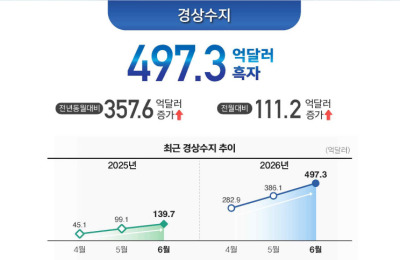
[서울=뉴스핌] 박가연 기자 = 지난 6월 우리나라의 경상수지가 전월에 이어 역대 최대 흑자를 기록했다. 반도체를 중심으로 한 정보기술(IT) 품목 수출 호조로 월간 상품수출이 처음으로 1000억달러를 넘어선 영향이다.
[자료=한국은행]
한국은행이 6일 발표한 '2026년 6월 국제수지(잠정)'에 따르면 지난 6월 경상수지는 497억3000만달러 흑자로 집계됐다. 전월(386억1000만달러)에 이어 두 달 연속 월간 기준 역대 최대 기록을 갈아치웠다. 이에 따라 올해 상반기 누적 경상수지 흑자는 1910억1000만달러를 기록했다.
경상수지 흑자를 견인한 것은 상품수지다. 6월 상품수지는 478억9000만달러 흑자를 기록하며 전월에 이어 역대 최대를 다시 썼다. 국제수지 기준 상품수출은 1123억7000만달러로 전년 동월 대비 84.5% 증가하며 월간 기준 처음으로 1000억달러를 넘어섰다. 상품수입은 644억8000만달러로 38.6% 늘었다.
통관 기준으로는 반도체 수출이 전년 동월 대비 196.9% 급증했고 컴퓨터·주변기기(SSD)는 282.7% 증가했다. IT 품목 수출은 160.4% 늘었으며 비IT 품목도 ▲석유제품(47.5%) ▲화공품(18.6%) ▲철강제품(17.9%) ▲승용차(6.1%) 등을 중심으로 18.6% 증가했다. 통관 기준 수입은 ▲원자재(30.5%) ▲자본재(35.3%) ▲소비재(16.4%)가 모두 늘었다.
서비스수지는 12억9000만달러 적자를 기록해 전월(-10억9000만달러)보다 적자 폭이 확대됐다. 여행수지는 외국인 입국자 증가와 유류할증료 인상 등에 따른 출국자 감소로 4억4000만달러 흑자를 기록했지만 지식재산권사용료수지는 전월 흑자에서 4억4000만달러 적자로 전환됐다.
본원소득수지는 배당소득을 중심으로 32억7000만달러 흑자를 기록해 전월(21억7000만달러)보다 흑자 폭이 확대됐다. 배당소득수지는 배당수입이 늘어난 데다 전월 분기배당에 따른 기저효과로 배당지급이 줄면서 25억6000만달러 흑자를 나타냈다.
금융계정 순자산은 6월 중 467억1000만달러 증가해 월간 기준 역대 최대 증가 폭을 기록했다. 종전 최대였던 올해 3월(369억9000만달러)을 넘어선 것이다. 직접투자에서는 내국인의 해외투자가 80억1000만달러, 외국인의 국내투자가 46억3000만달러 각각 증가했다.
증권투자에서는 외국인의 국내 주식 매도세가 이어졌다. 외국인의 국내 주식 투자는 차익실현 매도 등의 영향으로 316억1000만달러 감소하며 전월(-310억5000만달러)에 이어 역대 최대 순매도 기록을 다시 경신했다.
외국인의 국내 채권투자는 세계국채지수(WGBI) 자금 유입에도 분기 말 만기도래 영향으로 증가 폭이 줄어든 52억9000만달러를 기록했다. 내국인의 해외 증권투자는 주식을 중심으로 35억6000만달러 증가했다.
eoyn2@newspim.com
2026-08-06 08:00