


Remarks by Vice Chairman Donald L. Kohn At the Western Payments Alliance 2006 Payments Symposium, Las Vegas, NevadaSeptember 11, 2006 Evolution of Retail Payments and the Role of the Federal ReserveI am pleased to have the opportunity to speak at this symposium examining the continuing convergence of paper and electronic payments. Today marks the fifth anniversary of the September 11th terrorist attacks on the United States. On that day, as our nation came to grips with the terrible events it had just witnessed, the Federal Reserve remained open and operating, in part to help ensure that the nation’s payments system continued to function. In the aftermath of the attacks, the financial industry has taken many steps to strengthen the resilience of our nation’s critical payments infrastructures. For the retail payments system, the September 11th attacks highlighted the banking industry's extensive reliance on air transportation as planes came to a standstill and the collection of checks slowed dramatically. This prompted a heightened focus on how electronic processing technologies could be applied to the check-collection system to reduce the reliance on air transportation and improve check-processing efficiency more generally.My remarks today, which reflect my own thoughts and not necessarily those of the other members of the Federal Reserve Board, will focus on the future of the check-collection system and the future role of the Federal Reserve in retail payments services.1A Period of Transition in the Retail Payments System Today, shifts in consumer behavior and rapid industry innovation, along with legal and regulatory change, are dramatically reshaping our retail payments system. Because of the increasing availability and declining cost of convenient electronic payment alternatives, many payments that were until recently being made in paper form are today being made electronically. In addition, new electronic technologies are now being harnessed to improve the processing of checks.The 2003 Federal Reserve study on the use of retail payment instruments revealed dramatic changes in consumer behavior. It found that, for the first time ever, the number of electronic payments in the United States--such as credit card, debit card, and automated clearinghouse (ACH) payments--exceeded check payments. A range of data indicates that electronic payments have continued to increase and that check payments have continued to decline. Debit cards, primarily used by consumers for everyday purchases, are the fastest growing segment of the retail payments system. Consumers seem to view debit cards as a natural progression from cash and checks because they are a convenient electronic means of making payments without incurring the additional debt often associated with credit card use. In fact, on at least one major network, debit card payments are reported to have surpassed credit card payments.This shift in payment behavior can be attributed in part to changes in the rules and regulations governing the ACH network, which have facilitated the use of this network for one-time, nonrecurring payments. As you know, in the past the ACH was used mainly for recurring payments, such as payroll and mortgage payments. Today, consumer purchases at stores, over the telephone, and on the Internet can be completed using the ACH. Regulatory and rule changes have also facilitated the use of the ACH to convert checks that consumers mail to businesses or provide at the point of sale into electronic payments. These new uses of the ACH for one-time payments have driven the continuing double-digit growth rates of ACH transaction volume. Given these dynamic changes in the payments system, the Federal Reserve is planning to repeat its triennial survey of retail payments use next year to take another snapshot of the nation’s retail payments system.The Federal Reserve’s Experience with Check 21Not only are more payments being made electronically, but more check payments are also being processed electronically, in part because of the Check Clearing for the 21st Century Act, or Check 21.2 Clearly, Check 21 has begun to diminish the importance of geography and physical transportation in check processing, and banks have started to reengineer their backroom processes to accommodate end-to-end electronic check clearing. Since October 28, 2004, the date Check 21 took effect, the Reserve Banks’ Check 21 volume has grown rapidly, reflecting a trend that will lead to the widespread electronic processing of checks in the not-too-distant future. Private-sector service providers that offer Check 21 services are also experiencing rapid growth in volume as the banking industry becomes more interested in and capable of using Check 21 authority to clear checks. Today, about 17 percent of the checks deposited with the Federal Reserve Banks, or slightly over 6 million checks a day valued at about $20 billion, are deposited using the Reserve Banks’ Check 21 product suite. As expected, depository institutions have been somewhat slower in agreeing to accept their check presentments electronically because of the complexity of integrating such presentments into back-office processing and risk-management systems. As a result, the use of substitute checks is widespread. Nevertheless, in July 2006 almost 4 percent of the Reserve Banks’ daily volume, or about one and a half million checks, was presented to paying banks in electronic Check 21 files, and this volume is growing rapidly.Thus, banks are starting to realize many of the benefits of the end-to-end electronic check processing that were envisioned when Check 21 was enacted, including efficiency gains and cost savings. In addition, they are beginning to offer their customers new and better services. For example, some banks are offering their business customers the ability to truncate checks and deposit them electronically. Also, banks are now able to set a later-in-the-day cutoff hour for check deposits because they can transmit checks electronically from their branches to their central processing facilities for collection. As a result, banks should be able to provide customers with improved funds availability, more efficient cash management services, and better access to services for their geographically remote customers.The Evolution of Electronic Check CollectionHow will electronic check collection evolve in the years to come? The industry is discussing several possible models. In the first, check images are transmitted to the paying bank along with the MICR-line payment information.3 In the second, the MICR information is transmitted to the paying bank while the check images are stored in remote archives that can be accessed on demand. Both models are already being used to some extent and each has its advantages and disadvantages. I suspect that, as the industry gains greater experience with electronic check collection, the superiority of one of the models may become clearer. Those who favor the first model believe that it allows paying banks to better manage their risks and customer relationships. Paying banks would not have to rely on multiple image archive providers, with whom they may have no direct contractual relationship, to obtain check images for customer online banking services and backroom operations. Others believe that a small number of centralized check-image archives, as envisioned in the second model, would be more cost-effective and would not appreciably increase risk or degrade customer service. In this model, the MICR information on a check could be transmitted over a dedicated network or, as recently suggested by some bankers, the ACH. The ACH is seen as a potentially attractive option because it is an electronic system that reaches all depository institutions and could eliminate the need to print substitute checks. The flow of check information over the ACH system raises the legal question of whether the payments should be characterized as checks or electronic fund transfers. If the payments were characterized as checks, under current check law banks can choose whether to receive presentments electronically or in paper form. A key principle underlying Check 21 was to maintain this choice by permitting banks to participate in electronic check processing when their business case justified doing so. Requiring banks to accept electronic check presentment simply because they participate in the ACH system and have agreed to abide by NACHA rules might be viewed as contrary to this principle. Alternatively, if the payments were characterized as electronic funds transfers, then how would banks obtain the authorizations required under Regulation E to convert the transactions into ACH payments? When evaluating the relative benefits of using the ACH network for these payments, we must consider these threshold legal questions. A Perspective on the Future U.S. Check SystemThe checkless society has been predicted for decades; however, as we near 2007, we know that even though checks are used less frequently, they are still used widely. Industry experts are understandably wary of predicting what lies ahead for the U.S. check system. However, as we engage in strategic discussions on the future of checks and contemplate investments in check-processing infrastructure, we need to consider how the check system might evolve. Let me take a first step and offer one perspective.The decline in check use has already caused the Reserve Banks to reduce by half the number of offices at which they process paper checks. In 2003, the Reserve Banks had forty-five check-processing offices nationwide, versus the twenty-two they have today and the eighteen that they will have by early 2008. Further consolidations are likely as check volumes continue to decline and as checks are increasingly processed electronically. Ultimately, perhaps sometime late in the next decade, the Reserve Banks might process checks at only a single office nationwide. These changes in the Federal Reserve’s check-processing infrastructure will benefit bank customers by entitling them to earlier funds availability on their check deposits, because all checks will eventually become local checks, which are generally subject to a maximum permissible hold period of two business days. This will present risk-management challenges for banks because a bank seldom learns that a local check is unpaid before it must make the funds available to the customer for withdrawal.Moreover, while some checks are being collected faster as a result of electronic processing, in the future other checks might be collected more slowly. We have already seen some banks decide to process large- and small-dollar checks differently. Specifically, many banks are expediting the collection of larger-dollar checks by taking advantage of the Check 21 authority. On the other hand, banks are continuing to collect smaller-dollar checks in paper form, using physical transportation networks, because the value of collecting these smaller-dollar checks faster does not justify the cost of doing so.As larger-dollar checks are increasingly cleared electronically, the use of relatively expensive dedicated check-transportation networks to clear the aggregate value of the remaining checks will be harder and harder to justify economically. As a result, it is quite possible that it will take longer to collect smaller-dollar checks as dedicated, high-cost check-transportation networks are scaled back or eliminated and these checks are transported using slower, less costly means.The Federal Reserve is now studying whether overall improvements in the check-collection system would be sufficient in the near term to justify the Board’s use of its authority under the Expedited Funds Availability Act to reduce maximum hold periods.4 The likely slowing of the collection of smaller-value checks could make any change problematic in the near term. Nonetheless, as I have already noted, recent and future consolidations of Federal Reserve check-processing regions have benefited, and will continue to benefit, bank customers as many nonlocal checks become local and therefore subject to shorter maximum holds.If the payments system evolves as I have just outlined, then it is possible that in the next ten to twenty years the Reserve Banks will accept only checks that are deposited electronically and that can be presented electronically; any remaining paper checks may have to be cleared through other channels. In this scenario, the current paper-check infrastructure of the Federal Reserve that is heavily reliant on physical transportation will be replaced by an electronic-processing infrastructure with a production data center and a few backup sites, not unlike today’s ACH network.The Role of the Reserve Banks in the Provision of Retail Payments ServicesThe changes I have just described could very well have implications for the role of the Federal Reserve in the payments system. From its inception in 1913, the Federal Reserve has not only been closely involved in overseeing the nation’s payments system but has also been an important operational component of that system. This latter role has involved competing with the private sector to provide certain retail payments. Congress originally wanted the Federal Reserve to play this operational role to reduce inefficiencies in the payments arena. This role has changed considerably over the past century, with some changes resulting from the enactment of statutes such as the Monetary Control Act, or the MCA.The MCA went a long way toward establishing a relatively level playing field on which the Reserve Banks and private-sector payments providers have competed over the past quarter century. However, because of the inherent differences between the central bank and private-sector service providers, a truly level playing field will never be entirely possible. The Reserve Banks enjoy certain advantages, such as an unsurpassed credit rating, that makes them an attractive service provider in times of financial stress. On the other hand, the Reserve Banks do not have the flexibility enjoyed by their competitors to negotiate fees and other service terms with individual customers. Because of these differences, it is incumbent on us from time to time to reexamine our operational role in the payments system.These assessments have focused in the past, and should continue to focus in the future, on the Federal Reserve’s role as a provider of retail payment services. Large-value payments systems, such as Fedwire, are typically viewed as core, systemically important services, and they are commonly provided by other central banks around the globe. A rationale for the participation of a government-related entity, such as the Federal Reserve, in the retail payments system is harder to formulate. The most recent assessment of this operational role was conducted in the late 1990s, by the Committee on the Federal Reserve in the Payments Mechanism, better known as the Rivlin Committee, and it focused on the Federal Reserve’s role in the check and ACH systems. Ultimately, the committee concluded that the Federal Reserve should remain a provider of both check-collection and ACH services and should play a more active role in helping the banking industry become more efficient. The committee determined that the Federal Reserve played an important role in providing both check and ACH services to small and remote institutions and that, if the Federal Reserve stopped providing these services, it could disrupt the market in the short run, resulting in higher prices and more regulation, with little promise of substantial benefits over the long run. In recent years, we have actively pursued a strategy of engaging the industry in discussions on payments system issues and offering services designed to encourage the increased use of electronics.As we move into a more steady-state electronic check environment, the Federal Reserve may find it appropriate once again to review its longer-term operational role in the retail payments system. Clearly, at that time, the Federal Reserve’s national reach will no longer be a compelling reason for its operational role. As the Federal Reserve assesses its role in providing retail payment services, it will be important to consider how the circumstances that have provided the rationale for the Federal Reserve’s continuing involvement in retail payments services may have changed. The review would have to address, among other things, the following questions: If the Reserve Banks were to withdraw from check and ACH services, would these services continue to be provided competitively and cost-effectively? Would depository institutions continue to have equitable access to these services? In the event of an unanticipated shock, would the payments system be sufficiently resilient? ConclusionIn conclusion, the retail payments system will continue to become increasingly electronic even though the exact nature of that system is not yet clear. What is clear, however, is that the Federal Reserve will continue to foster a safe and efficient payments system. This shift away from paper and toward the electronic processing of payments has significant operational and legal implications that all of us need to ponder. I believe that an ongoing dialogue among payments system participants will help us address, in a balanced and thoughtful manner, these important issues that affect the long-term strategic direction of the U.S. financial system. This symposium is a welcome and constructive part of that dialogue.--------------------------------------------------------------------------------Footnotes1. Helena L. Tenenholtz and Jeffrey S. H. Yeganeh, of the Board’s staff, contributed to this speech. 2. Check 21 removed legal barriers that were preventing electronic technologies from being applied to long-established check-collection processes. Before Check 21, a bank had to present the original paper check to the paying bank unless the paying bank had agreed to accept presentment of the check electronically. While Check 21 did not mandate the electronic processing or presentment of checks, it did authorize a new negotiable instrument, called a substitute check, which is the legal equivalent of the original check. By permitting banks to use substitute checks in the check-collection process when the recipient could not or would not accept electronic presentment, Check 21 has facilitated the expanded use of electronic technologies in check processing, enabling the banking industry to improve the efficiency and cost-effectiveness of its check-processing operations over the long run. 3. The magnetic ink character recognition (MICR) line is the line of numbers printed near the bottom of the check, which generally includes the paying bank’s routing number, the customer’s account number, the check number, and the amount of the check. 4. The Expedited Funds Availability Act requires that the Board reduce the maximum hold periods to the period of time necessary for the depositary bank to reasonably expect to learn of the nonpayment of most checks in a given category. Because roughly half of all checks are for amounts of less than $100, the improvements in the check system due to Check 21 would likely not result in faster collection and return of most local or nonlocal checks in the near term.

[관련키워드]




[뉴스핌 베스트 기사]
 사진
사진
정동영 업무보고 논란
[서울=뉴스핌] 유신모 외교전문기자 = 청와대 영빈관에서 5일 열린 외교·안보 분야 정부 부처의 대통령 업무보고에서 정동영 통일부 장관의 '한반도 평화공존 발전 구상'과 업무보고 발언이 논란을 빚고 있다.
이날 정 장관의 발언 중에는 정부 내 조율을 거치지 않은 사안을 정책으로 추진하겠다고 공언한 것이 있는가 하면 사실 관계에 맞지 않은 설명도 있었다. 이재명 대통령은 공개적으로 신중을 기해 달라고 경고했고, 조현 외교부 장관은 '이상주의적 희망에 근거한 비현실적 구상'이라는 비판을 내놨다.
그동안 정 장관의 대북 정책 관련 발언이 물의를 빚은 적은 여러 번 있지만 대통령과 유관 부처 장관이 공개적으로 부정적 입장을 표명한 것은 이례적이다. 정 장관의 무리한 대북 접근법과 월권을 제어해야 한다는 목소리도 높아지고 있다.
[정동영 통일부 장관이 지난달 23일 오후 서울 종로구 정부서울청사에서 취임 1주년 기자간담회를 하고 있다. [사진=통일부] 2026.07.23
◆통일부 장관 권한 넘어선 주장
정 장관은 이날 업무보고에서 '한반도 평화공존 발전 구상'을 설명하면서 이재명 정부 2년차 핵심 과제로 상호 존중·평화적 갈등 해결·핵 없는 한반도 등 3대 기본 방향을 제시했다.
정 장관은 "대결과 혐오의 언어는 멈춰야 한다"면서 주적 용어 대체를 주장했다. 지난 25년간의 CVID(완전하고 검증가능하며 되돌릴 수 없는 비핵화) 구도는 이미 무너졌다고도 했다. 또 "현 시점에서 흘러간 선(先)비핵화만 되뇌는 것은 현실을 바꾸는 데 힘이 되지 않는다"고 주장했다. 정 장관은 또 "정전 체제를 평화 체제로 바꾸는 논의에 착수하겠다"면서 "북·미 정상회담 견인과 함께 4자 대화의 동력을 확보하기 위해 최선을 다할 것"이라고 말했다.
하지만 이 대통령은 정 장관의 구상에 대부분 제동을 걸었다. 이 대통령은 "평화공존 정책이 정치적으로 악용되는 측면이 있다"며 "많이 조심하셔야 한다"고 지적했다.
북한을 다른 이름으로 불러야 한다는 주장에는 "표현에 꼬투리가 잡혀 정쟁으로 휘몰아 들어가면 원래 하고자 했던 데에서 오히려 나쁜 상황이 초래될 수 있다"고 경고했다.
이 대통령은 남북 신뢰 구축을 위해 9·19 군사합의를 선제적으로 복원해야 한다는 정 장관의 주장에 대해서도 "우리의 선의대로 하는 게 과연 한반도의 평화와 안정에 플러스냐, 결론적으로 약간의 의문이 들 때도 있다"며 부정적으로 반응했다.
조현 외교부 장관은 업무보고 사후 브리핑에서 정 장관이 언급한 '4자 회담'에 대해 "이상주의에 근거한 어떤 희망이라 하더라도 그건 아직 조율되지 않은 방법"이라며 "여러분들께서 디스카운트해 주시면 좋겠다"고 선을 그었다.
정 장관이 9월 러시아 블라디보스토크에서 열리는 '동방경제포럼(EEF)'을 언급하며 "정부 차원에서 (참석을) 검토하고 있다"고 발언한 데 대해서도 조 장관은 "그것은 외교부의 몫"이라며 "아직 거기까지 진도가 나가지 않았다"고 잘랐다.
정 장관이 이날 소개한 대북 구상과 설명은 정부 내 조율을 거치지 않았다는 점에서 문제가 있다. 특히 주적 표현 대체와 국호 사용, 9·19 군사합의 복원, 4자회담 추진 등은 통일부 장관이 결정할 사안이 아니어서 월권이라는 지적이 나오고 있다. 이 대통령은 정 장관의 업무보고를 듣고 난 뒤 "여기 업무보고에 발표했다고 승인난 건 아니다"라고 재차 확인했다.
정부의 한 소식통은 "정 장관의 발언 내용은 대부분 국가안전보장회의(NSC)를 거쳐 결정된 사안이 아닌 정 장관의 개인적 생각에 가깝다"며 "안보 관련 부처 장관이 정부의 공식 정책이 아닌 사안을 추진하겠다고 업무보고를 하고 대통령의 면전에서 '국군통수권자가 나서야 한다'고 주장한 것은 심각한 문제"라고 지적했다.
이재명 대통령이 5일 청와대 영빈관에서 열린 통일 외교 국방 등 외교 안보 부처 업무보고에서 발언하고 있다. [사진=청와대] 2026.08.05
◆시대착오적 접근, 대북 인식 오류
더욱 문제인 것은 정 장관의 이같은 주장이 현 시점에서 이미 참고가 될 수 없는 과거의 경험 또는 사실과 다른 인식에 기반하고 있다는 것이다. 정 장관이 주장하는 구상은 급격히 변화하고 있는 북한의 전략과 한반도 및 국제 정세를 전혀 반영하지 못하고 있다는 비판이 제기되고 있다.
정 장관이 "흘러간 선(先)비핵화만 되뇌는 것은 현실을 바꾸지 못한다"고 언급한 것은 지금까지의 대북 접근법을 호도하고 있다. 북핵 위기 발발 이후 지금까지 모든 핵 협상에서 한국이나 미국은 북한에 선비핵화를 공식적으로 요구한 적이 없기 때문이다.
지금까지의 북핵 협상은 북한의 비핵화 조치에 한·미가 상응하는 대가를 제공하는 방식으로 이뤄졌다. 1994년 북·미 제네바 기본합의는 핵시설 동결과 중유 제공의 교환이었다. 2005년 9.19 공동성명도 북한의 비핵화 조치의 모든 단계에 상응조치를 제공하는 '행동 대 행동' 원칙이 적용됐다.
대북 협상에 관여했던 한 전직 관료는 "모든 북핵 협상은 북한의 비핵화 조치와 한·미가 제공하는 상응조치를 어떻게 정교하게 배열하느냐가 관건이었다"면서 "정 장관의 발언은 지금까지 한·미가 북한에 먼저 핵을 포기해야 대화할 수 있다는 정책을 고수해 현 상황에 이르게 됐다는 잘못된 인식에서 비롯된 것으로 보인다"고 말했다.
정 장관이 "지난 25년간의 CVID 구도가 무너졌다"고 말한 것도 비핵화의 개념에 대한 이해 부족이라는 비판이 제기되고 있다. 북핵 문제에 정통한 외교 소식통은 "어떤 명칭을 붙이든 핵을 제거한 뒤 이를 검증하고 재발 방지 조치를 하는 것은 비핵화에 반드시 포함되어야 하는 기본적 절차"라며 "CVID는 안 된다고 말하는 것은 북한의 비핵화 조치를 검증도 하지 않고 언제든 되돌릴 수 있도록 합의하자는 말과 같다"고 지적했다.
[서울=뉴스핌] 이길동 기자 = 조현 외교부 장관이 5일 오후 서울 종로구 정부서울청사 별관에서 2026년 하반기 업무보고 사후브리핑을 하고 있다. 2026.08.05 gdlee@newspim.com
◆안보 리스크 키우는 통일부 장관
정 장관은 지난해 취임 직후부터 청와대와 외교부를 제치고 통일부가 북한과 관련된 모든 정책을 주도해야 한다는 주장을 펴면서 단독 질주를 거듭해왔다.
북한의 '적대적 두 국가' 주장을 변형한 '평화적 두 국가'를 지향해야 한다고 주장하면서 이에 문제점을 지적하는 목소리를 무시했다. 외교부가 미국과 북한 문제를 논의하는 것에 대해 "한반도 정책과 남북관계는 주권의 영역이며 동맹국과 협의의 주체는 통일부"라고 주장해 물의를 빚었다. 문재인 정부 시절 한·미 워킹그룹이 남북관계 파탄 원인이었다고 사실과 다른 주장을 폈다.
지난해 업무보고에서는 국제정세를 감안하지 않고 남북대화 재개에만 초점을 맞춘 비현실적 내용으로 논란을 빚었다. 정부 내 조율도 거치지 않고 독자 대북제재인 5·24 조치를 해제하고 9·19 군사합의 비행금지구역 복원을 추진하겠다는 방침도 밝혔다.
지난 4월에는 평안북도 구성시에 우라늄 농축 시설이 있다고 말해 파장을 일으켰다. 미국은 이 발언을 계기로 한국과 대북정보 공유를 제한했다. 이 조치는 지금도 계속되고 있는 것으로 알려졌다.
정 장관이 이처럼 정부의 공식 결정을 거치지 않은 사안을 정부 정책인 것처럼 주장하며 좌충우돌하는 배경에 대해 여러가지 해석이 나온다. 북한 문제에서 조기에 성과를 거둬야 한다는 조급증과 자신의 존재감 과시 욕구가 작용하고 있다는 평가가 많다.
일각에서는 정 장관이 2007년 민주당 대선후보였을 때 이재명 대통령이 캠프에서 비서실 부실장으로 활동한 전력이 있다는 것을 들어 "정 장관이 아직도 이 대통령을 아랫사람으로 생각하고 있는 것 아니냐"는 비판을 내놓기도 한다.
한·미 관계와 북한 문제를 오래 다뤘던 전직 관료 출신의 한 전문가는 "정 장관 취임 후 지금까지의 언행은 잘못된 현실 인식에 따른 독단과 앞서 가기, 월권 등으로 점철돼 있다"면서 "통일부 장관이라는 중요한 직책에 있으면서 스스로 안보 리스크를 키우는 역할만 했다"고 비판했다.
opento@newspim.com
2026-08-06 06:10
 사진
사진
6월 경상수지 최대 흑자
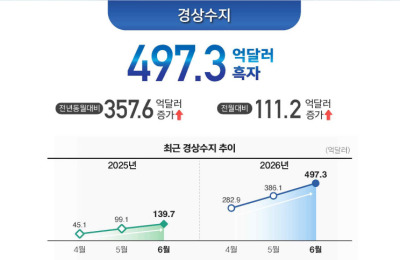
[서울=뉴스핌] 박가연 기자 = 지난 6월 우리나라의 경상수지가 전월에 이어 역대 최대 흑자를 기록했다. 반도체를 중심으로 한 정보기술(IT) 품목 수출 호조로 월간 상품수출이 처음으로 1000억달러를 넘어선 영향이다.
[자료=한국은행]
한국은행이 6일 발표한 '2026년 6월 국제수지(잠정)'에 따르면 지난 6월 경상수지는 497억3000만달러 흑자로 집계됐다. 전월(386억1000만달러)에 이어 두 달 연속 월간 기준 역대 최대 기록을 갈아치웠다. 이에 따라 올해 상반기 누적 경상수지 흑자는 1910억1000만달러를 기록했다.
경상수지 흑자를 견인한 것은 상품수지다. 6월 상품수지는 478억9000만달러 흑자를 기록하며 전월에 이어 역대 최대를 다시 썼다. 국제수지 기준 상품수출은 1123억7000만달러로 전년 동월 대비 84.5% 증가하며 월간 기준 처음으로 1000억달러를 넘어섰다. 상품수입은 644억8000만달러로 38.6% 늘었다.
통관 기준으로는 반도체 수출이 전년 동월 대비 196.9% 급증했고 컴퓨터·주변기기(SSD)는 282.7% 증가했다. IT 품목 수출은 160.4% 늘었으며 비IT 품목도 ▲석유제품(47.5%) ▲화공품(18.6%) ▲철강제품(17.9%) ▲승용차(6.1%) 등을 중심으로 18.6% 증가했다. 통관 기준 수입은 ▲원자재(30.5%) ▲자본재(35.3%) ▲소비재(16.4%)가 모두 늘었다.
서비스수지는 12억9000만달러 적자를 기록해 전월(-10억9000만달러)보다 적자 폭이 확대됐다. 여행수지는 외국인 입국자 증가와 유류할증료 인상 등에 따른 출국자 감소로 4억4000만달러 흑자를 기록했지만 지식재산권사용료수지는 전월 흑자에서 4억4000만달러 적자로 전환됐다.
본원소득수지는 배당소득을 중심으로 32억7000만달러 흑자를 기록해 전월(21억7000만달러)보다 흑자 폭이 확대됐다. 배당소득수지는 배당수입이 늘어난 데다 전월 분기배당에 따른 기저효과로 배당지급이 줄면서 25억6000만달러 흑자를 나타냈다.
금융계정 순자산은 6월 중 467억1000만달러 증가해 월간 기준 역대 최대 증가 폭을 기록했다. 종전 최대였던 올해 3월(369억9000만달러)을 넘어선 것이다. 직접투자에서는 내국인의 해외투자가 80억1000만달러, 외국인의 국내투자가 46억3000만달러 각각 증가했다.
증권투자에서는 외국인의 국내 주식 매도세가 이어졌다. 외국인의 국내 주식 투자는 차익실현 매도 등의 영향으로 316억1000만달러 감소하며 전월(-310억5000만달러)에 이어 역대 최대 순매도 기록을 다시 경신했다.
외국인의 국내 채권투자는 세계국채지수(WGBI) 자금 유입에도 분기 말 만기도래 영향으로 증가 폭이 줄어든 52억9000만달러를 기록했다. 내국인의 해외 증권투자는 주식을 중심으로 35억6000만달러 증가했다.
eoyn2@newspim.com
2026-08-06 08:00