


President's SpeechSpeech to California Independent Bankers 16th Annual Convention Laguna Beach, CaliforniaBy Janet L. Yellen, President and CEO of the Federal Reserve Bank of San FranciscoFor delivery October 9, 2006, 10:40 am Pacific, 1:40 pm Eastern.Prospects for the U.S. EconomyGood morning, everyone, and many thanks for inviting me to join you at this outstanding conference. It's always a pleasure for me to have the chance to meet with community and regional bankers in the District. It's also an opportunity, because getting to know your unique perspectives on conditions in your industry and in the economy helps inform my own decisions in both the supervisory area and in monetary policymaking. When I joined the San Francisco Fed two years ago, I was very glad to see how seriously our staff takes its responsibility for supervising community banks. To my mind, your institutions play a critical role in this country's diverse and flexible banking system: you provide essential services to your customers and make vital contributions to the economic health not only of your communities but of the nation. So I'm delighted that we can show our support and commitment by participating in events like this one.Joining me today from the San Francisco Fed is Steve Hoffman, Senior Vice President of Banking Supervision and Regulation. Tomorrow, Jose Alonso, Director of Regional and Community Banking in our Los Angeles Branch, will represent the Fed during the regulatory panel discussion of commercial real estate. For the question and answer session following my remarks, I'll defer to Steve for addressing any technical supervision questions that you might have.Although I will touch on some supervisory topics today, my remarks overall will cover my outlook for the U.S. economy and inflation. Before I begin, let me note that my comments represent my own views and not necessarily those of my colleagues in the Federal Reserve System. One of the main things I want to focus on is what this outlook implies for monetary policy, and, in particular, I'll discuss the decision at the last meeting of the Federal Open Market Committee. As you know, that was the second consecutive time that the Committee decided to hold the federal funds rate at 5¼ percent, after having raised it by one-quarter percentage point at each of the prior seventeen meetings. So my plan is to go into some of my reasoning for supporting the approach underlying that decision.To do that, I need to step back a little in time, because where the economy is now and where I think it is headed have a lot to do with how we got here in the first place. Let me take you back to mid-2004, when the Fed first began to raise the federal funds rate. This move followed a long period—about a year and a half—of holding the rate at a very low 1 to 1¼ percent to provide the stimulus needed to reduce the risk of outright deflation. Eventually, that stimulus, together with the general resilience of our economic system, did help the economy pick up steam. By June of 2004, the threat of deflation had passed, and it was time to start removing monetary stimulus. And, as I said, that's what the Committee did, one quarter-percentage-point step at a time. In fact, if you chart the path of the funds rate since then, it looks a lot like a staircase, or, as some have dubbed it, an escalator. Over the course of much of this time, the economy averaged solid growth—or even better than solid growth; in fact, the economy was growing at a pace that was noticeably higher than estimates of the rate it can sustain in the long run.With this strong performance, we also have seen the slack in labor and product markets dwindle. For example, the civilian unemployment rate dropped by 1 percentage point to 4.6 percent in September. This rate is a bit lower than conventional estimates of so-called "full employment" and, therefore, suggests that by now labor markets may even have moved a bit to the tight side.At the same time, inflation rose, and it has been higher for some time now than I like to see it—not only headline inflation, but also the core measure, which excludes the volatile food and energy components. The particular inflation measure the Committee focuses on in its Monetary Policy Report to Congress is the core personal consumption expenditures price index. Over the past year, it rose at nearly a 2½ percent rate. Although I'm somewhat encouraged that various measures of core inflation have edged down recently, it's clear that more progress is needed.At the August meeting, it seemed that the signs of a slowdown in economic activity were starting to show up, at least in part because of the Fed's previous efforts to remove monetary accommodation. Inflationary pressures also seemed reasonably likely to gradually abate. So, at that time, the Committee decided to pause—to "step off the escalator" and wait a while to see how the previous funds rate increases and other influences on the economy were playing out. Since then, there have been further signs of slowing, and at the September meeting, the Committee again decided in favor of a pause—to "stay on the landing," so to speak, leaving the funds rate at 5¼ percent.Prospects for Economic ActivityNow that I've covered how we got here, the questions are, where are we exactly, and what is the likely outlook for economic activity and inflation?First, the economy. As I mentioned, the data we've been seeing in recent months point to a noticeable slowdown for this half of the year, with growth running at only a modest pace and clearly below the rate that is sustainable in the long run. Naturally, there are forces both supporting growth and restraining it, so let me enumerate some of them here.The factors working to support growth include ongoing strength in business demand, fueling relatively rapid growth in spending on business investment in equipment and software, including the important high-tech industries. Moreover, spending for the construction of nonresidential structures has advanced smartly so far this year, and promises to remain strong for a while longer. For example, outlays on drilling and mining structures have continued to increase in response to oil prices that are still high and expected to remain so. Furthermore, fundamentals in commercial real estate markets continued to improve this year, increasing demand for commercial space from office parks to warehouses. Indeed, here in Southern California, for example, office vacancy rates in Los Angeles, Orange County, and Riverside Counties are at or near 10-year lows. Going forward, even at a more moderate pace of economic expansion, private forecasters expect the positive trends in commercial real estate in both California and the nation to continue but to moderate next year as capacity comes online.Now for the factors that are likely to restrain the nation's economic growth. One obvious factor, of course, is energy prices. It is quite likely that the surge in the price of oil over the past couple of years has taken a bite out of consumer spending, even if other factors, like growth of jobs, wages, and wealth, have kept consumption moving up overall.Needless to say, it has been something of a relief to see that oil prices have receded quite a bit in recent months, probably because threats to supply from the Middle East conflict and from the Gulf Coast hurricane season have eased. At this point, futures markets expect them to stabilize around the current lower levels, and if they do, the restraint we've felt this year should evaporate over 2007; in fact, stable oil prices would actually contribute to a pickup in growth next year. Of course, given the well known volatility of energy markets, that's a very big "if," so they remain a wild card in the outlook as usual.The high price of oil is also hitting the auto industry, in particular, U.S. auto production, and that is another factor working to slow our economy. People aren't just groaning every time they pump gas and watch the numbers roll up and up, they're also looking for more fuel-efficient vehicles. That's good news for some of the foreign automakers, but not such good news for some U.S. producers, for whom SUVs and trucks have been a key source of strength. As the demand for these vehicles has dropped pretty sharply, producers find themselves holding unsustainably high inventories. So it's little wonder that we should have read recently about Ford or GM offering buyouts to their employees as they move to ramp down production. These production cuts will likely slow overall real GDP growth in the U.S. until the adjustment to a lower level is reached, most likely next year.Another factor restraining growth is the rise in interest rates over the past couple of years as the Fed has removed monetary policy accommodation. Since this process began in mid-2004, short- and intermediate-term interest rates are up substantially. Long-term rates present a more mixed picture, with some—such as conventional mortgage rates—up slightly, and others actually lower than before. Nonetheless, the overall effect of these rate changes should be to reduce demand, particularly in interest-sensitive sectors.Of course, housing is a particularly interest-sensitive sector, and, as we know, it already has shown clear signs of cooling. Frankly, the pace of it has been a little surprising. Nationally, housing permits are down noticeably—by about 22 percent—from a year ago. In addition, inventories of unsold houses are up significantly, sales of new and existing homes are off their peaks, and surveys of homebuyers and builders are showing much more pessimistic attitudes.The national data on residential investment reflect all of these developments and enter directly into the calculation of real GDP growth. After adjusting for inflation, (real) residential investment dropped at an 11 percent annual rate in the second quarter following two small declines in the prior two quarters.The California data, not surprisingly, show even more softening in the housing market. For the first half of this year, quarterly average home sales in California are down nearly four times as much as they are nationwide, and new housing activity also has slowed more dramatically in the state.According to some of our contacts elsewhere in this Federal Reserve District, data like these are actually "behind the curve," and they're willing to bet that things will get worse before they get better. For example, a major home builder has told me that the share of unsold homes has topped 80 percent in some of the new subdivisions around Phoenix and Las Vegas, which he labeled the new "ghost towns" of the West. Though the situation isn't that bad everywhere, a significant buildup of home inventory implies that permits and starts may continue to fall and the market may not recover for several years. While builders remain hesitant to cut prices so far, and instead offer sales incentives, price cuts at some point in the future seem almost inevitable.Indeed, we have already seen that the pace of house-price appreciation has clearly moderated, and there are signs that it may continue. For example, one indicator we have been following is the Case-Shiller house price index, which is based on house price data in ten large urban markets—three of which are in California, by the way. Beginning in May of this year, futures contracts on this price index began trading, and they show house prices falling at about a 6 percent annual rate by the end of this year. Though this is still a very new and pretty thin market, the results are interesting and suggestive.Significant movements in house prices can be an issue for economic activity. Just as the run-up in house prices provided some support for consumer spending, slower increases, and especially outright decreases, could weaken that support. For example, back when house prices were rising so fast, people saw that more and more equity was being built up in their houses, and they might well have felt that they could afford to spend pretty freely. In economic terms, this is called the "wealth effect." In addition, with instruments like home equity loans, refinancing, and so on, households have found it much easier to pull money out of their rising house values to support their spending. Now, with the pace of house-price appreciation slowing, of course, their equity is not rising so fast anymore, which may weaken the growth in consumer spending. In California, the impact of a vanishing wealth effect might be quite significant because over the past year the state has seen a more rapid deceleration in housing prices than the nation.Before I turn to the prospects for inflation, I'd like to spend a few minutes discussing the outlook for both residential and commercial real estate in the context of the current regulatory focus on the banking industry's lending to these sectors of the economy.In fact, the San Francisco Fed has a long-standing supervisory interest in real estate conditions. We helped shape the current draft interagency guidance on commercial real estate concentrations, and our institutional memory of the devastating California real estate downturn in the early 1990s remains vivid. Frankly, it would be hard to forget that period, when California had 49 commercial bank failures between 1991 and 1996, accounting for about 11 percent of the state's banks. The vast majority—as well as many banks that survived in troubled condition—had very high construction loan concentrations for either commercial or residential properties, or both. Of course, circumstances have changed a lot since then. For example, there is now ready access to information on real estate market conditions and active secondary markets for real estate loans; and certainly, bank underwriting practices have improved significantly. While these changes have helped to mitigate risk, we can't afford to become complacent; as history has taught us, concentrations still can prove dangerous when market conditions turn. As you know, the performance of commercial real estate and construction loans on banks' balance sheets has been excellent, largely because of low interest rates and substantial appreciation of property values. These conditions may have encouraged banks to focus new lending towards these sectors—especially construction and land development. Although California banks no longer lead the nation in construction loan concentrations—as they did in the previous real estate cycle—more than 40 percent of the state's banks exceed the benchmark ratio contained in the draft interagency guidance, which, as you know, is 100 percent of total capital.Construction lending causes some concern at this point in the cycle because our examiners have found that much of the recent loan growth in community and regional banks is in the softening residential market. The riskiest loans are those for land acquisition and speculative development; historically, these are the first to register the effects of a slowdown in terms of weakening demand for new loans and declining quality of existing loans. If housing markets continue to slow, such banks should watch closely for signs of trouble, such as project delays, houses not selling, price discounts, condos converting to rentals, and increasing loan renewals, extensions, and refinancings. Any of these developments could have a significant impact on revenue and growth projections as well as loan losses at some banks.As the draft interagency guidance states, we expect banks to actively manage risk concentrations in commercial real estate and construction lending. Tomorrow, Jose will discuss some of the ways that banks are enhancing their approach to credit risk concentration management. Based on what we've seen in recent examinations, I'm pleased to say that it appears that a number of banks have already implemented most of the risk management practices outlined in the proposed guidance. Prospects for InflationNow let me return to the national outlook and focus on inflation. As I've indicated, core consumer inflation has been uncomfortably high recently. Therefore, in keeping with the Committee's responsibilities for promoting price stability for the nation, I believe it is critical that inflation trend in a downward direction over the medium term. Indeed, my expectation is that this is the most likely outcome for several reasons.First, as I've explained, the economy appears to have entered a period of below-trend growth. If this continues for a time, as I think is likely, the tightness we have seen in labor and product markets would ease somewhat, tending gradually to reverse any underlying inflationary pressures. A second reason to expect inflationary pressures to lessen has to do with the impact of stabilizing, or even falling, oil prices on core inflation. As I mentioned, core inflation, by definition, excludes energy prices, but energy prices may affect core inflation to the extent that they affect the prices of other goods and services. For example, transport companies might raise their prices to pass along the higher costs of filling their trucks' gas tanks. This is known as "passthrough," and it is likely that it has played at least some role in recent core inflation movements. Now that energy prices have fallen a fair bit from recent highs and are expected by futures markets to remain at those lower levels, this upward pressure on core inflation is likely to dissipate and could even turn into modest downward pressure at some point.But let me note that we shouldn't exaggerate the importance of this point. Recent analysis suggests that the extent of passthrough for any given rise in energy prices has been lower in the past twenty-five years than it was back in the 1970s.1 For a specific example, consider airfares, which have increased markedly over the past year. Considering that jet fuel accounts for one-eighth to one-fourth of airlines' operating costs, it would make sense to think they have passed through higher fuel prices into airfare increases. However, some simple calculations show that the cost increases from rising jet fuel are likely insufficient to explain more than a portion of the airfare increases, and that higher load factors are likely to be part of the explanation.The final reason to be optimistic about inflation moving lower is that inflation expectations appear to have been well anchored over the past ten years or so as the Fed has established its credibility with the public about both its commitment to and its competence in keeping inflation at low and stable rates. For example, in the face of the large oil price increases we've seen in recent years, this credibility shows up in the stability of survey and market measures of inflation expectations looking ten years ahead.2Statistical analysis of the behavior of core inflation over time also lends some support to the view that inflation expectations are well anchored. In such statistical analyses, the inflation data historically have exhibited persistence. This basically means that, when you're forecasting inflation, it works pretty well to assume that the rate in the future will be the same as it is today. The implication of persistence is frankly worrisome: Since inflation is too high today, persistence implies it could stay too high for an extended period.However, research suggests that if a central bank's commitment to price stability has gained credibility with the public, then the persistence observed in the inflation data will tend to be dampened. And as it turns out, recent research at the Federal Reserve Bank of San Francisco finds less evidence of persistence during the past ten years.3 That is, rather than sticking at a certain rate, core inflation has tended to revert to its long-run average, which, over that period, is between 1-1/2 to 2 percent. Admittedly, the past ten years constitute a relatively small sample from which to draw definitive conclusions. Nonetheless, this evidence is important because, if it holds up, it implies that inflation may move down from its elevated level faster than many forecasters expect. I would like to stress that a finding of low persistence in inflation is no reason for the Fed to rest on its laurels of credibility. Rather, credibility is something that neither I—nor my colleagues—take for granted for a moment. We know full well that maintaining credibility requires that we act when necessary to keep inflation under control.So, in summary, I think there are a number of reasons to expect core inflation to trend gradually lower in the future. However, I am keenly aware that this pattern has yet to show up in the data on any sort of a sustained basis. The inflation outlook remains highly uncertain, and until we actually see inflation begin to slow down, I will be focused on the upside risks in the outlook. Policy issues This leads me back to where I began—monetary policy and the Committee's decisions at the last two meetings to pause for a time after 17 quarter-point rate hikes in a row. Why does a pause make sense to me now, while at the same time I say I'm worried that inflation is too high? My answer is that I do want to see inflation move down, but I believe policy may now be well-positioned to foster exactly such an outcome while also giving due consideration to the risks to economic activity. The stance of policy can be assessed by a variety of metrics. These measures include the forecast I have outlined today, as well as the recommendations from commonly used monetary policy rules. Taken as a whole, such rules—often referred to as Taylor rules—indicate that the funds rate is currently within the moderately restrictive range that appears appropriate.If policy is now well positioned, it will still take time for inflation to unwind due to lags between policy actions and their impacts on economic activity and inflation. These lags can be anywhere from several months to a couple of years. This means that we have yet to see the full effects of the series of 17 funds rate increases—some are probably still in the pipeline.You will note that I am casting my statements about the stance of policy and the outlook in very conditional terms. I do this because of the great uncertainty that surrounds these issues. Frankly, all approaches to assessing the stance of policy are inherently imprecise. Just as imprecise is our understanding of how long the lags will be between our policy actions and their impacts on the economy and inflation. This uncertainty argues, then, for policy to be responsive to the data as it emerges, especially as we get within range of the desired policy setting. The decision to pause allows us more time to observe the data so that appropriate adjustments can be made over time. For example, with the passage of time, we will gain more information on whether we have done enough to assure that inflation moves gradually lower.In summary, monetary policymakers again are doing a balancing act, seeking the best way to temper inflationary pressures while not exposing the business cycle expansion to undue risk. Holding the stance of policy steady for a time makes sense to me. First, we appear to be within range of the moderately restrictive policy setting that seems appropriate. Second, pausing gives us time to observe the effects of previous policy actions and other factors to allow for adjustments to the policy setting that will keep us moving toward the desired outcome for inflation, output, and employment. Before I start to take questions, I'd like to thank you for your kind attention, and I'd also like to thank the California Independent Bankers Association again for having me here today. The connection we have built with community bankers over the years is very important to the mission of the San Francisco Fed. As president, it also is very important to me, and I am personally committed to playing my part in building on our already strong relationships.# # #1. Mark Hooker, "Are Oil Shocks Inflationary? Asymmetric and Nonlinear Specifications versus Changes in Regime," Journal of Money, Credit, and Banking, May 2002.2. Bharat Trehan with Jason Tjosvold, "Inflation Targets and Inflation Expectations: Some Evidence from the Recent Oil Shocks," FRBSF Economic Letter, 2006-22, September 1, 2006.http://www.frbsf.org/publications/economics/letter/2006/el2006-22.html3. John C. Williams, "The Phillips Curve in an Era of Well-Anchored Inflation Expectations," unpublished paper. A less technical version with the same title is forthcoming as FRBSF Economic Letter 2006-27 (October 13, 2006).http://www.frbsf.org/publications/economics/letter/

[관련키워드]




[뉴스핌 베스트 기사]
 사진
사진
정동영 업무보고 논란
[서울=뉴스핌] 유신모 외교전문기자 = 청와대 영빈관에서 5일 열린 외교·안보 분야 정부 부처의 대통령 업무보고에서 정동영 통일부 장관의 '한반도 평화공존 발전 구상'과 업무보고 발언이 논란을 빚고 있다.
이날 정 장관의 발언 중에는 정부 내 조율을 거치지 않은 사안을 정책으로 추진하겠다고 공언한 것이 있는가 하면 사실 관계에 맞지 않은 설명도 있었다. 이재명 대통령은 공개적으로 신중을 기해 달라고 경고했고, 조현 외교부 장관은 '이상주의적 희망에 근거한 비현실적 구상'이라는 비판을 내놨다.
그동안 정 장관의 대북 정책 관련 발언이 물의를 빚은 적은 여러 번 있지만 대통령과 유관 부처 장관이 공개적으로 부정적 입장을 표명한 것은 이례적이다. 정 장관의 무리한 대북 접근법과 월권을 제어해야 한다는 목소리도 높아지고 있다.
[정동영 통일부 장관이 지난달 23일 오후 서울 종로구 정부서울청사에서 취임 1주년 기자간담회를 하고 있다. [사진=통일부] 2026.07.23
◆통일부 장관 권한 넘어선 주장
정 장관은 이날 업무보고에서 '한반도 평화공존 발전 구상'을 설명하면서 이재명 정부 2년차 핵심 과제로 상호 존중·평화적 갈등 해결·핵 없는 한반도 등 3대 기본 방향을 제시했다.
정 장관은 "대결과 혐오의 언어는 멈춰야 한다"면서 주적 용어 대체를 주장했다. 지난 25년간의 CVID(완전하고 검증가능하며 되돌릴 수 없는 비핵화) 구도는 이미 무너졌다고도 했다. 또 "현 시점에서 흘러간 선(先)비핵화만 되뇌는 것은 현실을 바꾸는 데 힘이 되지 않는다"고 주장했다. 정 장관은 또 "정전 체제를 평화 체제로 바꾸는 논의에 착수하겠다"면서 "북·미 정상회담 견인과 함께 4자 대화의 동력을 확보하기 위해 최선을 다할 것"이라고 말했다.
하지만 이 대통령은 정 장관의 구상에 대부분 제동을 걸었다. 이 대통령은 "평화공존 정책이 정치적으로 악용되는 측면이 있다"며 "많이 조심하셔야 한다"고 지적했다.
북한을 다른 이름으로 불러야 한다는 주장에는 "표현에 꼬투리가 잡혀 정쟁으로 휘몰아 들어가면 원래 하고자 했던 데에서 오히려 나쁜 상황이 초래될 수 있다"고 경고했다.
이 대통령은 남북 신뢰 구축을 위해 9·19 군사합의를 선제적으로 복원해야 한다는 정 장관의 주장에 대해서도 "우리의 선의대로 하는 게 과연 한반도의 평화와 안정에 플러스냐, 결론적으로 약간의 의문이 들 때도 있다"며 부정적으로 반응했다.
조현 외교부 장관은 업무보고 사후 브리핑에서 정 장관이 언급한 '4자 회담'에 대해 "이상주의에 근거한 어떤 희망이라 하더라도 그건 아직 조율되지 않은 방법"이라며 "여러분들께서 디스카운트해 주시면 좋겠다"고 선을 그었다.
정 장관이 9월 러시아 블라디보스토크에서 열리는 '동방경제포럼(EEF)'을 언급하며 "정부 차원에서 (참석을) 검토하고 있다"고 발언한 데 대해서도 조 장관은 "그것은 외교부의 몫"이라며 "아직 거기까지 진도가 나가지 않았다"고 잘랐다.
정 장관이 이날 소개한 대북 구상과 설명은 정부 내 조율을 거치지 않았다는 점에서 문제가 있다. 특히 주적 표현 대체와 국호 사용, 9·19 군사합의 복원, 4자회담 추진 등은 통일부 장관이 결정할 사안이 아니어서 월권이라는 지적이 나오고 있다. 이 대통령은 정 장관의 업무보고를 듣고 난 뒤 "여기 업무보고에 발표했다고 승인난 건 아니다"라고 재차 확인했다.
정부의 한 소식통은 "정 장관의 발언 내용은 대부분 국가안전보장회의(NSC)를 거쳐 결정된 사안이 아닌 정 장관의 개인적 생각에 가깝다"며 "안보 관련 부처 장관이 정부의 공식 정책이 아닌 사안을 추진하겠다고 업무보고를 하고 대통령의 면전에서 '국군통수권자가 나서야 한다'고 주장한 것은 심각한 문제"라고 지적했다.
이재명 대통령이 5일 청와대 영빈관에서 열린 통일 외교 국방 등 외교 안보 부처 업무보고에서 발언하고 있다. [사진=청와대] 2026.08.05
◆시대착오적 접근, 대북 인식 오류
더욱 문제인 것은 정 장관의 이같은 주장이 현 시점에서 이미 참고가 될 수 없는 과거의 경험 또는 사실과 다른 인식에 기반하고 있다는 것이다. 정 장관이 주장하는 구상은 급격히 변화하고 있는 북한의 전략과 한반도 및 국제 정세를 전혀 반영하지 못하고 있다는 비판이 제기되고 있다.
정 장관이 "흘러간 선(先)비핵화만 되뇌는 것은 현실을 바꾸지 못한다"고 언급한 것은 지금까지의 대북 접근법을 호도하고 있다. 북핵 위기 발발 이후 지금까지 모든 핵 협상에서 한국이나 미국은 북한에 선비핵화를 공식적으로 요구한 적이 없기 때문이다.
지금까지의 북핵 협상은 북한의 비핵화 조치에 한·미가 상응하는 대가를 제공하는 방식으로 이뤄졌다. 1994년 북·미 제네바 기본합의는 핵시설 동결과 중유 제공의 교환이었다. 2005년 9.19 공동성명도 북한의 비핵화 조치의 모든 단계에 상응조치를 제공하는 '행동 대 행동' 원칙이 적용됐다.
대북 협상에 관여했던 한 전직 관료는 "모든 북핵 협상은 북한의 비핵화 조치와 한·미가 제공하는 상응조치를 어떻게 정교하게 배열하느냐가 관건이었다"면서 "정 장관의 발언은 지금까지 한·미가 북한에 먼저 핵을 포기해야 대화할 수 있다는 정책을 고수해 현 상황에 이르게 됐다는 잘못된 인식에서 비롯된 것으로 보인다"고 말했다.
정 장관이 "지난 25년간의 CVID 구도가 무너졌다"고 말한 것도 비핵화의 개념에 대한 이해 부족이라는 비판이 제기되고 있다. 북핵 문제에 정통한 외교 소식통은 "어떤 명칭을 붙이든 핵을 제거한 뒤 이를 검증하고 재발 방지 조치를 하는 것은 비핵화에 반드시 포함되어야 하는 기본적 절차"라며 "CVID는 안 된다고 말하는 것은 북한의 비핵화 조치를 검증도 하지 않고 언제든 되돌릴 수 있도록 합의하자는 말과 같다"고 지적했다.
[서울=뉴스핌] 이길동 기자 = 조현 외교부 장관이 5일 오후 서울 종로구 정부서울청사 별관에서 2026년 하반기 업무보고 사후브리핑을 하고 있다. 2026.08.05 gdlee@newspim.com
◆안보 리스크 키우는 통일부 장관
정 장관은 지난해 취임 직후부터 청와대와 외교부를 제치고 통일부가 북한과 관련된 모든 정책을 주도해야 한다는 주장을 펴면서 단독 질주를 거듭해왔다.
북한의 '적대적 두 국가' 주장을 변형한 '평화적 두 국가'를 지향해야 한다고 주장하면서 이에 문제점을 지적하는 목소리를 무시했다. 외교부가 미국과 북한 문제를 논의하는 것에 대해 "한반도 정책과 남북관계는 주권의 영역이며 동맹국과 협의의 주체는 통일부"라고 주장해 물의를 빚었다. 문재인 정부 시절 한·미 워킹그룹이 남북관계 파탄 원인이었다고 사실과 다른 주장을 폈다.
지난해 업무보고에서는 국제정세를 감안하지 않고 남북대화 재개에만 초점을 맞춘 비현실적 내용으로 논란을 빚었다. 정부 내 조율도 거치지 않고 독자 대북제재인 5·24 조치를 해제하고 9·19 군사합의 비행금지구역 복원을 추진하겠다는 방침도 밝혔다.
지난 4월에는 평안북도 구성시에 우라늄 농축 시설이 있다고 말해 파장을 일으켰다. 미국은 이 발언을 계기로 한국과 대북정보 공유를 제한했다. 이 조치는 지금도 계속되고 있는 것으로 알려졌다.
정 장관이 이처럼 정부의 공식 결정을 거치지 않은 사안을 정부 정책인 것처럼 주장하며 좌충우돌하는 배경에 대해 여러가지 해석이 나온다. 북한 문제에서 조기에 성과를 거둬야 한다는 조급증과 자신의 존재감 과시 욕구가 작용하고 있다는 평가가 많다.
일각에서는 정 장관이 2007년 민주당 대선후보였을 때 이재명 대통령이 캠프에서 비서실 부실장으로 활동한 전력이 있다는 것을 들어 "정 장관이 아직도 이 대통령을 아랫사람으로 생각하고 있는 것 아니냐"는 비판을 내놓기도 한다.
한·미 관계와 북한 문제를 오래 다뤘던 전직 관료 출신의 한 전문가는 "정 장관 취임 후 지금까지의 언행은 잘못된 현실 인식에 따른 독단과 앞서 가기, 월권 등으로 점철돼 있다"면서 "통일부 장관이라는 중요한 직책에 있으면서 스스로 안보 리스크를 키우는 역할만 했다"고 비판했다.
opento@newspim.com
2026-08-06 06:10
 사진
사진
6월 경상수지 최대 흑자
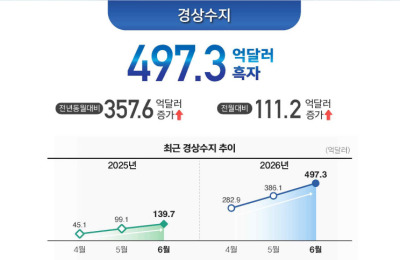
[서울=뉴스핌] 박가연 기자 = 지난 6월 우리나라의 경상수지가 전월에 이어 역대 최대 흑자를 기록했다. 반도체를 중심으로 한 정보기술(IT) 품목 수출 호조로 월간 상품수출이 처음으로 1000억달러를 넘어선 영향이다.
[자료=한국은행]
한국은행이 6일 발표한 '2026년 6월 국제수지(잠정)'에 따르면 지난 6월 경상수지는 497억3000만달러 흑자로 집계됐다. 전월(386억1000만달러)에 이어 두 달 연속 월간 기준 역대 최대 기록을 갈아치웠다. 이에 따라 올해 상반기 누적 경상수지 흑자는 1910억1000만달러를 기록했다.
경상수지 흑자를 견인한 것은 상품수지다. 6월 상품수지는 478억9000만달러 흑자를 기록하며 전월에 이어 역대 최대를 다시 썼다. 국제수지 기준 상품수출은 1123억7000만달러로 전년 동월 대비 84.5% 증가하며 월간 기준 처음으로 1000억달러를 넘어섰다. 상품수입은 644억8000만달러로 38.6% 늘었다.
통관 기준으로는 반도체 수출이 전년 동월 대비 196.9% 급증했고 컴퓨터·주변기기(SSD)는 282.7% 증가했다. IT 품목 수출은 160.4% 늘었으며 비IT 품목도 ▲석유제품(47.5%) ▲화공품(18.6%) ▲철강제품(17.9%) ▲승용차(6.1%) 등을 중심으로 18.6% 증가했다. 통관 기준 수입은 ▲원자재(30.5%) ▲자본재(35.3%) ▲소비재(16.4%)가 모두 늘었다.
서비스수지는 12억9000만달러 적자를 기록해 전월(-10억9000만달러)보다 적자 폭이 확대됐다. 여행수지는 외국인 입국자 증가와 유류할증료 인상 등에 따른 출국자 감소로 4억4000만달러 흑자를 기록했지만 지식재산권사용료수지는 전월 흑자에서 4억4000만달러 적자로 전환됐다.
본원소득수지는 배당소득을 중심으로 32억7000만달러 흑자를 기록해 전월(21억7000만달러)보다 흑자 폭이 확대됐다. 배당소득수지는 배당수입이 늘어난 데다 전월 분기배당에 따른 기저효과로 배당지급이 줄면서 25억6000만달러 흑자를 나타냈다.
금융계정 순자산은 6월 중 467억1000만달러 증가해 월간 기준 역대 최대 증가 폭을 기록했다. 종전 최대였던 올해 3월(369억9000만달러)을 넘어선 것이다. 직접투자에서는 내국인의 해외투자가 80억1000만달러, 외국인의 국내투자가 46억3000만달러 각각 증가했다.
증권투자에서는 외국인의 국내 주식 매도세가 이어졌다. 외국인의 국내 주식 투자는 차익실현 매도 등의 영향으로 316억1000만달러 감소하며 전월(-310억5000만달러)에 이어 역대 최대 순매도 기록을 다시 경신했다.
외국인의 국내 채권투자는 세계국채지수(WGBI) 자금 유입에도 분기 말 만기도래 영향으로 증가 폭이 줄어든 52억9000만달러를 기록했다. 내국인의 해외 증권투자는 주식을 중심으로 35억6000만달러 증가했다.
eoyn2@newspim.com
2026-08-06 08:00