


The Monetary Policy ModelWilliam Poole*President, Federal Reserve Bank of St. Louis National Association of Business Economics (NABE) Annual Meeting Boston Sept. 11, 2006 *I appreciate comments provided by my colleagues at the Federal Reserve Bank of St. Louis. I take full responsibility for errors. The views expressed are mine and do not necessarily reflect official positions of the Federal Reserve System.--------------------------------------------------------------------------------The Monetary Policy ModelI am sure that all of us find it sobering to meet on the fifth anniversary of the tragic events of Sept. 11, 2001. Many of you were present at the NABE annual meeting at the World Trade Center that day and were fortunate to escape before the great towers came down. It is a distinct honor to be here today to accept the Adam Smith Award. I’ll be talking about the subject I know best—monetary policy. I would have used the title, “My Monetary Policy Model” except for the fact that the model I use is not mine. Our current understanding of monetary economics has been built on contributions over many hundreds of years. In preparing this lecture, I reminded myself of just how clearly Adam Smith understood monetary issues by going back to reread sections of the Wealth of Nations. Smith begins the book with three short chapters on the division of labor. Chapter 4 is entitled, “Of the Origin and Use of Money.” Smith explains that division of labor requires exchange, and exchange requires money. He discusses the difficulty of conducting exchange efficiently because metallic money needs to be weighed and assayed. Smith discusses the practice of princes and sovereign states in debasing the currency. He notes that “[s]uch operations, therefore, have always proved favourable to the debtor and ruinous to the creditor, and have sometimes produced a greater and more universal revolution in the fortunes of private persons, than could have been occasioned by a very great public calamity.”Monetary policymakers are acutely aware of the potential for monetary policy to create “a very great public calamity” and they feel deeply their responsibility not to permit such an outcome. Our most fundamental challenges are basically the same ones Smith noted. Uncertainty over the value of money is one; another is the incentive of sovereign states to debase the value of money. My aim in this lecture is to provide a skeletal picture of how I view the Federal Reserve’s task. Before proceeding, I want to emphasize that the views I express here are mine and do not necessarily reflect official positions of the Federal Reserve System. I thank my colleagues at the Federal Reserve Bank of St. Louis for their comments, but I retain full responsibility for errors.Rational Expectations Macroeconomic EquilibriumMost macroeconomists today adhere to a model based on the idea of a rational expectations equilibrium. All aspects of government policy enter the rational expectations model—the “RE model” for short—but I’ll confine my remarks to monetary policy. Policymakers are assumed to have a set of goals and a conception of how the economy works. The private sector understands, to the extent possible, policymakers’ views. An equilibrium is characterized by a situation in which the private sector has a clear understanding of policy goals and the policymakers’ model of the economy, and the policy model of the economy is as accurate as possible. If the policymakers and private market participants do not have views that converge, no stable equilibrium is possible because expectations as to the behavior of others will be constantly changing.In this setting, market behavior depends centrally on expectations concerning monetary policy and the effects of monetary policy on the economy, including effects on inflation, employment and financial stability. A stable equilibrium requires that markets behave as policymakers expect and that policymakers behave as markets expect.It is easiest to describe the rational expectations equilibrium in a context of certainty. But, of course, all the really interesting questions arise in a context of uncertainty. One form of uncertainty concerns future states of the world. In principle, we can think about a model in which market responses and policy responses to new information reflect maximizing behavior. In the private sector, in response to new information, households change consumption plans to maximize utility and firms make operating and investment decisions to maximize profits. Similarly, policymakers revise the stance of monetary policy in an attempt to pursue policy goals as efficiently as possible. The continuous flow of new information includes everything that happens—weather disturbances, technological developments, routine economic data reports and the like. Thus, we can think of the economy as evolving efficiently in response to stochastic disturbances of all sorts. Of course, in practice, there is also uncertainty about market and policy responses to new information, and there are improvements over time in knowledge about how the economy works. Nevertheless, the RE model provides the core insights that shape my views as to how to make routine policy decisions and how to design a longer-run program to improve policy. Monetary Policy Imperatives in the ModelWe can think of the actual, observed equilibrium as a full rational expectations equilibrium under current policy. There may well be an alternative policy that would induce a new rational expectations equilibrium that would have more desirable properties than the current equilibrium. Thinking of the model this way provides an agenda for long-run improvement in monetary policy.Clarity of Goals. For the private sector to form accurate expectations about future monetary policy and outcomes of key economic variables, policymakers need to state their goals clearly. The literature on inflation targeting emphasizes this point, and I have long believed that the FOMC could improve the clarity with which it conveys its objectives to the general public. In the past, I have stated my own personal inflation objective as “zero inflation, properly measured” but have also said that FOMC agreement on an inflation objective, which some might express as a “comfort zone of 1-2 percent inflation,” is more important than which precise specification is selected. There are practical difficulties that can and should be addressed, such as what price index to use, over what period to measure price changes and what degree of tolerance to adopt if inflation runs outside the range. I do not believe that uncertainty about the Fed’s inflation objective is a large issue at present but do believe that there is an opportunity to improve clarity.Maintaining Credibility. To maintain credibility, the monetary authorities must deliver what they said they would deliver. Credibility is essential to the stability of longer-term inflation expectations. Central banks around the world emphasize the importance of achieving low and stable inflation. In the United States, the Federal Reserve lost considerable credibility in the 1970s because the inflation rate rose to unacceptable levels. With impaired credibility, the FOMC under Paul Volcker had to pursue a sustained anti-inflationary policy even in the face of the most severe recession since the Great Depression. The cost of restoring credibility makes clear the reason for not losing it.Credibility is not, however, one-dimensional. Sustained low inflation is desired for its own sake but even more for the contribution it makes to high employment and economic growth. Thus, while inflation damages credibility, so also can high unemployment. There is a fine balance here. We know that monetary policy cannot affect employment in the long run, but we also know that monetary policy mistakes can create unemployment over an uncomfortably long short run. When unemployment rises, policymakers need to be able to explain in credible fashion why the problem is not a consequence of a monetary policy mistake, for that perception is always present among some observers in such circumstances. There is, after all, some historical justification for such a perception given that almost all economists agree that monetary policy mistakes contributed to the severity of the Great Depression. Given the importance of high employment, a period of sustained excessive unemployment may create doubts about future policy, and this uncertainty is a manifestation of impaired credibility. The Federal Reserve’s credibility is also affected by other matters. Sound performance in dealing with financial crises and regulatory responsibilities enhances credibility. Reputational risk applies to the institution as a whole. Poor performance of responsibilities outside the monetary policy realm can affect the public’s confidence in the central bank’s leadership. Monetary policy success depends on high credibility, but it is important to recognize that credibility adheres to the entire institution that conducts monetary policy and not just to the department within the institution responsible for monetary policy.Some Implications of the Model The model I’ve sketched provides a way of thinking about current policy decisions. At least, the model provides a way for you to think about my thinking about current policy decisions. The model also provides a framework for analyzing potential policy improvements over time.The model clearly calls for improved clarity of central bank goals, a topic I’ve already discussed. Clearly also, the model supports continuing macroeconomics research to improve understanding of how the economy works. Because a full rational expectations equilibrium requires complete knowledge on the part of the private sector of central bank thinking and analysis, Federal Reserve research findings should be distributed widely. More generally, the model points to the importance of reducing asymmetries of knowledge through central bank transparency.A finding of the optimal control literature is that when a policy authority uses all available information as efficiently as possible in pursuing its goals, simple correlations between observable variables and goal variables may go to zero. Although the exact result will be model-dependent, we should not expect correlations such as between money growth and nominal GDP growth or between unit labor costs and inflation to be independent of the policy regime. This is a familiar proposition in the securities markets, where it is stated as the efficient markets hypothesis. Observable information should be quickly reflected in securities prices, leaving no risk-adjusted profit opportunities from trading on publicly available information. There is, of course, an opportunity to exploit nonpublic information. In the monetary policy context, research suggests that inflation-forecasting models have not worked very well in recent years. The reason, I believe, is that the Federal Reserve has been pretty successful in exploiting all available public information in its monetary policy decisions aimed at maintaining low and stable inflation. However, there is an opportunity to exploit non-public information. The Federal Reserve has an extensive process of gathering anecdotal information from business contacts. Much of this information is published in the Beige Book two weeks before every FOMC meeting. The policy model I’m sketching certainly leaves room for greater and more systematic effort to gather and exploit anecdotal information. What does the model imply about the value of financial-market information to policymakers? Consider the fed funds futures market. Does that market’s response to, say, the employment report help policymakers to assess the significance of the new data? In the RE model the clear answer is “no.” The behavior of the fed funds futures market tells us what the market believes will be the Fed’s response to the news. That is useful information for the Fed, but does not help in understanding what the new information itself means for the evolution of the economy. The same argument holds for other financial prices, which reflect a mixture of direct effects from new information and indirect effects from anticipated policy responses to the new information. The implication for policymakers is that we need to provide our own analysis of the implications of new information and cannot rely on financial markets to do that job for us.The model also contains a surprising implication for central bank communication. Consider the most extreme version of the model, in which there are no information asymmetries. The central bank and the private markets have the same information. The economy evolves as stochastic shocks occur. When shocks are observed, the central bank and the markets get the new information at the same time and both understand the implications of the new information for each others’ actions. Moreover, and this is the surprising result, the central bank does not need to say anything about the policy implication of any particular shock. The markets already know the implications because there is full knowledge and no information asymmetry.The practical import of this implication for central bank communication policy is that communications should focus on policy fundamentals of goals and the model of how the economy works. The economy works best when policymakers disclose the systematic part of policy and minimize the random part. That is, policy should not itself be a source of random disturbance. In the extreme, austere version of the model I am now discussing, central bank communication about policy responses to individual shocks is unnecessary and more likely to create market disturbances than enlightenment. Only when the central bank believes that the market is misinterpreting the policy significance of a shock is comment on the particular shock desirable. We can think of such communication as being designed to reduce an information asymmetry.You may believe that my argument from an extreme, austere model is far-fetched. However, as one who routinely talks with the press after every speech, I can tell you that imparting the correct interpretation of the policy significance of recent data is not a simple matter. It is all too easy to create an unintended market disturbance. Thus, I personally really do take seriously the practical relevance of the extreme model. I have discussed the implication of the RE model for central bank communication because it seems to me that there are many opportunities for improving communication, and many possible communications pits into which it is easy to fall. Central bank communications are not just “PR” issues, which I put in quotes to indicate how some might dismiss their importance, but essential to the monetary policy process. Expectations are critical to how markets perform and expectations are affected both by what the central bank says and by what it does.Concluding RemarksThe economics profession has converged to a basic conception of how the economy works based on a rational expectations view of the world. That core idea is at the heart of every model today and at the heart of monetary policy practice. Nevertheless, there is ample room for disagreement and further development. Some—and I include myself in this group—think about policy in a way that is pretty close to an austere version of the model in which information asymmetries play a minimal role, while others see a much larger role for imperfections in the market’s information set. In any event, the RE model provides an organizing framework and common language for analyzing monetary policy issues. Adam Smith posed fundamental issues well, but in the context of the gold standard. Since Smith’s day, we’ve come a long way. Indeed, we’ve come a long way since the 1960s and 1970s when fundamental differences between Keynesians and monetarists, as the split was then described, left monetary policy in a state that could only be described as incoherent. Fundamental advances in economics really have made a difference.

[관련키워드]




[뉴스핌 베스트 기사]
 사진
사진
정동영 업무보고 논란
[서울=뉴스핌] 유신모 외교전문기자 = 청와대 영빈관에서 5일 열린 외교·안보 분야 정부 부처의 대통령 업무보고에서 정동영 통일부 장관의 '한반도 평화공존 발전 구상'과 업무보고 발언이 논란을 빚고 있다.
이날 정 장관의 발언 중에는 정부 내 조율을 거치지 않은 사안을 정책으로 추진하겠다고 공언한 것이 있는가 하면 사실 관계에 맞지 않은 설명도 있었다. 이재명 대통령은 공개적으로 신중을 기해 달라고 경고했고, 조현 외교부 장관은 '이상주의적 희망에 근거한 비현실적 구상'이라는 비판을 내놨다.
그동안 정 장관의 대북 정책 관련 발언이 물의를 빚은 적은 여러 번 있지만 대통령과 유관 부처 장관이 공개적으로 부정적 입장을 표명한 것은 이례적이다. 정 장관의 무리한 대북 접근법과 월권을 제어해야 한다는 목소리도 높아지고 있다.
[정동영 통일부 장관이 지난달 23일 오후 서울 종로구 정부서울청사에서 취임 1주년 기자간담회를 하고 있다. [사진=통일부] 2026.07.23
◆통일부 장관 권한 넘어선 주장
정 장관은 이날 업무보고에서 '한반도 평화공존 발전 구상'을 설명하면서 이재명 정부 2년차 핵심 과제로 상호 존중·평화적 갈등 해결·핵 없는 한반도 등 3대 기본 방향을 제시했다.
정 장관은 "대결과 혐오의 언어는 멈춰야 한다"면서 주적 용어 대체를 주장했다. 지난 25년간의 CVID(완전하고 검증가능하며 되돌릴 수 없는 비핵화) 구도는 이미 무너졌다고도 했다. 또 "현 시점에서 흘러간 선(先)비핵화만 되뇌는 것은 현실을 바꾸는 데 힘이 되지 않는다"고 주장했다. 정 장관은 또 "정전 체제를 평화 체제로 바꾸는 논의에 착수하겠다"면서 "북·미 정상회담 견인과 함께 4자 대화의 동력을 확보하기 위해 최선을 다할 것"이라고 말했다.
하지만 이 대통령은 정 장관의 구상에 대부분 제동을 걸었다. 이 대통령은 "평화공존 정책이 정치적으로 악용되는 측면이 있다"며 "많이 조심하셔야 한다"고 지적했다.
북한을 다른 이름으로 불러야 한다는 주장에는 "표현에 꼬투리가 잡혀 정쟁으로 휘몰아 들어가면 원래 하고자 했던 데에서 오히려 나쁜 상황이 초래될 수 있다"고 경고했다.
이 대통령은 남북 신뢰 구축을 위해 9·19 군사합의를 선제적으로 복원해야 한다는 정 장관의 주장에 대해서도 "우리의 선의대로 하는 게 과연 한반도의 평화와 안정에 플러스냐, 결론적으로 약간의 의문이 들 때도 있다"며 부정적으로 반응했다.
조현 외교부 장관은 업무보고 사후 브리핑에서 정 장관이 언급한 '4자 회담'에 대해 "이상주의에 근거한 어떤 희망이라 하더라도 그건 아직 조율되지 않은 방법"이라며 "여러분들께서 디스카운트해 주시면 좋겠다"고 선을 그었다.
정 장관이 9월 러시아 블라디보스토크에서 열리는 '동방경제포럼(EEF)'을 언급하며 "정부 차원에서 (참석을) 검토하고 있다"고 발언한 데 대해서도 조 장관은 "그것은 외교부의 몫"이라며 "아직 거기까지 진도가 나가지 않았다"고 잘랐다.
정 장관이 이날 소개한 대북 구상과 설명은 정부 내 조율을 거치지 않았다는 점에서 문제가 있다. 특히 주적 표현 대체와 국호 사용, 9·19 군사합의 복원, 4자회담 추진 등은 통일부 장관이 결정할 사안이 아니어서 월권이라는 지적이 나오고 있다. 이 대통령은 정 장관의 업무보고를 듣고 난 뒤 "여기 업무보고에 발표했다고 승인난 건 아니다"라고 재차 확인했다.
정부의 한 소식통은 "정 장관의 발언 내용은 대부분 국가안전보장회의(NSC)를 거쳐 결정된 사안이 아닌 정 장관의 개인적 생각에 가깝다"며 "안보 관련 부처 장관이 정부의 공식 정책이 아닌 사안을 추진하겠다고 업무보고를 하고 대통령의 면전에서 '국군통수권자가 나서야 한다'고 주장한 것은 심각한 문제"라고 지적했다.
이재명 대통령이 5일 청와대 영빈관에서 열린 통일 외교 국방 등 외교 안보 부처 업무보고에서 발언하고 있다. [사진=청와대] 2026.08.05
◆시대착오적 접근, 대북 인식 오류
더욱 문제인 것은 정 장관의 이같은 주장이 현 시점에서 이미 참고가 될 수 없는 과거의 경험 또는 사실과 다른 인식에 기반하고 있다는 것이다. 정 장관이 주장하는 구상은 급격히 변화하고 있는 북한의 전략과 한반도 및 국제 정세를 전혀 반영하지 못하고 있다는 비판이 제기되고 있다.
정 장관이 "흘러간 선(先)비핵화만 되뇌는 것은 현실을 바꾸지 못한다"고 언급한 것은 지금까지의 대북 접근법을 호도하고 있다. 북핵 위기 발발 이후 지금까지 모든 핵 협상에서 한국이나 미국은 북한에 선비핵화를 공식적으로 요구한 적이 없기 때문이다.
지금까지의 북핵 협상은 북한의 비핵화 조치에 한·미가 상응하는 대가를 제공하는 방식으로 이뤄졌다. 1994년 북·미 제네바 기본합의는 핵시설 동결과 중유 제공의 교환이었다. 2005년 9.19 공동성명도 북한의 비핵화 조치의 모든 단계에 상응조치를 제공하는 '행동 대 행동' 원칙이 적용됐다.
대북 협상에 관여했던 한 전직 관료는 "모든 북핵 협상은 북한의 비핵화 조치와 한·미가 제공하는 상응조치를 어떻게 정교하게 배열하느냐가 관건이었다"면서 "정 장관의 발언은 지금까지 한·미가 북한에 먼저 핵을 포기해야 대화할 수 있다는 정책을 고수해 현 상황에 이르게 됐다는 잘못된 인식에서 비롯된 것으로 보인다"고 말했다.
정 장관이 "지난 25년간의 CVID 구도가 무너졌다"고 말한 것도 비핵화의 개념에 대한 이해 부족이라는 비판이 제기되고 있다. 북핵 문제에 정통한 외교 소식통은 "어떤 명칭을 붙이든 핵을 제거한 뒤 이를 검증하고 재발 방지 조치를 하는 것은 비핵화에 반드시 포함되어야 하는 기본적 절차"라며 "CVID는 안 된다고 말하는 것은 북한의 비핵화 조치를 검증도 하지 않고 언제든 되돌릴 수 있도록 합의하자는 말과 같다"고 지적했다.
[서울=뉴스핌] 이길동 기자 = 조현 외교부 장관이 5일 오후 서울 종로구 정부서울청사 별관에서 2026년 하반기 업무보고 사후브리핑을 하고 있다. 2026.08.05 gdlee@newspim.com
◆안보 리스크 키우는 통일부 장관
정 장관은 지난해 취임 직후부터 청와대와 외교부를 제치고 통일부가 북한과 관련된 모든 정책을 주도해야 한다는 주장을 펴면서 단독 질주를 거듭해왔다.
북한의 '적대적 두 국가' 주장을 변형한 '평화적 두 국가'를 지향해야 한다고 주장하면서 이에 문제점을 지적하는 목소리를 무시했다. 외교부가 미국과 북한 문제를 논의하는 것에 대해 "한반도 정책과 남북관계는 주권의 영역이며 동맹국과 협의의 주체는 통일부"라고 주장해 물의를 빚었다. 문재인 정부 시절 한·미 워킹그룹이 남북관계 파탄 원인이었다고 사실과 다른 주장을 폈다.
지난해 업무보고에서는 국제정세를 감안하지 않고 남북대화 재개에만 초점을 맞춘 비현실적 내용으로 논란을 빚었다. 정부 내 조율도 거치지 않고 독자 대북제재인 5·24 조치를 해제하고 9·19 군사합의 비행금지구역 복원을 추진하겠다는 방침도 밝혔다.
지난 4월에는 평안북도 구성시에 우라늄 농축 시설이 있다고 말해 파장을 일으켰다. 미국은 이 발언을 계기로 한국과 대북정보 공유를 제한했다. 이 조치는 지금도 계속되고 있는 것으로 알려졌다.
정 장관이 이처럼 정부의 공식 결정을 거치지 않은 사안을 정부 정책인 것처럼 주장하며 좌충우돌하는 배경에 대해 여러가지 해석이 나온다. 북한 문제에서 조기에 성과를 거둬야 한다는 조급증과 자신의 존재감 과시 욕구가 작용하고 있다는 평가가 많다.
일각에서는 정 장관이 2007년 민주당 대선후보였을 때 이재명 대통령이 캠프에서 비서실 부실장으로 활동한 전력이 있다는 것을 들어 "정 장관이 아직도 이 대통령을 아랫사람으로 생각하고 있는 것 아니냐"는 비판을 내놓기도 한다.
한·미 관계와 북한 문제를 오래 다뤘던 전직 관료 출신의 한 전문가는 "정 장관 취임 후 지금까지의 언행은 잘못된 현실 인식에 따른 독단과 앞서 가기, 월권 등으로 점철돼 있다"면서 "통일부 장관이라는 중요한 직책에 있으면서 스스로 안보 리스크를 키우는 역할만 했다"고 비판했다.
opento@newspim.com
2026-08-06 06:10
 사진
사진
6월 경상수지 최대 흑자
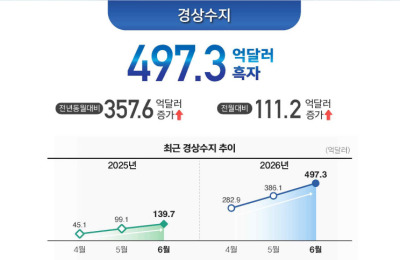
[서울=뉴스핌] 박가연 기자 = 지난 6월 우리나라의 경상수지가 전월에 이어 역대 최대 흑자를 기록했다. 반도체를 중심으로 한 정보기술(IT) 품목 수출 호조로 월간 상품수출이 처음으로 1000억달러를 넘어선 영향이다.
[자료=한국은행]
한국은행이 6일 발표한 '2026년 6월 국제수지(잠정)'에 따르면 지난 6월 경상수지는 497억3000만달러 흑자로 집계됐다. 전월(386억1000만달러)에 이어 두 달 연속 월간 기준 역대 최대 기록을 갈아치웠다. 이에 따라 올해 상반기 누적 경상수지 흑자는 1910억1000만달러를 기록했다.
경상수지 흑자를 견인한 것은 상품수지다. 6월 상품수지는 478억9000만달러 흑자를 기록하며 전월에 이어 역대 최대를 다시 썼다. 국제수지 기준 상품수출은 1123억7000만달러로 전년 동월 대비 84.5% 증가하며 월간 기준 처음으로 1000억달러를 넘어섰다. 상품수입은 644억8000만달러로 38.6% 늘었다.
통관 기준으로는 반도체 수출이 전년 동월 대비 196.9% 급증했고 컴퓨터·주변기기(SSD)는 282.7% 증가했다. IT 품목 수출은 160.4% 늘었으며 비IT 품목도 ▲석유제품(47.5%) ▲화공품(18.6%) ▲철강제품(17.9%) ▲승용차(6.1%) 등을 중심으로 18.6% 증가했다. 통관 기준 수입은 ▲원자재(30.5%) ▲자본재(35.3%) ▲소비재(16.4%)가 모두 늘었다.
서비스수지는 12억9000만달러 적자를 기록해 전월(-10억9000만달러)보다 적자 폭이 확대됐다. 여행수지는 외국인 입국자 증가와 유류할증료 인상 등에 따른 출국자 감소로 4억4000만달러 흑자를 기록했지만 지식재산권사용료수지는 전월 흑자에서 4억4000만달러 적자로 전환됐다.
본원소득수지는 배당소득을 중심으로 32억7000만달러 흑자를 기록해 전월(21억7000만달러)보다 흑자 폭이 확대됐다. 배당소득수지는 배당수입이 늘어난 데다 전월 분기배당에 따른 기저효과로 배당지급이 줄면서 25억6000만달러 흑자를 나타냈다.
금융계정 순자산은 6월 중 467억1000만달러 증가해 월간 기준 역대 최대 증가 폭을 기록했다. 종전 최대였던 올해 3월(369억9000만달러)을 넘어선 것이다. 직접투자에서는 내국인의 해외투자가 80억1000만달러, 외국인의 국내투자가 46억3000만달러 각각 증가했다.
증권투자에서는 외국인의 국내 주식 매도세가 이어졌다. 외국인의 국내 주식 투자는 차익실현 매도 등의 영향으로 316억1000만달러 감소하며 전월(-310억5000만달러)에 이어 역대 최대 순매도 기록을 다시 경신했다.
외국인의 국내 채권투자는 세계국채지수(WGBI) 자금 유입에도 분기 말 만기도래 영향으로 증가 폭이 줄어든 52억9000만달러를 기록했다. 내국인의 해외 증권투자는 주식을 중심으로 35억6000만달러 증가했다.
eoyn2@newspim.com
2026-08-06 08:00