

Richard W. Fisher The Economy at MidyearRemarks at a Community Luncheon hosted by the Federal Reserve Bank of Dallas, San Antonio BranchCorpus Christi, TexasJune 14, 2006The Latin root of the word “credit” is credo: I believe. As Jackson Lears wrote in Sunday’s New York Times Magazine: “Faith [is] a necessary component of most transactions in an expanding economy.” I do not know whether faith can move mountains—that is, of course, a matter of faith—but I know well the importance of faith in the great economic machinery that meshes the growing of wheat in West Texas, the making of semiconductors in North Texas, the distilling of petrochemicals on the Gulf Coast and the movement of the ships at sea that call on the nation’s sixth busiest port here in Corpus Christi. Faith is certainly the basis of your confidence in the Federal Reserve. I have spoken in previous speeches of our “faith-based currency,” a term I use only slightly tongue in cheek. The dollar—like the euro, the yen, the British pound and other currencies—is what economists call a fiat currency. It is backed only by the federal government’s power to raise the revenues needed to meet its obligations and by the rectitude of the U.S. central bank. If the market were to lose faith in either assumption, the dollar would be debased.It is not my place to comment on Congress’ business. With the acquiescence of its constituents, including the people in this room, the fiscal authorities have leveraged the U.S. government’s balance sheet by incurring structural liabilities exceeding projected revenues to an unprecedented degree. Economists and public policy analysts have myriad solutions for restoring balance to what they see as a highly leveraged—some would say overleveraged—American ledger. Congress, as keeper of the government’s purse and the sole body with the power to tax and spend the people’s money, has the duty and the means to impose solutions to these imbalances.The Federal Reserve has a different duty, performed by different means. We are charged with maintaining the monetary conditions for sustainable, non-inflationary economic growth. This task takes on heightened meaning in an era of highly leveraged government finances, for we must work overtime to sustain the faith.I am hardly an impartial observer, but I would submit that the Fed has done its job reasonably well. The numbers provide proof: Our $13 trillion economy has been barreling along at remarkable rates of growth for a sustained period without giving rise to inflation. We must continue to do our job. We know how close we came to creating an economic catastrophe when the Fed took its eye off the ball in the 1970s. And we remember the enmity the Federal Open Market Committee incurred when, under the chairmanship of Paul Volcker, it so dramatically took away the punchbowl of grain alcohol that was fueling reckless economic behavior. We never again want to be placed in the position of either promiscuous accomplice to fiscal impropriety or dour party pooper.Today, we labor under far more favorable conditions. Economic growth has been strong and prolonged. Employment is at an all-time high. And yet we have resisted monetizing Congress’ spendthrift ways. Money supply growth has thus far been tapered down without jeopardizing economic growth and has restrained inflationary impulses.But no Fed official can ever afford to become complacent. The surest way to jeopardize the goodwill earned through the Volcker and Greenspan years would be for the FOMC to brook any behavior that might fan the embers of inflation. We can ill afford to somehow encourage expectations that inflation might gain momentum. For in today’s monetary realm, with markets so fluid and swift, expectations can quickly become reality.In the marketplace, the working assumption is that the FOMC has a comfort zone for inflation, one that is quantifiable. According to this assumption, it is precisely quantifiable by a metric known as the Personal Consumption Expenditures deflator, stripped of energy and food prices, or the “PCE, ex-energy and food.”At the Dallas Fed, we rely on a different inflation metric, what we call the Trimmed-Mean PCE Deflator. Each month, it sets aside the prices that rose sharply and those that fell a lot, so that temporary inflationary and deflationary developments do not distort our sense of underlying trends. The Trimmed-Mean PCE Deflator captures mainstream inflationary impulses. It ignores the extremes and recognizes that people have to eat, drive and air-condition their homes. Of late, the Trimmed-Mean PCE Deflator has been running at a rate of 2.4 percent, about 30 basis points higher than the PCE ex-energy and food. A compounding of 2.4 percent over a decade cuts the purchasing power of a dollar to 79 cents. Of course, it is reckless to extrapolate historical numbers. But this 2.4 percent rate is disarmingly close to one of the market’s key indicators of inflationary expectations—the spread between rates paid on Treasury Inflation-Protected Securities, or TIPS, and ordinary Treasury bonds of 10-year maturity. Another indicator of inflationary expectations is a consumer survey conducted by the University of Michigan. In May, those polled said they expected inflation over the next five to 10 years to run at 3.2 percent a year. One always has to question whether a survey of 500 people, no matter how scientific, actually reflects overall inflationary expectations. Yet again, one turns to the math: Over a decade, 3.2 percent yearly would reduce the value of a dollar to 73 cents. To me, this is more than discomforting. It is unacceptable. To perform the duty you expect of me, I need to be relentlessly bird-dogging inflation to prevent a debasement of your dollars. I have done this by supporting each increase of the federal funds rate agreed to by the FOMC since I joined the committee over a year ago.This business of getting it right on inflation is by no means an easy task. Econometricians do their utmost to provide us with accurate metrics, such as the Trimmed-Mean PCE Deflator and the PCE ex-energy, ex-food. But we have yet to quantify the unquantifiable: the psychology of the marketplace. I just attended my 35th college reunion. When I went off to school, my old-fashioned Norwegian mother, worried that Harvard professors in that heyday of radicalism might lead me astray, slipped a quotation into my pocket that read: “Skepticism is the chastity of the intellect: it should not be surrendered to the first comer.” That sums up the Norwegian psyche as well as anything (even if it was borrowed from the decidedly un-Norwegian George Santayana!). Despite the fact that my genetic makeup was leavened by my Australian father’s more ebullient and trusting gene pool, I have carried that original clipping with me all these years, and today, 37 years later, it is taped to my desk at the Federal Reserve Bank of Dallas.“Skepticism is the chastity of the intellect” may seem a bit quaint in the age of Paris Hilton and Anna Nicole Smith, but I think it is a useful maxim for those assigned the dull and decidedly unsexy task of conducting monetary policy. We must always suspect the precision of numbers, even as we allow ourselves to be guided by them. And we must be ever watchful for influences that might throw off the accuracy of our econometric compasses.So, against that background, how do I see the economy through the circumspect eyes of the Dallas Fed?As far back as February, I suggested in a speech in London that first-quarter economic growth would exceed the 4 percent consensus guesstimate then circulating among economists. The latest revision of the GDP number came in at 5.3 percent.Since March, our Dallas team has been reporting a rotation of the impulses for growth, with business investment in plant and equipment accelerating significantly due to the confidence of corporations in their financial wherewithal and the need for capital expansion to meet projected needs, including continual cost efficiencies. Our economists have viewed this as a partial but not insignificant offset to weakness in the housing market. Despite the rising price of gasoline, our business contacts indicate that consumers continue to buy, but at a lesser clip. The bottom line on growth is that we see it beginning to slow from its torrid pace of the first quarter. Let me remind you that we grew at a 5.3 percent annualized rate in those first three months of the year. In our $13 trillion economy, a 5.3 percent growth rate, sustained for a year, would mean incremental growth of $690 billion, an amount equal to the entire output of India or the combined output of Indonesia, Ireland and … my ancestral Norway. If the economy achieves the current Wall Street consensus of 3.5 percent growth for 2006, that would mean increasing GDP by $394 billion, a healthy pace for a gargantuan economy in its fifth year of expansion.The numbers I cite are adjusted for inflation. That is, they are “real,” in the sense they are uncontaminated by inflation. The surest way to undermine the real growth rate we foresee from our perch in Dallas would be for inflationary expectations to take hold and begin distorting the spending and investment behavior of consumers and businesses. Against the background of sustained high prices for oil and gasoline and the inevitable propensity of sellers of goods and services to try to pass on cost increases, the brow begins to furrow in contemplating the inflation picture. On the one hand, I know that the Trimmed-Mean PCE Deflator is running at a rate that is just too corrosive to be accepted by a virtuous central banker. But I also know, having been party to it, of the incremental tightenings to which we have been subjecting the base interest rate. And I am fully aware that there is a lag between the time we tighten the valve and the time the impact of that tightening is felt.Mind you, I am not sure we can measure this lag effect with great precision. This is partly due to our imperfect understanding of globalization’s effect on the gearing of our economy—an imperfection we at the Dallas Fed have dedicated ourselves to repairing, if not eliminating. It may also have to do with how markets have discounted the kind of titration* that occurs with the removal of previous monetary stimulus through 16 quarter-percentage-point increases in the federal funds rate, as opposed to less frequent or more dramatic moves.This is all by way of saying that conducting monetary policy is as much an art as it is a science. We listen and watch and sniff the sounds and sights and smells of the economy as much as we measure with our advanced, constantly improving but nonetheless imperfect, econometric tool kit.I am but one voice behind the closed doors of the room where the FOMC deliberates. When called upon by the Chairman for my reading of the economy and my recommendations, I am constantly guided by my mother's advice, especially when it comes to contemplating inflation: I believe it safest to err on the side of skepticism. I cannot speak for my 18 brethren in that room, but I have noticed that each of them harbors a tendency towards Norwegian-like angst. And while this tendency of central bankers may at times be nervous-making for some of you, I believe you would lose faith in us if we conducted our business in any other way.*I have been eager to use this word ever since high school chemistry. Thank you for giving me the opportunity to finally do so.

[관련키워드]




[뉴스핌 베스트 기사]
 사진
사진
정동영 업무보고 논란
[서울=뉴스핌] 유신모 외교전문기자 = 청와대 영빈관에서 5일 열린 외교·안보 분야 정부 부처의 대통령 업무보고에서 정동영 통일부 장관의 '한반도 평화공존 발전 구상'과 업무보고 발언이 논란을 빚고 있다.
이날 정 장관의 발언 중에는 정부 내 조율을 거치지 않은 사안을 정책으로 추진하겠다고 공언한 것이 있는가 하면 사실 관계에 맞지 않은 설명도 있었다. 이재명 대통령은 공개적으로 신중을 기해 달라고 경고했고, 조현 외교부 장관은 '이상주의적 희망에 근거한 비현실적 구상'이라는 비판을 내놨다.
그동안 정 장관의 대북 정책 관련 발언이 물의를 빚은 적은 여러 번 있지만 대통령과 유관 부처 장관이 공개적으로 부정적 입장을 표명한 것은 이례적이다. 정 장관의 무리한 대북 접근법과 월권을 제어해야 한다는 목소리도 높아지고 있다.
[정동영 통일부 장관이 지난달 23일 오후 서울 종로구 정부서울청사에서 취임 1주년 기자간담회를 하고 있다. [사진=통일부] 2026.07.23
◆통일부 장관 권한 넘어선 주장
정 장관은 이날 업무보고에서 '한반도 평화공존 발전 구상'을 설명하면서 이재명 정부 2년차 핵심 과제로 상호 존중·평화적 갈등 해결·핵 없는 한반도 등 3대 기본 방향을 제시했다.
정 장관은 "대결과 혐오의 언어는 멈춰야 한다"면서 주적 용어 대체를 주장했다. 지난 25년간의 CVID(완전하고 검증가능하며 되돌릴 수 없는 비핵화) 구도는 이미 무너졌다고도 했다. 또 "현 시점에서 흘러간 선(先)비핵화만 되뇌는 것은 현실을 바꾸는 데 힘이 되지 않는다"고 주장했다. 정 장관은 또 "정전 체제를 평화 체제로 바꾸는 논의에 착수하겠다"면서 "북·미 정상회담 견인과 함께 4자 대화의 동력을 확보하기 위해 최선을 다할 것"이라고 말했다.
하지만 이 대통령은 정 장관의 구상에 대부분 제동을 걸었다. 이 대통령은 "평화공존 정책이 정치적으로 악용되는 측면이 있다"며 "많이 조심하셔야 한다"고 지적했다.
북한을 다른 이름으로 불러야 한다는 주장에는 "표현에 꼬투리가 잡혀 정쟁으로 휘몰아 들어가면 원래 하고자 했던 데에서 오히려 나쁜 상황이 초래될 수 있다"고 경고했다.
이 대통령은 남북 신뢰 구축을 위해 9·19 군사합의를 선제적으로 복원해야 한다는 정 장관의 주장에 대해서도 "우리의 선의대로 하는 게 과연 한반도의 평화와 안정에 플러스냐, 결론적으로 약간의 의문이 들 때도 있다"며 부정적으로 반응했다.
조현 외교부 장관은 업무보고 사후 브리핑에서 정 장관이 언급한 '4자 회담'에 대해 "이상주의에 근거한 어떤 희망이라 하더라도 그건 아직 조율되지 않은 방법"이라며 "여러분들께서 디스카운트해 주시면 좋겠다"고 선을 그었다.
정 장관이 9월 러시아 블라디보스토크에서 열리는 '동방경제포럼(EEF)'을 언급하며 "정부 차원에서 (참석을) 검토하고 있다"고 발언한 데 대해서도 조 장관은 "그것은 외교부의 몫"이라며 "아직 거기까지 진도가 나가지 않았다"고 잘랐다.
정 장관이 이날 소개한 대북 구상과 설명은 정부 내 조율을 거치지 않았다는 점에서 문제가 있다. 특히 주적 표현 대체와 국호 사용, 9·19 군사합의 복원, 4자회담 추진 등은 통일부 장관이 결정할 사안이 아니어서 월권이라는 지적이 나오고 있다. 이 대통령은 정 장관의 업무보고를 듣고 난 뒤 "여기 업무보고에 발표했다고 승인난 건 아니다"라고 재차 확인했다.
정부의 한 소식통은 "정 장관의 발언 내용은 대부분 국가안전보장회의(NSC)를 거쳐 결정된 사안이 아닌 정 장관의 개인적 생각에 가깝다"며 "안보 관련 부처 장관이 정부의 공식 정책이 아닌 사안을 추진하겠다고 업무보고를 하고 대통령의 면전에서 '국군통수권자가 나서야 한다'고 주장한 것은 심각한 문제"라고 지적했다.
이재명 대통령이 5일 청와대 영빈관에서 열린 통일 외교 국방 등 외교 안보 부처 업무보고에서 발언하고 있다. [사진=청와대] 2026.08.05
◆시대착오적 접근, 대북 인식 오류
더욱 문제인 것은 정 장관의 이같은 주장이 현 시점에서 이미 참고가 될 수 없는 과거의 경험 또는 사실과 다른 인식에 기반하고 있다는 것이다. 정 장관이 주장하는 구상은 급격히 변화하고 있는 북한의 전략과 한반도 및 국제 정세를 전혀 반영하지 못하고 있다는 비판이 제기되고 있다.
정 장관이 "흘러간 선(先)비핵화만 되뇌는 것은 현실을 바꾸지 못한다"고 언급한 것은 지금까지의 대북 접근법을 호도하고 있다. 북핵 위기 발발 이후 지금까지 모든 핵 협상에서 한국이나 미국은 북한에 선비핵화를 공식적으로 요구한 적이 없기 때문이다.
지금까지의 북핵 협상은 북한의 비핵화 조치에 한·미가 상응하는 대가를 제공하는 방식으로 이뤄졌다. 1994년 북·미 제네바 기본합의는 핵시설 동결과 중유 제공의 교환이었다. 2005년 9.19 공동성명도 북한의 비핵화 조치의 모든 단계에 상응조치를 제공하는 '행동 대 행동' 원칙이 적용됐다.
대북 협상에 관여했던 한 전직 관료는 "모든 북핵 협상은 북한의 비핵화 조치와 한·미가 제공하는 상응조치를 어떻게 정교하게 배열하느냐가 관건이었다"면서 "정 장관의 발언은 지금까지 한·미가 북한에 먼저 핵을 포기해야 대화할 수 있다는 정책을 고수해 현 상황에 이르게 됐다는 잘못된 인식에서 비롯된 것으로 보인다"고 말했다.
정 장관이 "지난 25년간의 CVID 구도가 무너졌다"고 말한 것도 비핵화의 개념에 대한 이해 부족이라는 비판이 제기되고 있다. 북핵 문제에 정통한 외교 소식통은 "어떤 명칭을 붙이든 핵을 제거한 뒤 이를 검증하고 재발 방지 조치를 하는 것은 비핵화에 반드시 포함되어야 하는 기본적 절차"라며 "CVID는 안 된다고 말하는 것은 북한의 비핵화 조치를 검증도 하지 않고 언제든 되돌릴 수 있도록 합의하자는 말과 같다"고 지적했다.
[서울=뉴스핌] 이길동 기자 = 조현 외교부 장관이 5일 오후 서울 종로구 정부서울청사 별관에서 2026년 하반기 업무보고 사후브리핑을 하고 있다. 2026.08.05 gdlee@newspim.com
◆안보 리스크 키우는 통일부 장관
정 장관은 지난해 취임 직후부터 청와대와 외교부를 제치고 통일부가 북한과 관련된 모든 정책을 주도해야 한다는 주장을 펴면서 단독 질주를 거듭해왔다.
북한의 '적대적 두 국가' 주장을 변형한 '평화적 두 국가'를 지향해야 한다고 주장하면서 이에 문제점을 지적하는 목소리를 무시했다. 외교부가 미국과 북한 문제를 논의하는 것에 대해 "한반도 정책과 남북관계는 주권의 영역이며 동맹국과 협의의 주체는 통일부"라고 주장해 물의를 빚었다. 문재인 정부 시절 한·미 워킹그룹이 남북관계 파탄 원인이었다고 사실과 다른 주장을 폈다.
지난해 업무보고에서는 국제정세를 감안하지 않고 남북대화 재개에만 초점을 맞춘 비현실적 내용으로 논란을 빚었다. 정부 내 조율도 거치지 않고 독자 대북제재인 5·24 조치를 해제하고 9·19 군사합의 비행금지구역 복원을 추진하겠다는 방침도 밝혔다.
지난 4월에는 평안북도 구성시에 우라늄 농축 시설이 있다고 말해 파장을 일으켰다. 미국은 이 발언을 계기로 한국과 대북정보 공유를 제한했다. 이 조치는 지금도 계속되고 있는 것으로 알려졌다.
정 장관이 이처럼 정부의 공식 결정을 거치지 않은 사안을 정부 정책인 것처럼 주장하며 좌충우돌하는 배경에 대해 여러가지 해석이 나온다. 북한 문제에서 조기에 성과를 거둬야 한다는 조급증과 자신의 존재감 과시 욕구가 작용하고 있다는 평가가 많다.
일각에서는 정 장관이 2007년 민주당 대선후보였을 때 이재명 대통령이 캠프에서 비서실 부실장으로 활동한 전력이 있다는 것을 들어 "정 장관이 아직도 이 대통령을 아랫사람으로 생각하고 있는 것 아니냐"는 비판을 내놓기도 한다.
한·미 관계와 북한 문제를 오래 다뤘던 전직 관료 출신의 한 전문가는 "정 장관 취임 후 지금까지의 언행은 잘못된 현실 인식에 따른 독단과 앞서 가기, 월권 등으로 점철돼 있다"면서 "통일부 장관이라는 중요한 직책에 있으면서 스스로 안보 리스크를 키우는 역할만 했다"고 비판했다.
opento@newspim.com
2026-08-06 06:10
 사진
사진
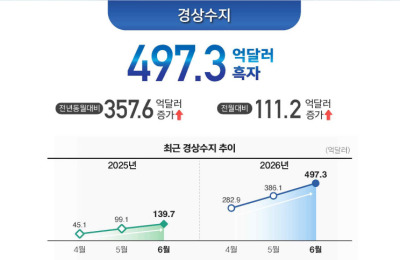
6월 경상수지 최대 흑자
[서울=뉴스핌] 박가연 기자 = 지난 6월 우리나라의 경상수지가 전월에 이어 역대 최대 흑자를 기록했다. 반도체를 중심으로 한 정보기술(IT) 품목 수출 호조로 월간 상품수출이 처음으로 1000억달러를 넘어선 영향이다.
[자료=한국은행]
한국은행이 6일 발표한 '2026년 6월 국제수지(잠정)'에 따르면 지난 6월 경상수지는 497억3000만달러 흑자로 집계됐다. 전월(386억1000만달러)에 이어 두 달 연속 월간 기준 역대 최대 기록을 갈아치웠다. 이에 따라 올해 상반기 누적 경상수지 흑자는 1910억1000만달러를 기록했다.
경상수지 흑자를 견인한 것은 상품수지다. 6월 상품수지는 478억9000만달러 흑자를 기록하며 전월에 이어 역대 최대를 다시 썼다. 국제수지 기준 상품수출은 1123억7000만달러로 전년 동월 대비 84.5% 증가하며 월간 기준 처음으로 1000억달러를 넘어섰다. 상품수입은 644억8000만달러로 38.6% 늘었다.
통관 기준으로는 반도체 수출이 전년 동월 대비 196.9% 급증했고 컴퓨터·주변기기(SSD)는 282.7% 증가했다. IT 품목 수출은 160.4% 늘었으며 비IT 품목도 ▲석유제품(47.5%) ▲화공품(18.6%) ▲철강제품(17.9%) ▲승용차(6.1%) 등을 중심으로 18.6% 증가했다. 통관 기준 수입은 ▲원자재(30.5%) ▲자본재(35.3%) ▲소비재(16.4%)가 모두 늘었다.
서비스수지는 12억9000만달러 적자를 기록해 전월(-10억9000만달러)보다 적자 폭이 확대됐다. 여행수지는 외국인 입국자 증가와 유류할증료 인상 등에 따른 출국자 감소로 4억4000만달러 흑자를 기록했지만 지식재산권사용료수지는 전월 흑자에서 4억4000만달러 적자로 전환됐다.
본원소득수지는 배당소득을 중심으로 32억7000만달러 흑자를 기록해 전월(21억7000만달러)보다 흑자 폭이 확대됐다. 배당소득수지는 배당수입이 늘어난 데다 전월 분기배당에 따른 기저효과로 배당지급이 줄면서 25억6000만달러 흑자를 나타냈다.
금융계정 순자산은 6월 중 467억1000만달러 증가해 월간 기준 역대 최대 증가 폭을 기록했다. 종전 최대였던 올해 3월(369억9000만달러)을 넘어선 것이다. 직접투자에서는 내국인의 해외투자가 80억1000만달러, 외국인의 국내투자가 46억3000만달러 각각 증가했다.
증권투자에서는 외국인의 국내 주식 매도세가 이어졌다. 외국인의 국내 주식 투자는 차익실현 매도 등의 영향으로 316억1000만달러 감소하며 전월(-310억5000만달러)에 이어 역대 최대 순매도 기록을 다시 경신했다.
외국인의 국내 채권투자는 세계국채지수(WGBI) 자금 유입에도 분기 말 만기도래 영향으로 증가 폭이 줄어든 52억9000만달러를 기록했다. 내국인의 해외 증권투자는 주식을 중심으로 35억6000만달러 증가했다.
eoyn2@newspim.com
2026-08-06 08:00