


Remarks by Governor Donald L. KohnAt the Federal Reserve Bank of Boston's 51st Economic Conference, Chatham, MassachusettsJune 16, 2006 The Effects of Globalization on Inflation and Their Implications for Monetary Policy Thank you for the opportunity to participate in this conference on global imbalances, a topic of growing importance. Although I will touch on global imbalances, I would like to focus on globalization’s potential influence on inflation and the associated implications for monetary policy. It seems a natural focus for a policymaker at a central bank, and, indeed, several of my colleagues on the Federal Open Market Committee (FOMC) have also addressed this issue in recent months.1 As you would see from reading their remarks, no consensus has yet emerged about how globalization has been influencing recent inflation developments, and part of my intention today is to illustrate some of the considerable challenges that are involved in attempting to identify the extent to which the recent pickup in the pace of global economic integration has influenced inflation dynamics in the United States.2Of course, the trend toward greater international integration of product and financial markets has been established for quite a while; the share of U.S. economic activity involved in international trade (measured by nominal exports plus imports as a share of nominal gross domestic product) has been rising since the early 1970s. However, this trend has accelerated markedly over the past fifteen years or so. In particular, the economies of eastern Europe became more integrated into the global economy, and China, India, and some other East Asian market economies have emerged as important players in the global trading system.Although inflation is ultimately a monetary phenomenon, it seems natural to expect, as others have argued, that these developments would have exerted some downward pressure on inflation in the United States. The opening up of China and India, in particular, represents a potentially huge increase in the global supply of mainly lower-skilled workers. And it is clear that the low cost of production in these and other emerging economies has led to a geographic shift in production toward them--not just from the United States but also from other formerly low-cost producers such as Mexico, Korea, Singapore, and Taiwan.3 Trade surpluses in China and in other East Asian countries have increased sharply over the past decade, and from a U.S. perspective, the ratio of imported goods to domestically produced goods has accelerated noticeably in recent years. However, the extent of the disinflationary effect of this shift in the pace of globalization is less obvious. Many U.S. goods and most services are still produced domestically with little competition from abroad. In addition, the significant expansion of production in China and elsewhere has put substantial upward pressure on the prices of oil and other commodities, many of which are imported for use as inputs to production in the United States. Indeed, the effects of globalization on domestic inflation need not even be negative, especially in today’s environment of strong global growth. One challenge in assessing the effect of increased globalization is the lack of research on this issue. At a research conference on modeling inflation held at the Federal Reserve Board last fall, none of the papers even touched on issues related to globalization. And, although some new and interesting research is emerging from places like the International Monetary Fund and the Bank for International Settlements, much of this work is still quite preliminary.4 Nevertheless, the existing research does highlight several channels through which globalization might have helped to hold down domestic inflation in recent years. These channels include the direct and indirect effects on domestic inflation of lower import prices, a heightened sensitivity of domestic inflation to foreign demand conditions (and perhaps less sensitivity to domestic demand conditions), downward pressure on domestic wage growth, and upward pressure on domestic productivity growth.5 In trying to clarify my own thinking about the likely magnitude of these effects, I find that a useful starting point is a simple reduced-form equation that attempts to explain movements in inflation and then to ask whether and how the statistical relationships embedded in this equation have been affected by globalization. The equation is a standard one in use at the Board and elsewhere. It relates core consumer price inflation--using, say, the index for core personal consumption expenditures (PCE) or the core consumer price index (CPI)--to resource utilization, lagged inflation, changes in relative prices of food and energy, and changes in relative import prices. Using this framework, we can look for the effect of globalization in several ways. First, we can look for influences that are directly controlled for in the model--notably the influence on domestic inflation of changes in import prices. Second, we can look for evidence of globalization-related structural change in the model by examining the stability of the parameter estimates. Third, we can see whether we have omitted from the standard model any variables that might be interpreted as representing changes in globalization. And, finally, we can look for evidence of model errors that would be consistent with the hypothesis that globalization has been restraining inflation. I will focus in particular on the past five years or so, which, judging from the data on U.S. trade shares, is when the pace of globalization appears to have picked up. I will start with the import price channel--the hypothesis that increased globalization has depressed import prices and thus domestic inflation. Importantly, the estimated strength of this channel should capture not only the direct effects of import prices on the cost of living in the United States but, also, at least a portion of the indirect effects of actual and potential import competition on the prices of goods produced domestically. In the reduced-form model that I’ve just described, the effects of import prices on inflation show up quite clearly; furthermore, the estimated effects appear to have increased over time, with the increase apparently stemming primarily from the upward trend in the share of imported consumer goods in household spending.6 We can use the model to get a rough idea of how relative changes in import prices have influenced domestic inflation by simulating how core consumer prices would have behaved if relative import prices had instead remained constant. In particular, the increase in core import prices since the mid-1990s has averaged about 1-1/2 percentage points less per year than the increase in core consumer prices. According to the model simulation, which also builds in the associated reduction in inflation expectations, the direct and indirect effects of this decline in the relative price of imports held down core inflation by between 1/2 and 1 percentage point per year over this period, an estimated effect that is substantially larger than it would have been in earlier decades. However, much of the decline in import prices during this period was probably driven by movements in exchange rates and the effects of technological change on goods prices rather than by the growing integration of world markets.7In addition, import prices have risen at about the same average pace as core consumer prices over the past several years and thus no longer appear to be acting as a significant restraint on inflation in the United States. This step-up in the rate of change of import prices obviously reflects, to some extent, recent movements in the dollar, especially its depreciation in 2004. However, it also reflects large increases in the prices of a number of imported commodities, which have been attributed in part to the rapid expansion of activity in China and other Asian countries. A second hypothesis is that increases in global capacity have held down U.S. inflation in recent years by limiting the ability of U.S. producers to raise prices in response to increases in the domestic costs of production. At a basic level, the elevated profit margins of U.S. producers over the past few years seem inconsistent with this hypothesis. But it does raise a broader issue about the determinants of inflation--that is, whether U.S. inflation is now less sensitive to domestic demand pressures and more sensitive to foreign demand conditions than it was earlier. In the context of the inflation model, we can examine this issue in two ways. First, we can look for evidence that the coefficients on the domestic output or unemployment gaps have fallen over time. Second, we can add a measure of foreign excess demand to the model to see whether it helps to explain domestic inflation in recent years.With regard to the first test, we do find evidence that the coefficient on the unemployment gap has fallen in the United States. In particular, the coefficient from a model estimated over the past twenty years appears to be about one-third lower than when the model is run over a forty-year period. Of course, globalization is not the only potential explanation for this result, and numerous other researchers have cited persistently low inflation and the improved credibility of monetary policy as having played a more important role. In fact, in rolling regressions, the timing of the decline in the sensitivity of inflation to the unemployment gap appears to be too early to be associated with the more recent acceleration in the pace of globalization. This aspect of the globalization hypothesis would be bolstered if the decline in the sensitivity of inflation to domestic demand was accompanied by an increased sensitivity to foreign demand. Efforts to find such a link have met with mixed results, with some researchers having found large effects and others having found no effect.8 Our own analysis of this issue indicates that these results are sensitive to how the foreign output gap is defined and to how the inflation model is specified, suggesting that any effect may not be especially strong.Similarly, the evidence that globalization has helped to restrain unit labor costs in recent years is mixed. One hypothesis is that the increase in the supply of low-skilled workers associated with the emergence of China and other East Asian countries as low-cost centers of production has put downward pressure on the growth of nominal wages in the United States. However, a model of changes in aggregate labor compensation that is similar in structure to the price-inflation model that I described earlier does not detect a stable relationship between measures of globalization (for example, import price changes or the BIS estimates of the foreign output gap) and aggregate wage dynamics in the United States. That said, the recent changes in some, though not all, measures of aggregate compensation seem to have been somewhat lower than such models would have predicted. Of course, several purely domestic factors could help to account for any shortfall, such as the aftereffects of the unusually sluggish recovery in job growth early in this expansion or a possible downward drift in the nonaccelerating-inflation rate of unemployment. But it also is a pattern that would be consistent with downward pressures from an expansion in global labor supply. In support of this link, some cross-section studies have found a relationship between industry wage growth and import penetration, while the research on wage inequality tends to relate some of the relative decline in wages of low-skilled workers to trade, although in both types of studies the effects are generally relatively small.9 Similarly, research from the Federal Reserve Bank of New York shows a modest relationship between exchange rate fluctuations and wage growth, with larger effects evident for the wages of lower-skilled workers.10 A second possibility is that globalization has restrained unit labor costs by raising productivity. Increasing volumes of trade should bolster productivity as economies concentrate their resources in those sectors in which they are relatively more efficient. But I have seen little direct evidence on the extent to which globalization may have boosted aggregate productivity growth in the United States in recent years. Nevertheless, research at the Board finds that multinational corporations, which may have the greater opportunities to realize efficiencies by shifting production locations, accounted for a disproportionate share of aggregate productivity growth in the late 1990s.11 And some microeconomic studies have found a relationship between global engagement and productivity at the firm level.12 Thus, it seems possible that the persistently high growth rates of multifactor productivity in recent years may partly be due to the productivity-enhancing effects of globalization.In this regard, I would note that a potential shortcoming of my approach to assessing the effects of globalization on inflation is that these effects may be too recent to be captured adequately by the data. That is, it may be too soon for globalization to have generated statistically observable changes in the parameter estimates or structure of the standard inflation model. Nonetheless, if the influence of globalization on inflation is as substantial as many claim, we might have expected the standard model to have had difficulty in predicting recent inflation trends. For example, if recent increases in world labor supply are restraining domestic unit labor costs to a significant degree or if there are other important influences on inflation that are related to globalization but difficult to quantify in the context of the standard model, we would expect to have seen sizable model errors over the past several years.Again, the evidence points to some limited influence of globalization on U.S. inflation. If we use out-of-sample dynamic simulations of a model for core PCE price inflation estimated from 1985 through the end of 2001, we find that, although the model overpredicts inflation over the past several years, the errors average only 0.1 to 0.2 percentage point per year, considerably less than one might have expected given the anecdotes in the popular press. In contrast, the forecast errors from a model of core CPI inflation are larger (averaging roughly 1/2 to 1 percentage point per year since mid-2001), perhaps suggestive of some influence from globalization. What do I conclude from all of this evidence? My own assessment is that, quite naturally, the greater integration of the U.S. economy into a rapidly evolving world economy has affected the dynamics of inflation determination. Unfortunately, huge gaps and puzzles remain in our analysis and empirical testing of various hypotheses related to these effects. But, for the most part, the evidence seems to suggest that to date the effects have been gradual and limited: a greater role for the direct and indirect effects of import prices; possibly some damping of unit labor costs, though less so for prices from this channel judging from high profit margins; and potentially a smaller effect of the domestic output gap and a greater effect of foreign output gaps, but here too the evidence is far from conclusive. In particular, the entry of China, India, and others into the global trading system probably has exerted a modest disinflationary force on prices in the United States in recent years. Moreover, we should recognize that these disinflationary effects could dissipate or even be reversed in coming years. They reflect, at least in part, the global imbalances that are the subject of this conference, rather than just the integration of emerging-market economies into the global trading system. For example, the fact that China and some other emerging-market economies have resisted upward pressure on their exchange rates and are running trade surpluses has undoubtedly contributed to their disinflationary effects on the rest of the world. The prices of their exports are lower than they would be if market forces were given greater scope in foreign exchange markets, and they are supplying more goods and services to the rest of the world than they themselves are demanding. These imbalances are not likely to be sustained indefinitely. The elevated rates of national saving in these economies--and, in some, relatively restrained rates of investment--are not likely to persist in the face of ongoing improvements in the functioning of their financial markets, increases in the depth of their product markets, and fuller development of economic safety nets. As individuals in these countries are increasingly drawn to investing at home and consuming more of their wealth and as their real wages catch up to past productivity gains, the upward pressures on their currencies will intensify, their demand will come into better alignment with their capacity to produce, cost advantages will decline, and these economies will exert less, if any, downward pressure on inflation in the United States. This observation brings me to my final point, which is about monetary policy. Clearly, the greater integration of the world’s economies does leave the United States more open to influences from abroad. In one sense, a more open economy may be more forgiving as shortfalls or excesses in demand are partly absorbed by other countries through adjustments of our imports and exports. And, to the extent that the United States can draw upon world capacity, the inflationary effect of an increase in aggregate demand might be damped for a time. But we are also subject to inflationary forces from abroad, including those that might accompany a shift to a more sustainable pattern of global spending and production, or those that might emanate from rising cost and price pressures. Moreover, a smaller response of inflation to domestic demand also implies that reducing inflation once it rose could be difficult and costly. And, from another perspective, integrated financial markets can exert powerful feedback, which may be less forgiving of any perceived policy error. For example, if financial market participants thought that the FOMC was not dedicated to maintaining long-run price stability--a notion that I can assure you is not correct--they would be less willing to hold dollar-denominated assets, and the resulting decline in the dollar would tend to add to inflationary pressures. Clearly, policymakers need to factor into their decisions the implications of globalization for the dynamics of the determination of inflation and output.In the end, however, policymakers here and abroad cannot lose sight of a fundamental truth: In a world of separate currencies that can fluctuate against each other over time, each country’s central bank determines its inflation rate. If the FOMC were to allow the U.S. economy to run beyond its sustainable potential for some time, inflation would eventually rise. And, this pickup would become self-perpetuating if it became embedded in inflation expectations. Thus, while a better understanding of the implications of globalization will aid in our understanding of inflation dynamics, it is also clear that such developments do not relieve central banks of their responsibility for maintaining price and economic stability.--------------------------------------------------------------------------------Footnotes1. For example, Richard W. Fisher (2005), "Globalization and Monetary Policy," Warren and Anita Marshall Lecture in American Foreign Policy, Harvard University, November 3; and Janet L. Yellen (2006), "Monetary Policy in a Global Environment," speech delivered at The Euro and the Dollar in a Globalized Economy Conference, University of California at Santa Cruz, May 27. 2. Deb Lindner and William Wascher, of the Board’s staff, contributed to these remarks. The views expressed are my own and are not necessarily shared by my colleagues on the Board or the FOMC. 3. See, for example, International Monetary Fund (2005), "Mexico: Staff Report for the 2005 Article IV Consultation," October 2005; and Alan G. Ahearne, John G. Fernald, Prakash Loungani, and John W. Schindler (2003), "China and Emerging Asia: Comrades or Competitors?" International Finance Discussion Paper 2003-789 (Washington: Board of Governors of the Federal Reserve System, December). 4. Thomas Helbling, Florence Jaumotte, and Martin Sommer (2006), "How Has Globalization Affected Inflation?" IMF World Economic Outlook (Washington: IMF, April), chapter 3; Claudio Borio and Andrew Filardo (2006), "Globalization and Inflation: New Cross-Country Evidence on the Global Determinants of Domestic Inflation," unpublished paper, Bank for International Settlements, March. 5. Ken Rogoff also argues that globalization has increased the incentives for central banks to keep inflation low (Kenneth S. Rogoff, 2003, "Globalization and Global Disinflation," in Monetary Policy and Uncertainty: Adapting to a Changing Economy," a symposium sponsored by the Federal Reserve Bank of Kansas City, pp. 77-112.) 6. As is standard in such models, we use a price measure for "core" imports, defined as imports of goods excluding energy, computers, and semiconductors. When the change in relative import prices is weighted by the import share, the coefficient in the model is fairly stable. 7. Research at the Board examined the direct effects of Chinese exports on global import prices from the mid-1990s to 2002 and found only a modest effect of U.S. import prices. Of course, it is possible that China’s influence on import prices has grown in recent years as its trade share has expanded. Refer to Steven B. Kamin, Mario Marazzi, and John W. Schindler (2004), "Is China ‘Exporting Deflation’?" International Finance Discussion Paper 2004-791 (Washington: Board of Governors of the Federal Reserve System, January). 8. Borio and Filardo (2006) and Gamber and Hung (2001) found that foreign resource utilization had sizable effects on U.S. inflation, while Tootell (1998) found little to no effect. Refer to Borio and Filardo, "Globalization and Inflation"; Edward N. Gamber and Juann H. Hung (2001), "Has the Rise in Globalization Reduced U.S. Inflation in the 1990s?" Economic Inquiry, vol. 39 (January), pp. 58-73; and Geoffrey M. B. Tootell (1998), "Globalization and U.S. Inflation," Federal Reserve Bank of Boston, New England Economic Review (July/August), pp. 21-33. 9. See, for example, Helbling, Jaumotte, and Sommer, "How Has Globalization Affected Inflation?"; and William R. Cline (1997), Trade and Income Distribution (Washington: Institute for International Economics). 10. Linda Goldberg and Joseph Tracy (2003), "Exchange Rates and Wages," unpublished paper, Federal Reserve Bank of New York. 11. Carol Corrado, Paul Lengermann, and Larry Slifman (2005), "The Contribution of MNCs to U.S. Productivity Growth, 1977-2000," unpublished paper, Board of Governors of the Federal Reserve System. 12. For example, Mark E. Doms and J. Bradford Jensen (1998), "Productivity, Skill, and Wage Effects of Multinational Corporations in the United States," in D. Woodward and D. Nigh, eds., Foreign Ownership and the Consequences of Direct Investment in the United States: Beyond Us and Them (Westport, Conn.: Quorum Books), pp. 49-68.

[관련키워드]



[뉴스핌 베스트 기사]
 사진
사진
정동영 업무보고 논란
[서울=뉴스핌] 유신모 외교전문기자 = 청와대 영빈관에서 5일 열린 외교·안보 분야 정부 부처의 대통령 업무보고에서 정동영 통일부 장관의 '한반도 평화공존 발전 구상'과 업무보고 발언이 논란을 빚고 있다.
이날 정 장관의 발언 중에는 정부 내 조율을 거치지 않은 사안을 정책으로 추진하겠다고 공언한 것이 있는가 하면 사실 관계에 맞지 않은 설명도 있었다. 이재명 대통령은 공개적으로 신중을 기해 달라고 경고했고, 조현 외교부 장관은 '이상주의적 희망에 근거한 비현실적 구상'이라는 비판을 내놨다.
그동안 정 장관의 대북 정책 관련 발언이 물의를 빚은 적은 여러 번 있지만 대통령과 유관 부처 장관이 공개적으로 부정적 입장을 표명한 것은 이례적이다. 정 장관의 무리한 대북 접근법과 월권을 제어해야 한다는 목소리도 높아지고 있다.
[정동영 통일부 장관이 지난달 23일 오후 서울 종로구 정부서울청사에서 취임 1주년 기자간담회를 하고 있다. [사진=통일부] 2026.07.23
◆통일부 장관 권한 넘어선 주장
정 장관은 이날 업무보고에서 '한반도 평화공존 발전 구상'을 설명하면서 이재명 정부 2년차 핵심 과제로 상호 존중·평화적 갈등 해결·핵 없는 한반도 등 3대 기본 방향을 제시했다.
정 장관은 "대결과 혐오의 언어는 멈춰야 한다"면서 주적 용어 대체를 주장했다. 지난 25년간의 CVID(완전하고 검증가능하며 되돌릴 수 없는 비핵화) 구도는 이미 무너졌다고도 했다. 또 "현 시점에서 흘러간 선(先)비핵화만 되뇌는 것은 현실을 바꾸는 데 힘이 되지 않는다"고 주장했다. 정 장관은 또 "정전 체제를 평화 체제로 바꾸는 논의에 착수하겠다"면서 "북·미 정상회담 견인과 함께 4자 대화의 동력을 확보하기 위해 최선을 다할 것"이라고 말했다.
하지만 이 대통령은 정 장관의 구상에 대부분 제동을 걸었다. 이 대통령은 "평화공존 정책이 정치적으로 악용되는 측면이 있다"며 "많이 조심하셔야 한다"고 지적했다.
북한을 다른 이름으로 불러야 한다는 주장에는 "표현에 꼬투리가 잡혀 정쟁으로 휘몰아 들어가면 원래 하고자 했던 데에서 오히려 나쁜 상황이 초래될 수 있다"고 경고했다.
이 대통령은 남북 신뢰 구축을 위해 9·19 군사합의를 선제적으로 복원해야 한다는 정 장관의 주장에 대해서도 "우리의 선의대로 하는 게 과연 한반도의 평화와 안정에 플러스냐, 결론적으로 약간의 의문이 들 때도 있다"며 부정적으로 반응했다.
조현 외교부 장관은 업무보고 사후 브리핑에서 정 장관이 언급한 '4자 회담'에 대해 "이상주의에 근거한 어떤 희망이라 하더라도 그건 아직 조율되지 않은 방법"이라며 "여러분들께서 디스카운트해 주시면 좋겠다"고 선을 그었다.
정 장관이 9월 러시아 블라디보스토크에서 열리는 '동방경제포럼(EEF)'을 언급하며 "정부 차원에서 (참석을) 검토하고 있다"고 발언한 데 대해서도 조 장관은 "그것은 외교부의 몫"이라며 "아직 거기까지 진도가 나가지 않았다"고 잘랐다.
정 장관이 이날 소개한 대북 구상과 설명은 정부 내 조율을 거치지 않았다는 점에서 문제가 있다. 특히 주적 표현 대체와 국호 사용, 9·19 군사합의 복원, 4자회담 추진 등은 통일부 장관이 결정할 사안이 아니어서 월권이라는 지적이 나오고 있다. 이 대통령은 정 장관의 업무보고를 듣고 난 뒤 "여기 업무보고에 발표했다고 승인난 건 아니다"라고 재차 확인했다.
정부의 한 소식통은 "정 장관의 발언 내용은 대부분 국가안전보장회의(NSC)를 거쳐 결정된 사안이 아닌 정 장관의 개인적 생각에 가깝다"며 "안보 관련 부처 장관이 정부의 공식 정책이 아닌 사안을 추진하겠다고 업무보고를 하고 대통령의 면전에서 '국군통수권자가 나서야 한다'고 주장한 것은 심각한 문제"라고 지적했다.
이재명 대통령이 5일 청와대 영빈관에서 열린 통일 외교 국방 등 외교 안보 부처 업무보고에서 발언하고 있다. [사진=청와대] 2026.08.05
◆시대착오적 접근, 대북 인식 오류
더욱 문제인 것은 정 장관의 이같은 주장이 현 시점에서 이미 참고가 될 수 없는 과거의 경험 또는 사실과 다른 인식에 기반하고 있다는 것이다. 정 장관이 주장하는 구상은 급격히 변화하고 있는 북한의 전략과 한반도 및 국제 정세를 전혀 반영하지 못하고 있다는 비판이 제기되고 있다.
정 장관이 "흘러간 선(先)비핵화만 되뇌는 것은 현실을 바꾸지 못한다"고 언급한 것은 지금까지의 대북 접근법을 호도하고 있다. 북핵 위기 발발 이후 지금까지 모든 핵 협상에서 한국이나 미국은 북한에 선비핵화를 공식적으로 요구한 적이 없기 때문이다.
지금까지의 북핵 협상은 북한의 비핵화 조치에 한·미가 상응하는 대가를 제공하는 방식으로 이뤄졌다. 1994년 북·미 제네바 기본합의는 핵시설 동결과 중유 제공의 교환이었다. 2005년 9.19 공동성명도 북한의 비핵화 조치의 모든 단계에 상응조치를 제공하는 '행동 대 행동' 원칙이 적용됐다.
대북 협상에 관여했던 한 전직 관료는 "모든 북핵 협상은 북한의 비핵화 조치와 한·미가 제공하는 상응조치를 어떻게 정교하게 배열하느냐가 관건이었다"면서 "정 장관의 발언은 지금까지 한·미가 북한에 먼저 핵을 포기해야 대화할 수 있다는 정책을 고수해 현 상황에 이르게 됐다는 잘못된 인식에서 비롯된 것으로 보인다"고 말했다.
정 장관이 "지난 25년간의 CVID 구도가 무너졌다"고 말한 것도 비핵화의 개념에 대한 이해 부족이라는 비판이 제기되고 있다. 북핵 문제에 정통한 외교 소식통은 "어떤 명칭을 붙이든 핵을 제거한 뒤 이를 검증하고 재발 방지 조치를 하는 것은 비핵화에 반드시 포함되어야 하는 기본적 절차"라며 "CVID는 안 된다고 말하는 것은 북한의 비핵화 조치를 검증도 하지 않고 언제든 되돌릴 수 있도록 합의하자는 말과 같다"고 지적했다.
[서울=뉴스핌] 이길동 기자 = 조현 외교부 장관이 5일 오후 서울 종로구 정부서울청사 별관에서 2026년 하반기 업무보고 사후브리핑을 하고 있다. 2026.08.05 gdlee@newspim.com
◆안보 리스크 키우는 통일부 장관
정 장관은 지난해 취임 직후부터 청와대와 외교부를 제치고 통일부가 북한과 관련된 모든 정책을 주도해야 한다는 주장을 펴면서 단독 질주를 거듭해왔다.
북한의 '적대적 두 국가' 주장을 변형한 '평화적 두 국가'를 지향해야 한다고 주장하면서 이에 문제점을 지적하는 목소리를 무시했다. 외교부가 미국과 북한 문제를 논의하는 것에 대해 "한반도 정책과 남북관계는 주권의 영역이며 동맹국과 협의의 주체는 통일부"라고 주장해 물의를 빚었다. 문재인 정부 시절 한·미 워킹그룹이 남북관계 파탄 원인이었다고 사실과 다른 주장을 폈다.
지난해 업무보고에서는 국제정세를 감안하지 않고 남북대화 재개에만 초점을 맞춘 비현실적 내용으로 논란을 빚었다. 정부 내 조율도 거치지 않고 독자 대북제재인 5·24 조치를 해제하고 9·19 군사합의 비행금지구역 복원을 추진하겠다는 방침도 밝혔다.
지난 4월에는 평안북도 구성시에 우라늄 농축 시설이 있다고 말해 파장을 일으켰다. 미국은 이 발언을 계기로 한국과 대북정보 공유를 제한했다. 이 조치는 지금도 계속되고 있는 것으로 알려졌다.
정 장관이 이처럼 정부의 공식 결정을 거치지 않은 사안을 정부 정책인 것처럼 주장하며 좌충우돌하는 배경에 대해 여러가지 해석이 나온다. 북한 문제에서 조기에 성과를 거둬야 한다는 조급증과 자신의 존재감 과시 욕구가 작용하고 있다는 평가가 많다.
일각에서는 정 장관이 2007년 민주당 대선후보였을 때 이재명 대통령이 캠프에서 비서실 부실장으로 활동한 전력이 있다는 것을 들어 "정 장관이 아직도 이 대통령을 아랫사람으로 생각하고 있는 것 아니냐"는 비판을 내놓기도 한다.
한·미 관계와 북한 문제를 오래 다뤘던 전직 관료 출신의 한 전문가는 "정 장관 취임 후 지금까지의 언행은 잘못된 현실 인식에 따른 독단과 앞서 가기, 월권 등으로 점철돼 있다"면서 "통일부 장관이라는 중요한 직책에 있으면서 스스로 안보 리스크를 키우는 역할만 했다"고 비판했다.
opento@newspim.com
2026-08-06 06:10
 사진
사진
6월 경상수지 최대 흑자
[서울=뉴스핌] 박가연 기자 = 지난 6월 우리나라의 경상수지가 전월에 이어 역대 최대 흑자를 기록했다. 반도체를 중심으로 한 정보기술(IT) 품목 수출 호조로 월간 상품수출이 처음으로 1000억달러를 넘어선 영향이다.
[자료=한국은행]
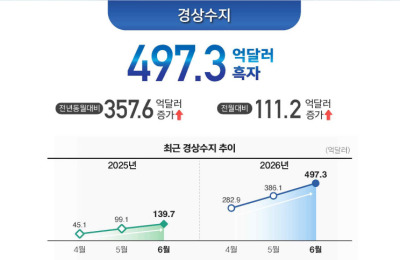
한국은행이 6일 발표한 '2026년 6월 국제수지(잠정)'에 따르면 지난 6월 경상수지는 497억3000만달러 흑자로 집계됐다. 전월(386억1000만달러)에 이어 두 달 연속 월간 기준 역대 최대 기록을 갈아치웠다. 이에 따라 올해 상반기 누적 경상수지 흑자는 1910억1000만달러를 기록했다.
경상수지 흑자를 견인한 것은 상품수지다. 6월 상품수지는 478억9000만달러 흑자를 기록하며 전월에 이어 역대 최대를 다시 썼다. 국제수지 기준 상품수출은 1123억7000만달러로 전년 동월 대비 84.5% 증가하며 월간 기준 처음으로 1000억달러를 넘어섰다. 상품수입은 644억8000만달러로 38.6% 늘었다.
통관 기준으로는 반도체 수출이 전년 동월 대비 196.9% 급증했고 컴퓨터·주변기기(SSD)는 282.7% 증가했다. IT 품목 수출은 160.4% 늘었으며 비IT 품목도 ▲석유제품(47.5%) ▲화공품(18.6%) ▲철강제품(17.9%) ▲승용차(6.1%) 등을 중심으로 18.6% 증가했다. 통관 기준 수입은 ▲원자재(30.5%) ▲자본재(35.3%) ▲소비재(16.4%)가 모두 늘었다.
서비스수지는 12억9000만달러 적자를 기록해 전월(-10억9000만달러)보다 적자 폭이 확대됐다. 여행수지는 외국인 입국자 증가와 유류할증료 인상 등에 따른 출국자 감소로 4억4000만달러 흑자를 기록했지만 지식재산권사용료수지는 전월 흑자에서 4억4000만달러 적자로 전환됐다.
본원소득수지는 배당소득을 중심으로 32억7000만달러 흑자를 기록해 전월(21억7000만달러)보다 흑자 폭이 확대됐다. 배당소득수지는 배당수입이 늘어난 데다 전월 분기배당에 따른 기저효과로 배당지급이 줄면서 25억6000만달러 흑자를 나타냈다.
금융계정 순자산은 6월 중 467억1000만달러 증가해 월간 기준 역대 최대 증가 폭을 기록했다. 종전 최대였던 올해 3월(369억9000만달러)을 넘어선 것이다. 직접투자에서는 내국인의 해외투자가 80억1000만달러, 외국인의 국내투자가 46억3000만달러 각각 증가했다.
증권투자에서는 외국인의 국내 주식 매도세가 이어졌다. 외국인의 국내 주식 투자는 차익실현 매도 등의 영향으로 316억1000만달러 감소하며 전월(-310억5000만달러)에 이어 역대 최대 순매도 기록을 다시 경신했다.
외국인의 국내 채권투자는 세계국채지수(WGBI) 자금 유입에도 분기 말 만기도래 영향으로 증가 폭이 줄어든 52억9000만달러를 기록했다. 내국인의 해외 증권투자는 주식을 중심으로 35억6000만달러 증가했다.
eoyn2@newspim.com
2026-08-06 08:00