
Remarks by Chairman Ben S. BernankeCommencement addressAt the Massachusetts Institute of Technology 2006 commencement, Cambridge, MassachusettsJune 9, 2006 President Hockfield, members of the faculty, alumni, families and friends of graduates, and, especially, members of the 2006 graduating class: I am honored to speak at the 140th commencement exercises of this distinguished institution.It is wonderful to be back at MIT. I graduated from the Institute with a Ph.D. in economics in 1979. That year, President Weisner gave the commencement address. He spoke about, among other things, the nation’s transition from an era of cheap energy to one of energy scarcity and about the need for new technologies to aid in this transition. Obviously, these issues still confront us. One cannot help but wonder whether that theme will feel as current twenty-seven years from now as it does today.As for today, you may have been surprised at some point to learn that an economist rather than an engineer or scientist would be serving as your commencement speaker. But in my remarks, I hope to illustrate that this address continues a long and productive tradition of collaboration at MIT between economics and the engineering and scientific disciplines for which the Institute is so well-known. Building on that theme, I will discuss the essential complementarity of technology and economics in modern economies. Finally, I will have a few words to say about what you, as MIT graduates, can do to strengthen our economy and our society even as you pursue your personal and professional goals. A Short History of Economics at MITIf you will bear with me, I would like to begin with a short history of economics at MIT. The MIT Economics Department is, of course, the part of the Institute that I know best, and I hope to persuade you that it has played a special and unique role in this institution.MIT’s connection to economics dates at least to 1881, when Francis A. Walker became the institution’s third president. To say that Walker had already had a distinguished career would be an understatement. He was named a brevet brigadier general at the end of the Civil War, at the age of twenty-four. He served as the superintendent of the 1870 and 1880 Censuses of the United States and was one of the leading economists of his era. The year he arrived at MIT, he taught the first economics course ever offered at the Institute. The course covered political economy and was so popular that it was soon accorded its own course classification as "Course IX, General Studies." Walker helped found the American Economic Association, still the leading professional association for economists. During his tenure at MIT, he moonlighted both as the first president of that association and as president of the American Statistical Association.In the early twentieth century, the economics program at MIT aimed to prepare undergraduates for leadership roles in business. During those years, economics as a discipline was gaining greater prominence both here and abroad. But the modern era of economics at MIT began in 1940--the year that Paul Samuelson, not yet having even received his doctorate, was persuaded to emigrate here from a somewhat less technically proficient institution located on another stretch of the Charles River. In part, Samuelson was willing to leave Harvard because his Foundations of Economic Analysis--a book now universally recognized by economists as inaugurating the modern mathematical approach to economics--was not well received by the old guard at the Harvard Economics Department.MIT’s Ph.D. program in economics was established a year after Samuelson arrived. Right from the start, the department attracted strong graduate students: The very first of these, Lawrence Klein, received the Nobel Prize in Economics in 1980 for his work in econometric modeling. With support from MIT’s administration, the department expanded rapidly after World War II, and MIT led the development of a more mathematically rigorous approach to economics. Given the emphasis on quantitative reasoning at MIT, it makes perfect sense that the Economics Department here was in the vanguard of those using mathematics as a framework for organizing economic thought.These developments laid the foundation for economics as a discipline in the second half of the twentieth century, and the department quickly rose to the top of national rankings. Besides Samuelson, many economists contributed to the department’s outstanding reputation--Franco Modigliani, Robert Solow, Charles Kindleberger, Rudiger Dornbusch, and Stanley Fischer, to name just a few. Modigliani, Samuelson, and Solow won Nobel Prizes for their research. In addition, nine other economists with MIT connections have won Nobels. Mathematical approaches to economics have at times been criticized as lacking in practical value. Yet the MIT Economics Department has trained many economists who have played leading roles in government and in the private sector, including the current heads of four central banks: those of Chile, Israel, Italy, and, I might add, the United States. One of my teachers at MIT, Stan Fischer, is a sterling example of what MIT training can produce. Stan followed a brilliant career as a researcher and teacher at MIT with important work as a public servant, including top positions at the World Bank, the International Monetary Fund, and, currently, the Bank of Israel.Why did economics at MIT become so successful? Perhaps Paul Samuelson and the people he helped to attract here could have been equally successful anywhere. But I suspect that the placement of economics in a milieu where quantitative reasoning and the scientific method are the coin of the realm was an important contributing factor. The Sloan School, with its close links both to the Economics Department and to other parts of the Institute, has benefited from the same milieu and has been the source of many fundamental advances as well. Notably, in recent years the global financial industry has been transformed by new quantitative approaches to pricing complex financial instruments such as derivatives and to measuring and managing risk. This transformation stemmed from the application of formal tools of mathematical economics that were developed to a substantial extent by faculty at the Sloan School, including Fischer Black, Robert Merton, and Myron Scholes--the latter two of whom won Nobel Prizes for their work. As MIT economics has benefited from its proximity to the scientific and engineering expertise of MIT, so the Institute has benefited from the presence of a world-class economics department, over and above the addition of still more luster to the MIT name. The exposure of students and faculty from other divisions to the discipline and approaches of economics has stimulated creative thinking about how technology can be used to improve the economic welfare of the average person. That thought brings me to my second topic: the link between technology and economic growth. Translating Technological Advances into Economic GrowthAs has always been the case, technological change and innovation are today in large part driving economic growth and the improvement of living standards. But it is important to understand that even the very best ideas in science or engineering do not automatically translate into broader economic prosperity. In large measure, the material benefits of innovation spring from complementarities between technology and economics, where I include in "economics" not only economic ideas but also economic policies and, indeed, the entire economic system. When the economics is right, scientific and technological advances promote economic development, which in turn, in a virtuous circle, may provide resources and incentives that help to foster more innovation. A negative example is the former Soviet Union, which certainly did not lack for scientific and engineering talent but which had an economic system that was poorly suited for translating scientific advances into economic progress.The experience of the United States over the past decade illustrates the essential complementarity of technology and economics, in my view. Before the mid-1990s, the growth of productivity--the amount of output produced per worker or per hour of work--had been relatively sluggish for more than two decades in this country. As productivity is perhaps the single most important determinant of average living standards--a country in which the average worker can produce a lot is usually also a place in which the average person can consume a lot--the so-called productivity slowdown of that earlier period was the source of much concern among economists and policymakers. In the mid-1990s, however, productivity growth picked up in the United States. The growth rate of productivity increased still further around the turn of the century and remains strong today. This productivity revival augurs well for the future of the U.S. economy. But why did it happen?You, of all people, will not be surprised to hear that the research suggests that the pickup in U.S. productivity growth in the mid-1990s was importantly related to advances in information and communication technologies.1 But these technical advances in and of themselves can’t be the whole story. For example, even though the new technologies are widely available around the world, many other countries appear not to have derived the same degree of economic benefit from them as has the United States. Notably, productivity in Europe increased rapidly in the decades after World War II but then decelerated around the mid-1990s, at about the same time that U.S. productivity growth began to increase. Thus the gap between productivity levels in the United States and Europe, which had nearly closed by 1995, has been widening since then. What accounts for the apparently disparate effects of technology on growth here and abroad?Differences in economic policies and systems likely account for some of the differences in performance--another example of the complementarity of technology and economics. One leading explanation for the strong U.S. productivity performance is that labor and product markets in the United States tend to be more flexible and competitive, and that these market characteristics have allowed the United States to realize greater economic benefits from the new technologies. For example, taking full advantage of new information and communication technologies may require extensive reorganization of work practices, reassignment and retraining of workers, and ultimately some reallocation of labor among firms and industries. Regulations that raise the costs of hiring and firing workers and that reduce employers’ ability to change work assignments--like those in a number of European countries, for example--may make such changes more difficult to achieve. Likewise, in product markets, a high degree of competition and low barriers to the entry of new firms in most industries in the United States provide strong incentives for firms to find ways to cut costs and to improve their products. In some other countries, in contrast, the prominence of government-owned firms with a degree of monopoly power, together with a regulatory environment that protects large incumbent firms and makes the entry of new firms difficult, reduces the competitive pressure for innovation and the application of new ideas. Competition is one of the key benefits of free and open trade; companies that are exposed to global competition tend to be much more efficient and to produce goods of higher quality than companies that are sheltered from international competition.Other economic factors have probably been important in translating technological change into material progress.2 Some observers point to the depth, liquidity, and sophistication of American financial markets as contributing to recent productivity gains. Sizable markets for venture capital and ready access to equity financing facilitate start-up enterprises, which are often the best means of bringing new technologies to the market. The United States also benefits from its high-quality research universities, which have shown both the willingness and the ability to collaborate with the private sector and, in some cases, with the government as well, in the development and commercialization of new ideas. For example, Intel was co-founded by an MIT graduate, and MIT graduates played key roles in designing and developing the Internet.Management practices also differ across countries, and these differences may also matter for productivity. A recent study found that business establishments in the United Kingdom that are owned by U.S. multinationals get higher productivity from information technology than do other establishments, and it tied this differential to the management and organization of U.S. firms.3 Finally, relatively more positive attitudes toward competition and entrepreneurship in the United States--a factor that spans economics and sociology--may also stimulate innovation and its commercial application as well as economic policies that support innovation. Of course, there are factors that may restrain both technological innovation and its commercialization in the United States as well: I would put at the top of the list the relatively poor performance of our K-12 educational system in stimulating interest in and providing solid training in the sciences.One interesting feature of the U.S. and global experience with major innovations is that often a significant amount of time passes between the initial development and diffusion of new technologies and the realization of the associated productivity benefits. Computers were first commercialized in the 1950s, for example, and personal computers came into widespread use beginning in the early 1980s. But until the mid-1990s these developments had little evident effect on measures of productivity. Indeed, MIT’s Robert Solow famously quipped in 1987 that "computers are everywhere except in the productivity statistics." Moreover, despite the sharp decline in information-technology investment after the meltdown of tech-sector stocks earlier this decade, the growth rate of productivity actually increased further in recent years, as I mentioned. These long lags raise additional questions about the nature of the links between new technologies and the resulting productivity gains.Perhaps the answer lies in taking the longer view. Some research by economists has drawn an analogy between modern information and communication technologies and earlier so-called general-purpose technologies such as the steam engine, the electric motor, and the internal combustion engine. General-purpose technologies have broad application and thus have the potential both to revolutionize methods of production and to make a host of new goods and services available to businesses and consumers.4 For example, when smaller electric motors replaced single-power sources, such as steam or water power, in manufacturing facilities, it became feasible to reorganize the layouts of plants to optimize the flow of materials rather than the distribution of power.5 And the advent of air conditioning significantly expanded opportunities for economic development in the warmer regions of the United States and the world. However, in all cases, these developments evolved over a long period and required firms to make collateral investments in research and development, organizational structure, and employee training. These investments in learning how to make the best use of new technologies have been dubbed intangible capital, to distinguish them from investments in physical goods like new machines or facilities. In the case of information and communication technologies, new economic research suggests that the investments in associated intangible capital--figuring out what to do with the computer once it’s out of the box--are quite important indeed.6 In my view, important investments in intangible capital remain to be made, as much still remains to be learned about how to harness these technologies most effectively. Thus, it should not be surprising that the benefits of these technologies have taken a long time to show up in the productivity statistics. This research also suggests that the current productivity revival still has some legs, as the full economic benefits of recent technological changes have not yet been completely realized.Looking to the FutureAs graduates of MIT, you will be at the heart of this critical process of developing new technologies and taking them to the marketplace. We are in an age in which technology and its fruits will be a dominant force not only in our economic lives but in the cultural, social, political, and personal aspects of our lives as well. Your training at MIT equips each of you exceptionally well to take the fullest advantage of the professional and personal opportunities that technological innovation and change will create.Each of you, because of your youth, your talent, your demonstrated commitment to learning, and your personal and intellectual attainments during your time at MIT, will soon find--to paraphrase Shakespeare--that the world is your oyster. I hope that you will contribute in some measure to economic progress, whether in the United States or elsewhere; and I hope you find some measure of financial reward. But the world has a great deal more to offer than money, and a key question each of you will face repeatedly in your lives is how to use the talent and education that you have been given and the knowledge that you have attained. With respect to your professional lives, I hope that when you make career choices, you will look first for opportunities that excite you intellectually, that allow you to use your creative powers to the fullest extent, and that let you continue to learn and grow. I hope you will not be afraid to be unconventional, to do something nobody else has thought of before. Remember that the path to success and fulfillment may not be well marked, the scaling of some predetermined ladder; it may instead be a road without signs or maps. And remember that it is OK to fail--really: New opportunities will always arise for those who seek them. If you remain nimble in searching out new and unexpected opportunities, it will not only benefit you, but it will also benefit the economy and our society, as long experience has shown that dynamism and creativity are the seeds of innovation and of progress. In the personal sphere, as you make your way in the world, I hope you will not forget the importance of your family and how much it has already contributed to your journey through life. Remember, too, family members are the ones who will still love you even when things aren’t going so well. Even as you focus intensively on your professional interests, I hope you will remain intellectually broad--well-read, well-informed, and open to new experiences. And finally, I hope you will remain engaged with the broader society. That may involve entering public service at some point, as many MIT graduates have chosen to do. But it need not. There are always opportunities to make a difference in the world, through volunteering, civic participation, charitable activities, or the type of work you choose to do.I congratulate all graduates and your families for what you have accomplished and wish you the very best for the future.--------------------------------------------------------------------------------Footnotes1. See Stephen Oliner and Daniel Sichel (2000), "The Resurgence of Growth in the Late 1990s: Is Information Technology the Story?" Journal of Economic Perspectives, vol. 14, pp. 3-22. Also see Dale W. Jorgenson and Kevin J. Stiroh (2000), "Raising the Speed Limit: U.S. Economic Growth in the Information Age," Brookings Papers on Economic Activity: 1, pp. 125-211. 2. For a discussion of some of these other factors, see Robert J. Gordon (2004), "Why Was Europe Left at the Station When America’s Productivity Locomotive Departed?" NBER Working Paper Series 10661 (Cambridge, Mass.: National Bureau of Economic Research, August). 3. See Nick Bloom, Raffaella Sadun, and John Van Reenen (2006), "It Ain’t What You Do, It’s the Way that You Do I.T.--Testing Explanations of Productivity Growth Using U.S. Affiliates" working paper (London: Centre for Economic Performance, London School of Economics, March). 4. See Timothy Bresnahan and Manuel Trajtenberg (1995), "General Purpose Technologies: 'Engines of Growth?'" Journal of Econometrics, vol. 65, pp. 83-108. 5. See Paul David (1990), "The Dynamo and the Computer: An Historical Perspective on the Modern Productivity Paradox," American Economic Review, vol. 80 (May), pp. 355-61. 6. See Carol A. Corrado, Charles R. Hulten, and Daniel E. Sichel, (2006), "Intangible Capital and Economic Growth," NBER Working Paper Series 11948 (Cambridge, Mass.: National Bureau of Economic Research, January). Also see Erik Brynjolfsson, Lorin M. Hitt, and Shinkyu Yang (2002), "Intangible Assets: Computers and Organizational Capital" Brookings Papers on Economic Activity: 1, pp. 137-198.

[관련키워드]



[뉴스핌 베스트 기사]
 사진
사진
위고비에 도전한 새 비만약 '에페' 가격은?
[서울=뉴스핌] 김신영 기자 = 한미약품의 국산 비만 신약 '에페'가 위고비와 마운자로가 86%를 장악한 국내 비만치료제 시장에 뛰어든다. 후발주자인 만큼 자체 생산을 통한 가격 경쟁력과 국내 환자 임상 데이터, 기존 병·의원 영업망을 앞세워 선발 제품 중심의 처방 시장을 파고든다는 전략이다.
관건은 가격 이외의 경쟁력을 실제 처방 전환으로 연결할 수 있느냐다. 위고비와 마운자로는 글로벌 시장에서 이미 높은 인지도와 장기간의 처방 경험을 쌓은 데다 대표 임상에서 높은 체중 감량 효과를 제시했다. 에페가 연매출 1000억원 목표를 달성하려면 가격에 민감한 신규 수요를 확보하는 동시에 기존 GLP-1 치료제 사용자의 선택까지 끌어와야 한다.
17일 제약·바이오업계에 따르면 한미약품은 오는 10월 식품의약품안전처 품목허가를 목표로 에페(성분명 에페글레나타이드) 출시를 준비하고 있다. 허가 이후 연내 출시가 목표다.
한미약품 본사 전경 [사진=한미약품]
◆ 가격 경쟁력 갖췄지만…출시 이후 기존 제품 인하 변수
에페는 한미약품이 자체 개발한 주 1회 투여 글루카곤 유사 펩타이드(GLP-1) 계열 비만치료제다. 약물이 체내에서 오래 작용하도록 한 한미약품의 지속형 플랫폼 기술 '랩스커버리'가 적용됐다.
에페가 진입할 시장은 이미 선발주자 중심으로 2강 구도가 형성돼 있다. 의약품 시장조사기관 아이큐비아에 따르면 국내 비만치료제 시장은 2024년 2426억원에서 지난해 8195억원으로 1년 만에 3배 이상 확대됐다. 이 중 위고비와 마운자로 판매액은 각각 4833억원, 2209억원으로 두 제품이 전체 시장의 약 86%를 차지했다.
후발주자인 에페가 내세운 무기는 가격이다. 한미약품은 최종 공급가를 공개하지 않았지만 업계와 증권가에서는 4주 투약 기준 10만원대 가격이 거론된다. 현재 위고비의 시작용량인 0.25㎎의 4주분 공급가는 21만6000원, 마운자로의 시작용량인 2.5㎎은 27만8000원 수준이다.
한미약품이 가격 경쟁력을 확보할 수 있는 배경에는 자체 생산체제가 있다. 회사는 경기도 평택 바이오플랜트에서 에페를 직접 생산한다. 외부 생산 의존도를 낮춰 공급 안정성을 높이는 동시에 가격을 낮추겠다는 구상이다.
하지만 가격만으로 선발주자의 벽을 넘을 수 있을지는 미지수다. 국내에서 가장 먼저 출시된 비만치료제인 위고비는 마운자로의 국내 출시를 앞둔 지난해 용량별 차등가격제를 도입하면서 시작용량 공급가를 기존 37만2000원에서 21만6000원으로 약 42% 낮췄다. 경쟁 제품 등장에 맞춰 선발주자가 가격을 조정한 전례가 있는 만큼 에페 출시 이후 추가 가격 경쟁이 벌어질 가능성도 제기된다.
비만치료제의 핵심 경쟁력은 체중 감량 효과다. 한미약품이 공개한 에페 임상 3상 40주차 중간 결과에서 평균 체중 감소율은 9.75%였다. 체중이 5% 이상 감소한 환자는 79.42%, 10% 이상은 49.46%, 15% 이상은 19.86%였다.
선발 제품들은 글로벌 임상에서 더 높은 체중 감소율을 제시했다. 위고비는 비만 또는 과체중 성인 1961명을 대상으로 한 STEP 1 임상에서 68주 투여 후 평균 체중이 14.9% 감소했다. 체중이 5% 이상 줄어든 환자는 86.4%, 10% 이상은 69.1%, 15% 이상은 50.5%였다.
마운자로는 비만 또는 과체중 성인 2539명을 대상으로 한 'SURMOUNT-1' 임상에서 72주 후 평균 체중 감소율이 5mg 투여군 15.0%, 10mg 19.5%, 15mg 20.9%로 나타났다. 15mg 투여군에서는 70.6%가 체중을 15% 이상 줄였고, 56.7%는 20% 이상 감량했다.
다만 에페와 위고비, 마운자로의 임상은 투약 기간과 대상 환자, 용량과 시험 설계 등이 달라 체중 감소율을 단순 비교해 우열을 판단하기에 한계가 있다. 현재 공개된 에페의 임상 수치는 40주차 3상 중간 결과다.
한미약품 비만 신약 '에페' 로고 [사진=한미약품]
◆ 국내 환자 448명 임상으로 차별화, 브랜드·시장 경험은 숙제
이에 한미약품이 강조하는 에페의 차별점은 국내 환자를 대상으로 직접 확보한 임상 데이터다. 에페 임상 3상은 국내 성인 비만 환자 448명을 대상으로 실시했다. 위고비 역시 한국인을 포함한 아시아 환자 대상 임상을 진행했지만 에페는 3상 전체를 국내 비만 환자로 구성했다.
한미약품은 국내 환자로 구성된 임상을 통해 한국 진료현장에서 참고할 수 있는 데이터를 확보했다는 점을 차별화 요소로 내세운다. 다만 국내 환자 대상 임상이라는 사실 자체가 기존 치료제보다 높은 효능이나 안전성을 의미하는 것은 아니다.
임상에서 체질량지수(BMI) 30㎏/㎡ 미만 여성 환자의 평균 체중은 12.20% 감소했다. 한미약품은 이를 토대로 고도비만 환자뿐 아니라, 비만도가 낮거나 장기적인 체중 관리가 필요한 환자까지 처방 수요를 넓힐 수 있을 것으로 보고 있다.
한미약품은 에페가 GLP-1 비만치료제의 대표적인 부작용인 구역과 구토 등 위장관계 이상반응이 기존 제품 대비 낮다는 점도 내세우고 있다. 구역과 구토는 비만치료제의 투약을 중단하게 하는 요인으로 거론된다.
그러나 브랜드 인지도와 시장 경험에 있어서는 선발주자의 우위가 뚜렷하다. 위고비와 마운자로는 각각 노보 노디스크와 일라이 릴리라는 글로벌 대형 제약사의 제품으로, 해외에서 이미 대규모 판매와 처방 경험을 축적했다. 환자들의 실제 사용 경험과 장기 데이터가 쌓였다는 점도 후발주자인 에페가 단기간에 따라잡기 어려운 부분이다.
반면 한미약품은 국내 병·의원을 대상으로 구축한 영업망과 자체 생산능력을 갖추고 있다. 기존 영업망을 치료제 처방으로 연결할 수 있느냐가 후발주자의 한계를 극복할 변수가 될 것이라는 평가가 나온다.
한미약품은 에페를 연 매출 1000억원 이상 품목으로 육성한다는 목표를 세웠다. 목표 달성을 위해서는 가격 경쟁력 등 회사가 내세운 강점을 처방 확대로 연결할 수 있어야 한다.
한 업계 관계자는 "에페는 가격과 국내 환자 대상 임상 데이터에서 차별화 요소가 있지만 위고비와 마운자로는 높은 인지도와 처방 경험을 확보한 제품"이라며 "후발주자인 만큼 실제 진료 현장에서 의사와 환자의 선택을 얼마나 바꿀 수 있느냐가 시장 안착의 관건"이라고 봤다.
sykim@newspim.com
2026-09-17 15:33
 사진
사진
李, 일정 최소화 '18일 회견' 준비 몰두
[서울=뉴스핌] 김미경 기자 = 이재명 대통령이 18일 기자회견을 하루 앞둔 17일 공식 일정을 최소화하고 회견 준비에 몰두했다.
이 대통령은 지난 14일부터 3일간 중앙아시아 5개국 정상과 연쇄 회담을 하고 1차 한-중앙아시아 정상회의를 주재하며 외교 일정으로 숨가쁘게 지냈다.
이 대통령이 기자회견 일정을 18일로 정한 것도 외교 일정을 모두 마무리하고 하루 정도 준비하는 시간이 필요하다는 판단을 한 것으로 보인다.
이 대통령은 이날 통상 목요일에 열던 수석보좌관회의도 없이 파티 비롤 국제에너지기구(IEA) 사무총장을 접견하는 일정만 소화한다.
이재명 대통령이 취임 1주녁 기자회견에서 주택공급을 위해 재건축·재개발도 속도를 내야한다고 말했다. [사진=청와대]
◆청와대 "국민이 궁금한 국정 현안, 진솔하게 소통할 것"
이 대통령은 비롤 사무총장 접견 외 나머지 시간은 회견 준비에 쓸 것으로 예상된다. 이 대통령은 참모들에게서 분야별 핵심 쟁점과 추진 방향을 보고받고 예상 질문을 추려 답변을 거듭 다듬는 것으로 알려졌다.
회견은 18일 오전 10시 청와대 영빈관에서 열린다. 모두발언과 질의응답, 마무리 발언을 합쳐 90분가량 진행한다는 계획이다. 기자회견에는 내·외신 기자 150여 명이 참석한다.
질의응답은 정치·외교와 정책·경제 두 분야로 나눠 주제 제한 없이 진행하고 실시간 국민 댓글도 소개한다.
청와대는 회견 제목을 수식어 없이 '이재명 대통령 기자회견'으로 정했다. 회견장 배경막에는 '국민의 뜻, 국민의 삶, 더 살피겠습니다'라는 문구를 건다.
성기홍 청와대 홍보소통수석은 지난 15일 브리핑에서 "대통령의 확고한 개혁 의지와 민생 최우선 국정 기조, 더 단단한 국민 통합의 메시지를 전하는 자리가 될 것"이라고 했다. 이어 "국민이 궁금해하고 듣고 싶어 하는 국정 현안을 진솔하고 충실하게 소통하려 한다"고 설명했다.
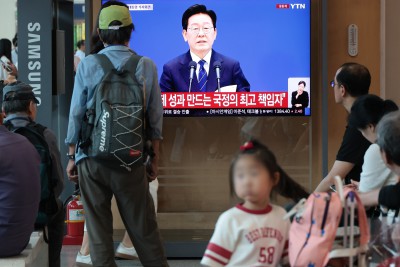
[서울=뉴스핌] 이건주 기자 = 8일 오전 서울 중구 하나은행 딜링룸에서 이재명 대통령 취임 1주년 기자회견 '대체불가 대한민국'이 생중계되고 있다. 2026.06.08 kunjoo@newspim.com
◆연임·공소취소·파병 정치 현안에 부동산·증시 민생 현안 산적
회견의 관심은 산적한 현안에 이 대통령이 과연 명확한 입장을 밝힐 것인지다.
특히 공소 취소와 연임 헌법 개정(개헌) 논란은 피할 수 없는 질문이다. 집권 여당인 더불어민주당은 '조작기소 특검법안'을 9월 중 처리하겠다고 예고했다.
특검에 공소취소 권한을 줄지가 핵심 쟁점이다. 이 대통령 사건 공소 취소를 앞장서 주장했던 김승원 의원이 법무부 장관 후보자로 지명됐고 민주당 주도로 국회 인사청문 경과보고서가 채택됨에 따라 야권의 공세는 더 거세졌다.
인사 검증 문제에 대한 언론의 질의도 예상된다. 용혜인 전 성평등가족부 장관 후보자는 자진사퇴했고 김승원 후보자는 '식약처 청탁 의혹'에 휩싸였다.
미국 요청에 따른 호르무즈 해협 파병 검토와 대미 투자 협상 관련 질문도 이 대통령에게는 고난도 문제다.
민생 현안으로는 부동산이 첫손에 꼽힌다. 정부는 취임 후 8·13 대책을 포함해 6차례 부동산 대책을 내놨다.
하지만 한국부동산원 집계에 따르면 서울 아파트 주간 매매 가격이 지난해 2월 첫째 주부터 83주 연속 올랐다.
문재인 정부 시절 세운 최장 기록(85주)에 바짝 다가섰다. 강남 3구 집값은 약세로 돌아섰지만 수도권 중저가 아파트값이 오르고 전세 매물 품귀와 월세 상승이 이어지고 있다. 부동산 정책 효과에 대한 논란이 적지 않다.
이재명 대통령이 8일 청와대 영빈관에서 취임 1주년 기자회견을 하고 있다. 2026.06.08 [사진=청와대]
◆이 대통령 "임기는 헌법상 명확하게 제한"…이번엔 어떤 답 낼까
이 대통령이 앞서 일부 현안에 짧게 입장을 밝히기는 했지만 대체로 원론적 언급에 그친 경우가 많았다.
연임 개헌 논란을 두고는 프랑스 국빈방문 중이던 지난 9일(현지시간) 파리 동포 오찬간담회에서 "(대통령) 임기는 헌법상 명확하게 제한돼 있다"고 했다.
취임 초 해외 순방을 자주 다니는 이유를 설명하는 차원의 언급이었지만 연임 논란을 의식한 우회적 입장 표명이라는 해석이다.
공소 취소와 관련해서는 지난 6월 8일 진행한 취임 1주년 회견에서 "(조작기소 여부의) 진상 규명은 해야 한다"는 원론적 답변을 내놨다.
이 대통령은 당시 공소 취소 특검에 대한 질문을 받고 "결론적으로 법과 상식대로 하면 된다"며 "최소한의 진상규명을 해야 한다"고 했다.
이 대통령은 "뭔가 문제는 있어 보인다. 주관적 판단은 있지만 객관적으로도 문제가 있어 보이는 것이 꽤 많다"며 "잘못된 게 있으면 바로 잡고 없으면 그냥 놔두면 된다. 잘못됐으면 취소하고 잘못된 게 아니면 놔두는 것"이라고 했다.
사실상 공소가 잘못됐으면 바로 잡아야 한다는 취지의 설명이었다.
◆여권에서도 "공소취소·연임 명확한 입장 내야" 목소리 강해
야권뿐 아니라 여권에서도 이 대통령이 민감한 현안에 대해 명확한 입장 표명을 해야 한다는 목소리가 강하다.
장동혁 국민의힘 대표는 이날 최고위원회의에서 "기자회견이 의미가 있으려면 그동안의 오만과 무능부터 국민에게 사과해야 한다"며 "부동산과 이란 파병 문제 등 모든 정책에서 국정 기조 대전환을 선언하고 국민이 납득할 분명한 답을 내놓길 바란다"고 요구했다.
한병도 민주당 원내대표는 정책조정회의에서 "기자회견은 국민 목소리를 경청하고 국정 현안을 두고 진솔한 대화를 나누는 소통의 장이 될 것"이라고 강조했다.
이광재 민주당 의원은 "공소 취소는 정무적이고 정치적인 문제이니 대통령이 언급할 것으로 본다"고 했다.
여권의 한 중진 의원은 "대통령이 연임 개헌이나 공소 취소와 관련해 명확한 입장을 내놓지 않는다면 향후 국정 운영이 쉽지 않을 것"이라고 우려했다.
이재명 대통령이 8일 청와대 영빈관에서 취임 1주년 기자회견을 하고 있다. 2026.06.08 [사진=청와대]
◆9주 연속 지지율 하락…추석 전 기자회견, 반등 할까
이번 기자회견은 추석 연휴를 앞두고 열리는 만큼 지지율 반등의 분수령으로 꼽힌다.
여론조사 전문기관 리얼미터가 14일 공개한 9월 2주차 주간동향(에너지경제신문 의뢰, 7~11일, 무선 자동응답 방식 조사, 표본오차는 95% 신뢰수준에 ±2.0%포인트, 중앙선거여론조사심의위원회 홈페이지 참조)을 살펴보면 이 대통령의 국정수행 긍정평가는 9주 연속 하락해 취임 후 최저치인 33.8%였다. 부정평가는 63.3%로 처음 60%대에 올라섰다.
리얼미터는 외교 행보에도 개각 인선 논란과 호르무즈 파병 검토, 부동산 정책 불확실성이 겹친 데다 진보층과 20대 이탈이 더해진 것을 하락 주요 원인으로 분석했다.
한국갤럽이 17일 발표한 '2026 대한민국 신뢰도 조사'(시사IN 의뢰, 6~8일, 유선전화와 휴대전화 무작위 전화걸기 전화면접조사)에서는 이 대통령이 정치인 중 2위로 내려앉았다. 이 대통령은 2021년 이후 해당 조사에서 줄곧 가장 신뢰하는 정치인 1위였다. 올해 조사에서는 한동훈 무소속 의원에게 1위를 내줬다.
이 대통령에 대한 신뢰도 조사에서는 '신뢰한다' 35.9%, '불신한다' 50.4%였다. 지난해 조사에서는 이 대통령을 신뢰한다는 응답이 51.2%, 불신한다는 응답이 34.1%였다. 신뢰와 불신의 국민 평가가 1년 만에 뒤집어졌다.
the13ook@newspim.com
2026-09-17 14:37